Support

Hwaseong Haenggung Palace

About

Hwaseong Haenggung Palace is an impressive reconstructed palace complex that served as a temporary residence for the kings of the Joseon dynasty. Located inside the famous Hwaseong Fortress in the city of Suwon, near Seoul, South Korea, this palace is considered the largest of the country's surviving "temporary palaces." These palaces, known as "haenggung," were used by monarchs during travels outside the capital or during times of war, offering them a temporary home and a center of government.
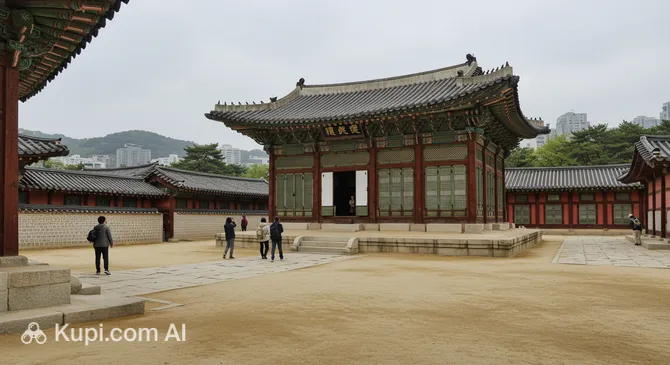
Hwaseong Haenggung Palace. Illustration.
Source: Kupi.com AI

Traveler photos:

Hwaseong Haenggung is situated at the scenic foot of Mount Paldalsan and is an integral part of the grand defensive complex of Hwaseong Fortress. Hwaseong Fortress itself is a UNESCO World Heritage site, highlighting the historical and cultural significance of the entire area, including the palace. A visit to the palace provides a unique opportunity to immerse yourself in the atmosphere of royal life of past eras and imagine the daily lives of the Joseon rulers.

The architectural ensemble of Hwaseong Haenggung Palace is a harmonious blend of traditional Korean features and elements of Western defensive structures, making it unique among Korea's historical buildings. A walk through its many pavilions and well-kept courtyards allows you to appreciate the craftsmanship of ancient architects and learn more about the country's rich history and culture. This place undoubtedly deserves the attention of anyone interested in history, architecture, and traditional Korean culture.

Contacts

For the most up-to-date information on opening hours, ticket prices, and available tours at Hwaseong Haenggung Palace, it is recommended to visit the attraction's official website or contact tourist information centers in Seoul or Suwon. There you can also find the best ways to reach the palace complex and get other useful information for planning your visit.

How to contactContact
Address825 Jeongjo-ro, Paldal-gu, Suwon, Gyeonggi-do, South Korea
Phone number+82 31-290-3600
Websitewww.swcf.or.kr

What to Do

A visit to Hwaseong Haenggung Palace is a true immersion into the history of South Korea. Guests can take a leisurely stroll through its extensive and picturesque grounds, admiring the traditional Korean architecture and the elegant interior decor of the numerous palace halls. This is a wonderful opportunity to learn more about the daily life of the Joseon royal family, their customs, and court etiquette, imagining yourself as a witness to eras long gone.

The cultural events regularly held at Hwaseong Haenggung Palace create a special atmosphere. Visitors can witness or even participate in colorful historical reenactments of scenes from royal life or enjoy interactive performances that make the visit even more engaging and memorable. These events allow for a deeper feel of the spirit of the time and the culture of Joseon-era Korea.

For those who want to learn as much as possible, themed excursions are offered. Experienced guides tell fascinating stories about the construction of the palace itself and the surrounding majestic Hwaseong Fortress, as well as sharing interesting facts about the lives of the kings whose fates were linked to this landmark site. Additionally, the complex features information centers and pavilions with exhibitions dedicated to the history of the palace, its restoration, and the preservation of this important cultural heritage.

Getting There

Getting to Hwaseong Haenggung Palace from Seoul is quite easy, even though it is located in another city—Suwon. Suwon is situated approximately 30 kilometers south of the capital of South Korea. The most popular and convenient method for independent travelers is to use public transportation. You will need to take a train or subway (Line 1) to Suwon Station. The train ride from central Seoul typically takes about an hour, depending on the type of train and your point of departure.

Upon arrival at Suwon Station, your journey to the palace is not yet over. From there, you can reach Hwaseong Fortress, where Hwaseong Haenggung Palace is located, by local bus or taxi. The ride is short. Once you reach the main entrance of Hwaseong Fortress, the palace itself is just a few minutes' walk away. Navigating the area is easy thanks to the many signs.

If you prefer a more organized approach or want to avoid transfers, other options are available. Tourist buses and guided tours regularly depart from Seoul, including visits to not only Hwaseong Haenggung Palace but the entire magnificent Hwaseong Fortress. This can be a convenient solution, as such tours often include a guide who will share interesting historical facts about these sites. The complex is well-equipped for tourists, with information stands and rest areas throughout, making for a comfortable visit.

Nearest city: Seoul

History & Facts

Hwaseong Haenggung Palace has a rich history closely tied to the reign of King Jeongjo, one of the most enlightened monarchs of the Joseon dynasty. Construction of the palace was completed in 1796, immediately following the completion of the grand Hwaseong Fortress. King Jeongjo's primary goal was not only to create a temporary residence for his visits to Suwon but also to express deep respect for the memory of his father, Crown Prince Sado, whose remains were moved here. Furthermore, there were ambitious plans to turn Suwon into a new capital of Korea, and Hwaseong Haenggung Palace was to be a key element of this vision.

The design and construction of this unique palace complex were entrusted to a prominent scholar and architect of the time—Jeong Yak-yong, also known by his pen name Dasan. He was a leading representative of the "Silhak" (Practical Learning) school, which advocated for the practical application of knowledge and innovative approaches. This influence is clearly visible in the architecture and layout of Hwaseong Haenggung, where traditional Korean motifs are combined with engineering solutions that were advanced for that era, especially in the context of the defensive structures of Hwaseong Fortress.

The uniqueness of Hwaseong Haenggung's history also lies in the fact that, thanks to a highly detailed illustrated report on its construction known as the "Hwaseong Seongyeok Uigwe," published in 1800, the palace was able to be restored with remarkable accuracy after being destroyed. These detailed records became an invaluable source for restorers in the 20th century. Today, Hwaseong Haenggung Palace is not just a beautiful historical building, but a vital cultural site in South Korea that attracts thousands of tourists and researchers every year who wish to experience the legacy of the Joseon dynasty.

King Jeongjo used the palace not only for rest during his frequent visits to Suwon (often related to visiting his father's tomb) but also for conducting important official ceremonies and banquets. This emphasizes the significance of Hwaseong Haenggung as an administrative and ceremonial center, even as a temporary residence. The palace witnessed many significant events and reflected the king's desire to strengthen the state and honor his ancestors.

Time Needed

To fully explore Hwaseong Haenggung Palace and soak in its atmosphere, most visitors will need about 1.5 to 3 hours. This is usually enough time to leisurely walk through the main pavilions and courtyards and look at the exhibitions presented within the complex.

Of course, the duration of your visit may vary. If you plan to simply stroll through the palace, enjoying its architecture and taking photos, an hour and a half to two hours might be sufficient. However, if you want to delve deeper into the history, join a guided tour, visit all the exhibition halls, or catch any cultural events or reenactments that are occasionally held here, it is better to set aside about three hours or even a bit more. Also, consider the time needed for a walk through the adjacent Hwaseong Fortress grounds if you decide to combine both visits.

Working Hours

Hwaseong Haenggung Palace is typically open to visitors daily. Standard operating hours are generally from 09:00 to 18:00, with the last admission allowed one hour before closing, at 17:00. It is important to remember that these hours may change depending on the season, as well as on national holidays or during special events. The palace is generally open year-round, though seasonal adjustments to the schedule are possible.

To avoid any inconvenience and plan your visit in the best possible way, it is highly recommended to check the current operating hours of Hwaseong Haenggung Palace on its official website or at local tourist information centers before your trip. There you can also find information about the need for advance ticket booking, which may be relevant during peak seasons or for group visits, and learn about any schedule changes related to holidays.

9:00 – 18:00

Nearby

Visiting Hwaseong Haenggung Palace is undoubtedly a highlight, but exploring its surroundings can make your journey even more fulfilling and memorable. The area around the palace, part of a larger historical complex, is rich in cultural sites that harmoniously complement the experience of the main attraction.

By taking some time to explore nearby locations, you can dive deeper into the history of South Korea, see other significant architectural monuments, and perhaps discover something completely unexpected. This is a wonderful opportunity to broaden your horizons and get a more complete picture of the region's rich heritage.

NameDistance
Hwaseong Fortress0.6 km
Paldalmun Gate0.6 km
Seoul Grand Park16.2 km
Caribbean Bay16.6 km
Gwacheon National Science Museum17.3 km
Coex Aquarium26 km
World Aquarium26.9 km

Have you reached the end of the page?

So the route has been studied inside and out