Support

Grand Ducal Palace

About

The Grand Ducal Palace (Luxembourgish: Groussherzogleche Palais) is the magnificent official residence where the head of state of Luxembourg performs his duties. Located in the heart of Luxembourg City, this palace is not just an administrative building, but a true symbol of the monarchy and the country's history.
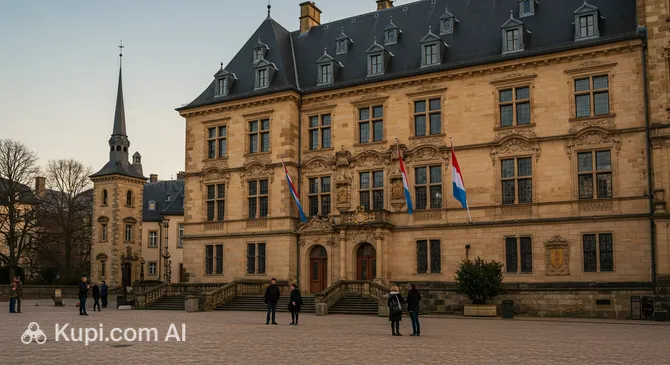
Grand Ducal Palace. Illustration.
Source: Kupi.com AI

Traveler photos:

The architectural appearance of the palace is captivating with its Renaissance elegance. The facade is adorned with elegant spires, carved balconies, intricate stonework, and beautiful windows, giving the building a majestic yet refined look. Every detail bears witness to a rich past and cultural heritage.

Soldiers of the Luxembourg Army stand as a guard of honor at the massive gates of the Grand Ducal Palace, their ceremonial duty adding a special sense of occasion to the site. It is not only a working residence but also one of the capital's main attractions, drawing tourists from all over the world as an important historical monument that preserves the spirit of the centuries.

Contacts

For up-to-date information on opening hours, tour availability, and special events at the Grand Ducal Palace, it is recommended to consult official sources. Key contact details for visitors are provided below.

How to contactContact
Address17 Rue du Marché-aux-Herbes, 1728 Ville-Haute Luxembourg
Phone number+352 22 28 09
Websitemonarchie.lu

What to Do

A visit to the Grand Ducal Palace offers a unique opportunity to peek inside the official residence of the head of state. Tourists can view the luxurious interiors, including the working offices of the Grand Duke and Grand Duchess, as well as rooms for business meetings and protocol events. Of particular interest are the magnificent halls designed for solemn receptions, banquets, and balls, where one can imagine the splendor of court life.

One of the most memorable ceremonies to witness at the Grand Ducal Palace is the changing of the guard. Since 1966, soldiers of the Luxembourg Army have performed this honorary duty at the palace entrance. This colorful and solemn spectacle attracts many spectators and provides a glimpse into the country's military traditions.

In addition to the interiors and ceremonies, the exterior of the palace itself deserves close attention. Walking around, you can appreciate the graceful architectural details: tall spires, skillfully crafted carved balconies, intricate stone patterns on the facade, and beautiful windows. Each element contributes to the majestic look of the palace, making it one of the main architectural gems of Luxembourg City.

Getting There

The Grand Ducal Palace is conveniently located in the heart of Luxembourg City, making it easily accessible for visitors. If you are in the historic center of the capital, walking to the palace is effortless—it’s a pleasant stroll through picturesque streets. The nearby Luxembourg parliament building serves as a handy landmark, highlighting the central position of this iconic attraction.

Thanks to the compact size of Luxembourg City, the Grand Ducal Palace can also be reached by public transport. Various bus routes pass near the center, so you can easily find a suitable option to get to the palace's vicinity. To check current routes and schedules, we recommend using local transport apps or information boards at bus stops. Generally, it’s just a few minutes' walk from the nearest stops to the palace.

Nearest city: Luxembourg City

History & Facts

The history of the Grand Ducal Palace dates back to the 16th century, when it was originally designed and built not as a monarch's residence, but as the town hall of Luxembourg City. Construction began in 1572 and continued until 1773. Interestingly, the impetus for the new building was a tragic event: in 1554, a powerful explosion at a gunpowder storehouse, caused by a lightning strike, virtually destroyed an entire neighborhood, including the old town hall, necessitating a large-scale redevelopment of the city center.

Throughout its long history, the building has repeatedly suffered damage and underwent reconstruction. The palace sustained serious damage in 1683–1684 during the French siege led by the famous military engineer Vauban. However, it was restored by 1728 and even expanded 13 years later. A major renovation occurred in the late 19th century when Adolphe, the first Grand Duke of independent Luxembourg, chose this building as his official residence, which determined its modern status and name.

The mid-20th century was a challenging period for the palace, but with the return of Grand Duchess Charlotte in 1945, the Grand Ducal Palace once again became a symbol of sovereignty and the official seat of the head of state. Under her patronage, the interiors were updated in the 1960s, and between 1991 and 1996, a large-scale and meticulous restoration was carried out, returning the palace to its former glory.

Time Needed

When planning a visit to the Grand Ducal Palace in Luxembourg City, you should aim for approximately 1-2 hours. This is generally enough time to admire the majestic facade from the outside, take some memorable photos, and, if your visit coincides with the tour season, explore the ceremonial state rooms inside. A tour of just the exterior and perhaps watching the changing of the guard ceremony (if it takes place during your visit) usually takes about 30–45 minutes.

If you plan to visit the palace interiors with an organized tour—which is mostly possible during the summer months—the total duration of your visit will increase. The tour itself usually lasts about 1 hour. Therefore, for a full experience, including waiting for the tour to start and viewing the interiors, it’s best to allow at least one and a half to two hours. Your level of interest in history and architecture will also influence how much time you want to spend studying the details of this landmark site in Luxembourg.

Working Hours

Visiting the interiors of the Grand Ducal Palace is usually only possible during a specific period, typically in the summer months when special guided tours are organized for the public. During the rest of the year, the palace is used as a working residence and is closed to the general public. It is highly recommended to check the exact opening dates for tourists, tour times, and the need for advance ticket booking on the official website of the Grand Ducal Palace or at Luxembourg City tourist information centers, as this information can change annually.

External viewing of the palace and watching the changing of the guard (if it takes place) are available year-round and do not require prior booking. However, if you plan to go inside, be sure to check current information in advance, as the number of tour tickets may be limited and advance purchase or registration is often required.

10:00 – 17:00

Nearby

A visit to the Grand Ducal Palace is undoubtedly a highlight of any trip to Luxembourg City. However, to make your discovery of the capital of Luxembourg truly complete, don’t limit yourself to just one site, no matter how significant it is. Exploring the surroundings will allow you to dive deeper into the city's atmosphere, discover its hidden gems, and form a more multifaceted impression.

There are many interesting places concentrated around the Grand Ducal Palace, each reflecting the history and culture of this amazing city in its own way. A short walk from the palace can lead you to other iconic landmarks, cozy corners, or impressive museums, enriching your travel experience with new discoveries and emotions. Below is a list of some attractions located in the immediate vicinity.

NameDistance
Place Guillaume II0.1 km
Konrad Café & Bar0.1 km
National Museum of History and Art0.1 km
Luxembourg City History Museum0.1 km
De Gudde Wëllen0.2 km
Notre-Dame Cathedral of Luxembourg0.2 km
Bock Casemates0.3 km

Have you reached the end of the page?

So the route has been studied inside and out