Support

Taman Negara

About

Taman Negara is not just a geographic point, but a true treasure trove of wildlife located in the heart of the Malay Peninsula. It is the oldest tropical rainforest on the planet, with an age exceeding 130 million years, making it older than the Amazon jungle and the Congo Basin. For travelers discovering a country as amazing as Malaysia, this national park becomes a gateway to a world of pristine nature and exciting adventures.
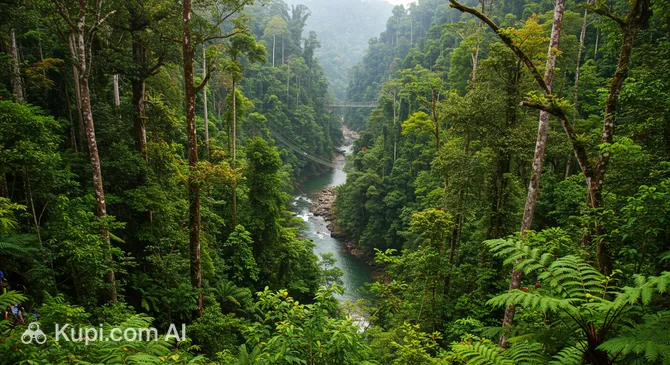
Taman Negara. Illustration.
Source: Kupi.com AI

Geographically, the park spans three states, including Pahang, covering an impressive area of over 4,000 square kilometers. The climate here is typically equatorial: high humidity and warmth persist year-round, creating ideal conditions for the lush growth of exotic flora. The unique history of Taman Negara as a protected area began back in 1938, when these lands were granted protected status to preserve the region's biodiversity.

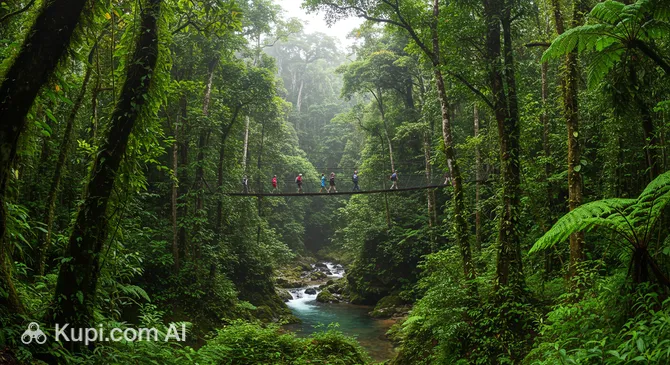
Among the main points of interest is the famous Canopy Walkway. Walking along shaky bridges at the height of giant tree crowns offers unforgettable emotions and allows you to see the forest from an unusual perspective. Boat cruises along the Tembeling River and trekking to Gunung Tahan—the highest peak on the peninsula—are also popular. Here you can encounter rare animals and insects, while night safaris allow you to hear the symphony of the night jungle.

Visiting Taman Negara is a mandatory item on the program for all lovers of ecotourism and active recreation. This place allows you to escape the city bustle, breathe deeply the fresh air of the tropical forest, and feel a true union with nature.
Weather Overview

The climate in Taman Negara is typically equatorial, which means high humidity and warmth throughout the year. As this is a true tropical forest, there is no distinct dry season, and the park remains evergreen thanks to abundant moisture. To choose the right clothing and gear for trekking, we recommend checking the monthly weather in Taman Negara in advance.

The temperature regime in the reserve is quite stable and comfortable for warmth lovers. The average daytime temperature fluctuates around +26...+27°C. The hottest months are usually March, April, and May, when the air can warm up to +31.8°C. Nights bring a welcome freshness: the temperature drops to +21...+23°C, allowing for a rest from the daytime heat.

As for precipitation, rain is a frequent and expected occurrence here. The wettest period is considered the end of the year: in October and November, the number of rainy days reaches 29 per month. A relatively "dry" period can be called February and March, when it rains less frequently—about 16–18 days. Expect consistently warm weather year-round with frequent tropical showers that sustain the life of this unique ecosystem.

Average monthly temperature

Average monthly precipitation

Interesting Facts

Taman Negara is a place full of mysteries and amazing discoveries that go far beyond the scope of a standard guidebook. Here are a few facts that will let you look at this ancient forest in a new way.
Taman Negara National Park. Illustration.
Source: Kupi.com AI

Traveler photos:

  • The name Taman Negara National Park literally translates from Malay as "National Park," however, it didn't always carry this name. The reserve was founded in 1938 under the name "King George V National Park" and was renamed only after Malaysia gained independence in 1957.

  • The local jungles are unique because they were never affected by ice ages. Thanks to the stable equatorial climate, this ecosystem has developed continuously for 130 million years, allowing ancient species of plants and insects that disappeared in other parts of the planet to survive.

  • The territory of the park is still home to representatives of the nomadic Batek tribe (part of the Orang Asli people). These people, referred to as "jungle gypsies," have preserved their traditional way of life: they do not use electricity, know the medicinal properties of plants perfectly, and hunt with blowpipes and poisoned arrows.

  • Here you can encounter an amazing phenomenon—the "shy mimosa" and giant bamboo thickets, but the true legend is the Rafflesia flower. Although it is famous for its specific smell that attracts flies, finding this giant flower with a diameter of up to a meter is considered great luck, as its blooming period lasts only a few days.

How to Get There

A journey to Taman Negara is the start of a true adventure, as the national park is hidden deep within the Malay jungle, far from bustling metropolises. Since the reserve is located in a remote area, there is no direct air connection, and tourists will have to take a combined route. You can learn more about how to get to Taman Negara to choose the optimal option that suits you.

There is no airport in Taman Negara itself. The nearest air harbors accept flights in neighboring major cities, from where you will have to continue by land. One convenient option is Sultan Haji Ahmad Shah Airport (KUA) in Kuantan. It is located about 130 km from the park. The road by taxi or bus from here will take about 3.5 hours, allowing you to enjoy the views of Pahang province.

An alternative route lies through Ipoh Airport (IPH) located in the city of Ipoh, approximately 146 km from Taman Negara. Travel time by ground transport will be about 4 hours. You can also consider flying into Sultan Mahmud Airport (TGG) in Kuala Terengganu (113 km from the park, about a 3-hour drive), which handles a fairly large flow of tourists.

For clarity, here is a summary of the main airports in the region:

AirportPassenger trafficDistance
Sultan Mahmud Airport894 737113 km
Kerteh Airport80 000114 km
Sultan Haji Ahmad Shah Airport176 100130 km
Pulau Redang Airport25 000141 km
Ipoh Airport517 160146 km

Rail travel is another popular, though not direct, way to reach the reserve. There is no station in Taman Negara itself, but most travelers begin their journey from the capital. The key transport hub is the KL Sentral (XKL) station in Kuala Lumpur. It is about 184 km from the park. From here, tourists usually travel by train or bus to the town of Jerantut, which serves as the main gateway to the national park, and then transfer to a boat or shuttle.

Below is information about the nearest major railway hub:

StationPassenger trafficDistance
KL Sentral Station36.5 mln184 km

Main Attractions

A trip to Taman Negara is an immersion into a world where nature reigns supreme. There are no conventional city entertainments here, but there are endless jungles, turbulent rivers, and unique ecosystems. The main attractions focus on forest exploration, wildlife watching, and active recreation.

The absolute center of attraction is Taman Negara National Park itself. This is the heart of the reserve, where the main hiking trails and routes are concentrated. Here you enter a true "green ocean" that is over 130 million years old. A walk through the park is a chance to see giant trees with powerful buttress roots, exotic flowers and, if you're lucky, meet wild inhabitants, from colorful birds to tapirs.

Taman Negara National Park. Illustration.
Source: Kupi.com AI

Traveler photos:

One of the most recognizable landmarks of the area is the Canopy Walkway. It is the world's longest canopy walkway, laid in the treetops: its length is about 530 meters, and its height reaches 40 meters above the ground. Walking across the swaying bridges allows for a bird's-eye view of the jungle and reveals the forest layer that is usually hidden from the eyes of a hiker.

For those who want to enjoy the cool and picturesque water views, a visit to the Lata Berkoh cascades is a must. You can get here by boat up the Tahan River, and the journey itself becomes an adventure as the boat maneuvers between rocks and overhanging tree branches. Lata Berkoh is a series of rocky rapids with natural pools resembling jacuzzis, where it is pleasant to refresh yourself in clean water surrounded by the sounds of the forest.

Fans of panoramic views should climb Bukit Teresek hill. The ascent to a height of 334 meters requires some effort, but it pays off in full. From the top, a breathtaking view opens up over the endless green sea of the jungle, winding rivers and, on a clear day, the majestic Gunung Tahan—the highest point of Peninsular Malaysia.

Local Cuisine

Cuisine in the Taman Negara area is an immersion into authentic Malay traditions of the state of Pahang. You won't find pretentious fine-dining establishments here, but you can enjoy simple, hearty, and incredibly tasty home-cooked food. The basis of the local menu is rice, an abundance of aromatic spices and, of course, the freshest river fish caught in local waters.

The main gastronomic experience every tourist should have is tasting Ikan Patin Masak Tempoyak. This is the region's signature dish: tender silver catfish (patin) stewed in a thick yellow sauce made from fermented durian (tempoyak). The dish has a specific, sweet-spicy, and rich flavor, making it a true delicacy for daring gourmets. If you prefer more familiar tastes, try the classic Nasi Lemak (rice cooked in coconut milk) or fried Mee Goreng noodles, which are prepared on every corner here.

Among drinks, the absolute leader is Teh Tarik—hot tea with condensed milk that is frothed into a thick foam by pouring it from one container to another. In the tropical heat, fresh juices made from watermelon, pineapple, or lime are also popular. Travelers should keep in mind that in the village of Kuala Tahan, which has a predominantly Muslim population, alcohol is virtually unavailable for open sale. You can usually only find beer or cocktails in the restaurant at the Mutiara resort.

The dining culture here is inextricably linked to nature. The center of attraction for all hungry travelers is the "floating restaurants" moored along the bank of the Tembeling River. Dinner in such a place is a special pleasure: you eat while gently swaying on the water, enjoying the cool breeze and the view of the majestic Taman Negara National Park, whose dark wall of jungle rises on the opposite bank.

Travel Tips

A trip to Taman Negara is an immersion into the wild, which requires special preparation different from a trip to a typical resort town. To ensure your adventure in the planet's oldest jungle is comfortable and safe, we have gathered the most important practical recommendations.

  1. Clothing and Gear. In humid tropical conditions, light synthetic clothing that dries quickly works best (cotton stays damp for hours here). Be sure to bring comfortable trekking boots with good tread, as trails are often slippery and muddy. Also, pack a raincoat or poncho and a waterproof cover for your backpack.
  2. Transport and Logistics. In the village of Kuala Tahan itself (the park's base camp), public transport is non-existent. The primary way to get around is on foot or by boat ("water taxis"), which ferry tourists across the river into the national park for a symbolic fee (about 1 Ringgit). Apps like Grab are not available here, so it is better to book transfers to other cities in advance through your hotel or travel agencies.
  3. Finances. This is a critically important point: there are no ATMs in Taman Negara. The nearest one is in the town of Jerantut (about an hour's drive away). Be sure to stock up on enough cash (Malaysia uses Ringgits) to pay for food, boats, and small expenses. Bank cards are only accepted at the large Mutiara hotel and some travel offices, but the connection is often unstable.
  4. Health and Safety. There are no 24/7 pharmacies here, only a basic medical clinic, so bring your own first-aid kit (plasters, antiseptics, stomach upset remedies). The main nuisance in the jungle is insects and leeches, so a powerful repellent is mandatory. Drink only bottled water to avoid infections.
  5. Communication and Internet. Wi-Fi is available in guesthouses and restaurants, but the speed is usually low. Mobile connection works, but coverage may drop in the jungle. The best signal in this region is usually with the Celcom operator; if it's important for you to stay connected, buy a SIM card in a major city beforehand. Park staff and guides understand English well.
  6. Local Etiquette. Kuala Tahan is a Malay village with a predominantly Muslim population. In public areas (outside the jungle), it is recommended to dress modestly, covering shoulders and knees. It is customary to remove shoes when entering private homes or chalets. When greeting, locals often place a hand over their heart—this is a sign of respect and friendliness.
  7. What to Avoid. It is strictly discouraged to wander off marked trails without a certified guide—it is very easy to get lost in the dense jungle. Also, avoid swimming in the Tembeling River in non-designated areas: the current can be strong and unpredictable.
  8. Extra Tip. Buy or bring "leech socks" with you. These are fabric covers worn over regular socks and trousers, preventing leeches from reaching your skin. They can be found in the small shops in Kuala Tahan, and they really save the day during trekking after rain.

Taman Negara is a place where you disconnect from civilization and tune into the rhythm of nature. By following these simple tips, you can avoid everyday inconveniences and fully focus on the beauty of the ancient forest and its amazing inhabitants.

Entertainment & Nightlife

It's important to set the right mood immediately: Taman Negara is a realm of wildlife, not a hub for noisy parties. You won't find neon signs for nightclubs, discos, or typical bar streets here. "Nightlife" in these parts has a literal meaning—it's the life of the jungle after sunset. The evening's main soundtrack isn't DJ music, but a deafening chorus of cicadas, frogs, and nocturnal birds.

The center for evening leisure is Taman Negara National Park itself. The most popular activity here is the Night Jungle Walk (Night Safari). This is an organized guided walk that starts around 20:30. Armed with flashlights, tourists head into the forest to see those inhabitants that hide during the day: from giant stick insects and glowing mushrooms to leopard cats and tapirs. The atmosphere of mystery and adrenaline here replaces any club drive.

The social life of Kuala Tahan village after dark centers on the Tembeling River, in floating restaurants. These are local establishments built on rafts where travelers from all over the world gather. A relaxed atmosphere prevails: people in trekking gear share their hiking impressions, drink tea, and have dinner to the sound of splashing water. There is no dress code at all—the main thing is to be comfortable and keep your body protected from mosquitoes.

If you are looking for a place resembling a bar, the only option is the restaurant at the Mutiara Taman Negara hotel. This is perhaps the only location in the immediate vicinity of the park where you can legally buy alcohol (beer or wine), as the village itself is predominantly Muslim, and the sale of alcohol there is restricted. The establishment stays open until late evening, offering a more comfortable setting and a river view from the terrace.

Among other evening spots, the Family Restaurant floating cafe stands out. There is no alcohol here, but they serve excellent fresh juices and local food. It's a great place to meet other tourists and discuss plans for tomorrow. Keep in mind that most establishments close quite early, around 22:00–23:00, as life in the jungle begins at dawn.

Safety and Tips: Walking in the illuminated part of Kuala Tahan village is safe; crime is virtually non-existent here. However, wandering far from the residential zone in the dark is not recommended due to the risk of encountering wild animals or snakes. Always carry a powerful flashlight. To get from one riverbank to the other (for example, from the floating restaurants to the Mutiara hotel), water taxis are used, which run until late evening (usually until 23:00); the fare is symbolic—about 1 Ringgit.

Regarding daytime entertainment not related to trekking, the choices are limited. There are no theaters or museums in the classic sense. You can diversify your cultural program with a visit to an Orang Asli settlement (indigenous people), where they will show you how to make fire without matches and shoot from a blowpipe, or by enjoying a calm boat ride along the river rapids.

Parks & Museums

Taman Negara is a unique place where the standard concept of "city parks" and "museum quarters" dissolves in the grandeur of primordial nature. Here, the forest itself serves as a giant open-air museum, and green zones are not limited by fences, stretching for thousands of kilometers. Nevertheless, near the park headquarters and the village of Kuala Tahan, there are several locations that perform educational and recreational functions, introducing guests to the wealth of the local ecosystem and culture.

The absolute dominant feature of the region is Taman Negara National Park itself. This is not just a forest, but the most complex ecosystem on the planet, existing for millions of years. For tourists, special marked trails and wooden boardwalks have been laid out here, allowing you to walk through the jungle with relative comfort without disturbing the topsoil. It's an ideal place for "forest bathing" and bird watching, where every step reveals new plant species, from tiny mosses to giant dipterocarp trees.

Taman Negara National Park. Illustration.
Source: Kupi.com AI

Traveler photos:

As a natural area for relaxation, Lubuk Simpon is worth highlighting. This is a natural river pool located about 15-20 minutes' walk from the main park headquarters. Unlike the turbulent rapids deep in the forest, the water here is relatively calm, making this spot a popular "beach" among tired trekkers. Surrounded by a wall of jungle, Lubuk Simpon offers the opportunity to safely swim in cool river water while surrounded by the sounds of nature.

Regarding museum displays, the main educational hub is the Interpretive Centre, located at the main entrance to the park (in the Wildlife Department building). This is a small but informative museum that is worth visiting before starting your hikes. It features displays with information about the reserve's flora and fauna, samples of animal tracks, and taxidermy and skeletons of jungle inhabitants. The exhibition helps you understand exactly who you might meet on the trail and how the life of the tropical forest is organized.

A kind of "living museum" can be found in the Kampung Orang Asli settlements. Although this is not a museum in the classic sense with walls and display cases, a visit to the indigenous people (Batek tribe) provides deep immersion into the anthropology and history of the region. Tourists are shown traditional survival skills: making fire by friction and crafting poisoned arrows for blowpipes. This is a unique chance to see the daily life of people who have lived in harmony with the forest for centuries, without changing their habits under the influence of civilization.

From an architectural point of view, the floating restaurants on the Tembeling River are of interest. These structures on rafts and barrels have become a symbol of the Kuala Tahan tourist zone. They demonstrate the adaptation of local infrastructure to seasonal changes in water levels: when the river rises during the rainy season, the restaurants simply float higher, remaining accessible and safe.

Insider Tip: Be sure to visit one of the observation towers, such as Bumbun Tahan. It is located just a few minutes' walk from the Mutiara resort. This is a wooden structure with slit windows overlooking a salt lick (a salt-crusted clearing) where animals come to lick salt. It is the best "gallery" for watching deer, wild boar, and sometimes rarer guests, especially at dusk.

Getting Around

It's important to clarify right away: Taman Negara is not a metropolis, but a reserve with the adjacent village of Kuala Tahan. Therefore, the usual public transport system, including subways, trams, or city buses, is completely absent here. Paved roads end at the entrance to the village, and the main transport arteries are rivers and forest trails. All logistics are built around water communication and walking.

Water Taxis are the primary and most in-demand type of "public transport" in this region. Wooden motorized boats ply across the Tembeling River, connecting Kuala Tahan village (where guesthouses and shops are located) with the main national park entrance and the Mutiara resort on the opposite bank. Boats do not have route numbers; they simply wait for passengers at the jetties. Departure occurs as they fill up or on demand.

For longer trips to sights (e.g., to waterfalls or aboriginal settlements), long narrow boats—longtails—are used. They operate on a charter or shared taxi principle for excursion groups. You can find them at the main Kuala Tahan jetty. This is the only way to get deep into the jungle if you don't plan on a multi-day hike.

The payment system here is as simple and conservative as possible: cash only. No transport cards, season tickets, validators, or mobile apps for fare payment exist. Payment is made personally to the boatman before boarding or immediately after crossing. The currency is the Malaysian Ringgit. It is extremely important to have small bills (1, 5, 10 Ringgits) with you, as drivers may not have change.

Approximate service prices:

  • River crossing (from one bank to the other): usually costs 1 Ringgit per person one way. At night, the price can double.
  • Boat rental for a trip to attractions (e.g., Lata Berkoh): the price is fixed for the whole boat (around 200–250 Ringgits) and is divided among all passengers (usually up to 4 people).

On land, within Kuala Tahan village itself, transport as such is not needed. The village is compact, and any guesthouse, shop, or restaurant can be reached on foot in 5–15 minutes. There are virtually no sidewalks here, so you have to walk along the roadside, so be careful. Taxi services like Grab or Uber do not work here. If you need to reach a distant hotel with heavy luggage, you can arrange with locals in pickup trucks, but this is more of a private service than systematic transport.

Practical tips for tourists:

  • Operating Hours: Boats across the river run from early morning (around 7:00) until late evening (usually until 23:00). If you are staying on the park side later than this, arrange with a boatman in advance, otherwise you risk spending the night in the jungle.
  • Safety: Boats can often be wet and shaky. Keep your balance when boarding and disembarking, and protect your electronics from splashes.
  • Bus Tickets: If you need to leave Taman Negara for other cities (Kuala Lumpur, Cameron Highlands), tickets for tourist minivans and buses are sold at small travel agency kiosks in the village center or at your hotel's reception.

Accommodation

Where to stay:

Accommodation options in Taman Negara are quite specific and fully reflect the character of this wild place. You won't find high-rise chain hotels or luxurious business centers here. The housing stock consists mainly of eco-lodges, simple chalets, guesthouses, and hostels. The entire spectrum of housing can be divided into two main categories: the single resort located directly within the reserve, and many budget options in the village of Kuala Tahan on the opposite riverbank.

For tourists wanting maximum immersion in the jungle atmosphere, staying on the reserve side itself is considered the best choice. This is where the only official eco-resort is located, offering comfortable wooden chalets with all amenities. Staying here puts you within walking distance of the trailheads and allows you to hear the sounds of the forest right from your room. This is an ideal option for families and those who value comfort even in wild conditions, although the cost here is the highest in the region.

Taman Negara National Park. Illustration.
Source: Kupi.com AI

Traveler photos:

The alternative is the village of Kuala Tahan, located across the river from the entrance to Taman Negara National Park. This is the hub of tourist life with a large selection of budget accommodation. Hostels for backpackers, family mini-hotels, and campsites are concentrated here. Living conditions in the village are usually modest: often simple rooms with a fan (no air conditioning) and a shared bathroom, but prices are significantly lower. The advantage of staying in Kuala Tahan is its proximity to floating restaurants, shops, and the boat crossing.

Booking Tip: Despite the remote location, popular accommodation options (especially the eco-resort and high-quality guesthouses with air conditioning) fill up quickly. It is highly recommended to book a room in advance, 1–2 months ahead, especially if your trip falls during the "dry" season (February to September) or on weekends and holidays when many locals visit.

The price range varies from budget to mid-range. A bed in a shared hostel room can cost from 30–40 Ringgit, a private room in a guesthouse from 80 to 150 Ringgit, and staying at a resort hotel will be significantly more expensive. Large accommodation facilities can be booked via popular online platforms, but many small family guesthouses in Kuala Tahan only work via direct calls or messaging apps, and often only accept cash payment.

Nearby Cities

For those who want to explore the surrounding area, Taman Negara serves as an excellent starting point for day trips to several interesting nearby locations:

Kuantan—the capital of Pahang state, located about 137 km from the park. This lively coastal city attracts travelers with its picturesque beaches, such as Teluk Cempedak, and beautiful waterfalls. Here you can enjoy fresh seafood, visit the majestic Sultan Ahmad Shah State Mosque, and see how modern buildings stand alongside traditional Malay culture.

Ipoh, located at a distance of about 148 km, is famous for its unique colonial architecture and gastronomic delights. The city is surrounded by limestone hills that hide impressive cave temples, such as Kek Lok Tong and Sam Poh Tong. Ipoh is also known for its "white coffee" and street art, making it a great place for a cultural stroll and getting to know the region's heritage.

Kuala Lumpur—the dynamic capital of Malaysia, located 185 km from the reserve. Although the trip may take some time, this metropolis offers a contrast to the wild jungle: the famous Petronas Towers, huge shopping malls, and historical districts. This is an ideal place for those who want to combine ecotourism with the rhythm of a big city and see the main symbols of the country.

CityPopulationDistance
Sungei Tekai59 km
Kuala Lipis20 00064 km
Cukai82 42567 km
Raub40 024110 km
Kuala Terengganu255 109112 km

These nearby destinations provide insight into the diverse culture and landscapes of the region.

Shopping & Souvenirs

General Overview: When heading to Taman Negara, you should immediately prepare for the fact that shopping here is purely functional. In the heart of the ancient jungle, you won't find the usual malls, brand boutiques, or outlets. All local trade is focused on providing travelers with essentials: provisions, water, hygiene products, and tourist gear. The range of shops is modest but quite sufficient for a comfortable stay in the wild.

Main Shopping Areas: The hub of all commercial life is the village of Kuala Tahan. It is here, along the main village streets and near the boat crossing, that small family shops are located. Walking through the village, you will find several mini-markets (known as "kedai runcit") where you can buy everything from flashlights, batteries, and raincoats to instant noodles, snacks, and soft drinks.

Shopping Centers: There are no large shopping complexes in Taman Negara. This is a protected area remote from civilization. The nearest supermarkets and full-fledged stores are in the town of Jerantut, which serves as a transit point on the way to the park. Therefore, if you need specific goods, complex electronics, or high-quality trekking clothing, it is better to purchase them in advance in the major cities of Malaysia.

Markets: There are no classic oriental bazaars in the tourist sense here. However, there is a small morning market for locals in Kuala Tahan selling fresh fruit, vegetables, and river fish. For a traveler, this is more of an opportunity to buy fresh bananas or mangoes for the road. Sometimes small stalls with local produce appear at the entrance to Taman Negara National Park or near the floating restaurants.

Souvenirs: Despite the limited selection, it's hard to leave without a keepsake. The most popular items are T-shirts with "Taman Negara" prints and images of wild animals, magnets, and keychains. Handcrafted items by local aborigines (Orang Asli tribe) are of particular value. Tourists often buy wooden figurines, woven bracelets, and even souvenir blowpipes. You can also find batik products in the shops.

Opening Hours and Payment: Shops in Kuala Tahan usually open early in the morning, around 8:00, and stay open until late evening (22:00–23:00), catering to tourists returning from evening safaris. The most important detail is cash only. Credit cards are accepted in only a few places (e.g., the souvenir shop of the large resort), and there are no ATMs in the village. Be sure to stock up on sufficient Malaysian Ringgits before your trip.

Tax Free: The Tax Free refund system does not operate in local shops. This is a small-scale retail area not oriented toward large purchases eligible for tax refunds.

Reached the end of the page?

That means the route is fully explored