Support

Swayambhunath Stupa

About

Perched on a high hill just three kilometers west of Kathmandu, the Swayambhunath Stupa stands as one of the most famous and ancient Buddhist shrines in Nepal. Also widely known as the "Monkey Temple" due to the many primates playing on its grounds, it attracts pilgrims and tourists from all over the world. Breathtaking views of the Kathmandu Valley open up from the hilltop.
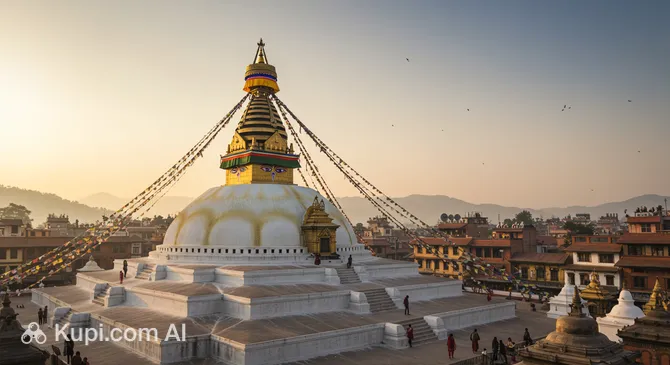
Swayambhunath Stupa. Illustration.
Source: Kupi.com AI

Traveler photos:

The architectural style of the stupa is instantly recognizable. It consists of a massive brick and clay hemisphere representing the world, topped by a cubic base with a gilded spire. From each of the four sides of this base, the famous all-seeing eyes of Buddha look out toward the cardinal directions. This image has become one of Nepal's most iconic symbols, seen on countless souvenirs and postcards.

Swayambhunath Stupa is not just an architectural monument but a living spiritual center. Tibetan monasteries, temples, and a Hindu shrine surround the main stupa, reflecting the harmonious fusion of the two religions. To reach the shrine, pilgrims and tourists must climb 365 steps—one for each day of the year—making the ascent a symbolic journey.

Contacts

Swayambhunath Stupa is a large open-air temple complex, so it does not have a single information center with a phone number or website for tourists. The shrine is located on a hill in the northwestern part of Kathmandu, just a few kilometers from the popular Thamel tourist district. You can reach the attraction either on foot or by taxi, which takes about 10 minutes.

How to contactContact
AddressP77R+X52, BHAGANPAU 44600, Nepal

What to Do

Visiting Swayambhunath Stupa is an immersion into the spiritual and cultural atmosphere of Nepal. The main activity here is exploring the unique architecture of the Buddhist shrine. You can examine its elements in detail: from the massive white dome to the gilded spire featuring the all-seeing eyes of Buddha, which have become one of the country's most recognizable symbols. Pilgrims and tourists perform a "kora"—a ritual clockwise circumambulation of the stupa, spinning numerous prayer wheels, which is believed to bring spiritual purification.

The stupa is also known as the "Monkey Temple," and watching its numerous and playful inhabitants is an essential part of the visit. Hundreds of primates roam freely throughout the complex, creating a lively and slightly mischievous atmosphere. Be careful with your personal belongings, as the monkeys can be overly curious about food or shiny objects. Furthermore, its hilltop location offers some of the best panoramic views of Kathmandu and the surrounding valley, especially at sunrise or sunset.

Getting There

Getting to Swayambhunath Stupa from the tourist heart of Kathmandu, the Thamel district, is quite simple as it is located just 3-4 kilometers to the west. Travelers can choose from three main options: hire a taxi, go on foot, or use public transportation. Each of these options offers its own unique experience of the city.

Taking a taxi is the fastest and most convenient way. The ride takes between 10 to 15 minutes, depending on traffic, and will drop you right at the base of the hill. For those who enjoy walking, the route from Thamel takes 30 to 60 minutes and offers a true immersion into local life, as the path winds through non-tourist residential neighborhoods. The most budget-friendly but adventurous option is using local buses or microbuses (tempos) that run toward Swayambhu from bus stops near Thamel.

Once you arrive at the foot of the hill, the final stage is the climb to the stupa itself. Most visitors choose the main eastern staircase, which has 365 steps and is considered part of the pilgrimage. However, there is an easier way: you can ask a taxi driver to take you via the road that circles the hill and leads to a parking area near the summit. This option is especially convenient for those looking to save their energy or those traveling with small children.

Nearest city: Kathmandu

History & Facts

The history of the Swayambhunath Stupa is rooted in antiquity and shrouded in legends. According to one, the Kathmandu Valley was once a lake, and a miraculous lotus emitting light bloomed on the hill where the stupa now stands. The place became known as "Swayambhu," meaning "self-arisen." While legends speak of a spontaneous appearance, historical records are more specific. Ancient manuscripts indicate that the temple's construction began in the 5th century AD, around the year 460. However, some sources suggest the stupa's origins are even older, potentially dating back to the 3rd century BC.

The architectural design of Swayambhunath is a striking example of Nepalese craftsmanship that evolved over centuries. The oldest and main part of the structure is considered to be the massive monolithic hemisphere, symbolizing the earth and the element of water, resting on a stepped base. Over time, presumably in the 7th-9th centuries, the complex was rebuilt and acquired its recognizable appearance. By the 13th century, Swayambhunath was already a well-known center of Buddhism. Later, in the 17th century, under King Pratap Malla, the complex was significantly expanded, notably with the installation of a huge vajra at the base of the stairs.

Every element of the stupa carries deep symbolism. Above the white dome rises a square tower, with the all-seeing eyes of Buddha depicted on each side. Between them, instead of a nose, a Nepali symbol resembling a question mark is painted, representing unity and the single path to enlightenment. Above the eyes is a gilded spire divided into 13 steps. These steps symbolize the thirteen heavens or stages of knowledge required to reach nirvana. The entire structure is crowned by a gilded umbrella—a traditional symbol of high spiritual authority and protection.

Time Needed

You should set aside 2 to 3 hours to explore the Swayambhunath Stupa temple complex. This time is usually sufficient for a leisurely introduction to the main shrine. During this period, you will have time to climb the famous 365-step staircase, perform a ritual circumambulation (kora) around the main stupa while spinning prayer wheels, and, of course, enjoy the magnificent panoramic views of the Kathmandu Valley from the top of the hill.

If you are short on time, a quick tour including only the climb and a visit to the central stupa can be done in 1–1.5 hours, especially if you take the road leading almost to the top. However, to truly soak up the atmosphere, it's worth planning half a day. Extra time will allow you to explore the numerous monasteries and smaller temples within the complex, observe the famous monkeys that gave the stupa its nickname, and sit unhurriedly in one of the cafes overlooking the city. A visit at sunrise or sunset can also extend your stay and provide an unforgettable experience.

Working Hours

The Swayambhunath Stupa temple complex is accessible year-round, making it a convenient attraction when planning a trip to Kathmandu in any season. Most sources indicate that the shrine grounds themselves are open 24/7, allowing visitors to come at any time. Early morning is a particularly popular time to visit to catch the sunrise and witness morning rituals, as is the evening to enjoy the sunset over the valley. However, it's worth noting that the ticket office may operate on a more standard schedule, typically during daylight hours.

Pre-booking tickets for Swayambhunath is generally not required. Tickets are purchased on-site at the office near the entrance to the complex. Since this is a large, open religious site rather than a museum with limited entry, there are no strict time slots for visiting. Nevertheless, it's always useful to check for the latest information on ticket office hours and any changes in access rules locally, such as at your hotel or with local guides, to ensure your visit goes as smoothly as possible.

Open 24 hours

Nearby

Visiting the majestic Swayambhunath Stupa is just the beginning of exploring the rich cultural and spiritual heritage of this Kathmandu district. The area surrounding the hill where the shrine stands is filled with other interesting sites, and exploring them will allow for a deeper immersion into the atmosphere of Nepal. Many of these attractions are within walking distance, offering travelers the chance to take a fascinating walk through the city's non-tourist corners.

Exploring neighboring temples, monasteries, and cultural sites will enrich your experience and show how closely Buddhism and Hinduism are intertwined in Nepalese life. Near the famous "Monkey Temple," you can find both secluded shrines and bustling sites, each with its own unique history and atmosphere. Below is a list of nearby attractions worth including in your itinerary.

NameDistance
Bhagawan Pau0.3 km
National Museum of Nepal1 km
Soaltee Kathmandu1.6 km
Carpe Diem Lounge & Bakery1.7 km
Kathmandu Grill Restaurant1.9 km
Sicily by Ts1.9 km
Museum of Nepali Art1.9 km

Have you reached the end of the page?

So the route has been studied inside and out