Support

Al Buraimi

About

Al Buraimi is a vibrant city in the northwest of the Sultanate, welcoming travelers with lush palm groves amidst desert landscapes. As the administrative center of the region of the same name, it plays the role of a strategically important "gateway" connecting Oman with the United Arab Emirates. Thanks to its immediate proximity to the Emirate of Al Ain, there is a special atmosphere of cultural blending here, where modern rhythms of life are harmoniously intertwined with centuries-old traditions.

Geographically, the city is a large oasis, which gives it freshness and greenery even in a hot climate. With a population of about 127,000 people, Al Buraimi maintains a sense of comfort and a measured pace of life not found in bustling metropolises. This is a place where you can take a break from the hustle and bustle and immerse yourself in authentic Arabian life. Dating back centuries, the history of Al Buraimi has left its mark on the architecture and way of life: ancient forts stand alongside new buildings, and the narrow streets of the old quarters invite you on fascinating walks.
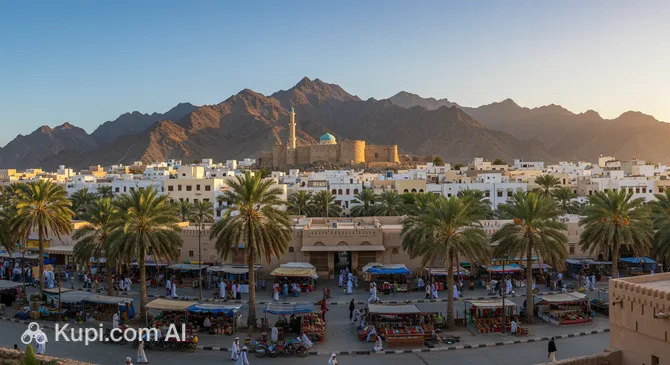
Al Buraimi. Illustration.
Source: Kupi.com AI

For tourists, the city is attractive primarily for its historical heritage and oriental flavor. The main points of attraction are the majestic defensive structures, such as Al Khandaq Fort, and the lively traditional markets where you can find everything from aromatic spices to local handicrafts. The uniqueness of Al Buraimi lies in the opportunity to see a real, non-touristy way of life, stroll through the shady alleys of the oasis, and experience the legendary local hospitality.

Visiting Al Buraimi is an excellent choice for those looking for new experiences away from the beaten path. It is an ideal starting point for exploring the region, offering a relaxing getaway, deep cultural immersion, and unforgettable views of a desert oasis.
Weather Overview

The climate of Al Buraimi can be described as typical for desert regions: dry weather with many sunny days a year prevails here. Summer in the city is truly sweltering: from June to August, the average temperature stays at +36°C, and daily maximums regularly exceed the +42°C mark. During this period, rain is practically impossible, so the heat is quite hard to bear.

The winter months, on the contrary, offer a pleasant coolness and are an ideal time for travel. In December and January, the average temperature is a comfortable +19...+20°C, which is perfect for long walks. However, it should be noted that nights can be fresh, with temperatures dropping to +13...+15°C. You can find out what the expected weather in Al Buraimi will be for the dates of your trip on our special page.

Expect very hot summers and mild, dry winters with minimal rainfall. Rain here is an extremely rare phenomenon: even in the winter period, only 1-2 rainy days per month are recorded, so you are unlikely to need an umbrella on your trip.

Average monthly temperature

Average monthly precipitation

Interesting Facts

In addition to its main attractions, Al Buraimi holds many fascinating secrets that reveal the city from a completely new perspective. This is a place where boundaries are blurred not only on maps but also in cultural traditions, creating a unique pattern of history.

  • Heritage of an Ancient Oasis. Historically, Al Buraimi was part of the famous Tuwam oasis, which served as a vital crossroads for trade routes for centuries. The city's prosperity was ensured by a complex system of underground channels—aflaj—which delivered water even in the driest seasons. A symbol of this natural wealth today remains the Buraimi Public Park, which continues the traditions of a green oasis in the middle of the desert.

  • Twin City. One of the most amazing features is the close connection with the Emirati city of Al Ain. For a long time, there was no formal border between them, and the two settlements effectively functioned as a single organism. This free movement in the past gave rise to a unique blend of cultures, family ties, and traditions that can still be felt here today.

  • Guardian of the Desert. For centuries, the city played the role of a key defensive outpost. Local forts and watchtowers that have survived to this day are reminders of the region's turbulent history, when Al Buraimi protected the approaches to the interior of Oman from invaders.

  • Legends of Sheikhs and Traders. The history of the region is inextricably linked with influential Omani families. Oral traditions preserve the memory of wise rulers and brave merchants who not only built this city but also turned it into a thriving center of trade, where goods from all over the Arabian Peninsula flowed.

Buraimi National Park. Illustration.
Source: Kupi.com AI

Traveler photos:

How to Get There

Due to its location on the border with the United Arab Emirates, the city is an important transport hub. When planning your trip, you can choose one of several routes through nearby major cities. To study the logistics in detail and plan the perfect route, we recommend reading about all the ways to get to the city.

Al Buraimi itself does not have its own airport; however, its proximity to the developed infrastructure of neighboring regions makes it easy to reach by air. The nearest hub is Al Ain (IATA: AAN). It is located in the city of Al Ain (UAE), just 22 km from the center of Al Buraimi. This is a convenient option for those traveling through the Emirates. A taxi ride from here will take about 30–40 minutes, including border crossing. Despite its international status, passenger traffic here is small, ensuring a calm atmosphere.

If you prefer to fly directly into Oman, you should consider Sohar Airport (IATA: OHS). It is located in the Omani city of Sohar, approximately 82 km from Al Buraimi. This is a regional airport with low passenger traffic, accepting domestic and some international flights. The journey by car or taxi from here to your destination will take about 1 hour and 20 minutes.

For those looking for more international flight options, Al Maktoum International Airport (Dubai World Central) (IATA: DWC) is an excellent choice. Located in Dubai (UAE) at a distance of 96 km, this major aviation hub serves millions of passengers annually. The journey to Al Buraimi from here will take about 1.5–2 hours by taxi or rental car.

For clarity, here is a summary of the main airports:

AirportPassenger trafficDistance
Al Ain Airport96 77522 km
Sohar Airport76 00082 km
Dubai World Central – Al Maktoum International Airport1.1 mln96 km
Al-Fujairah International175 000105 km
Dubai Airport92.3 mln117 km

Rail service in this region is not yet developed for passenger transport, so it is impossible to get to Al Buraimi by train. Roads remain the primary way to travel between Omani cities and neighboring countries. Tourists often use the comfortable intercity buses of the state company Mwasalat or rent cars to enjoy the picturesque desert views along the way.

Main Attractions

Al Buraimi is a city where ancient history harmoniously intertwines with the natural beauty of an oasis. The main attractions here are compactly located, allowing you to see them in one or two days. A journey through the city is primarily an introduction to the majestic fortification architecture of Oman and the traditional way of life.

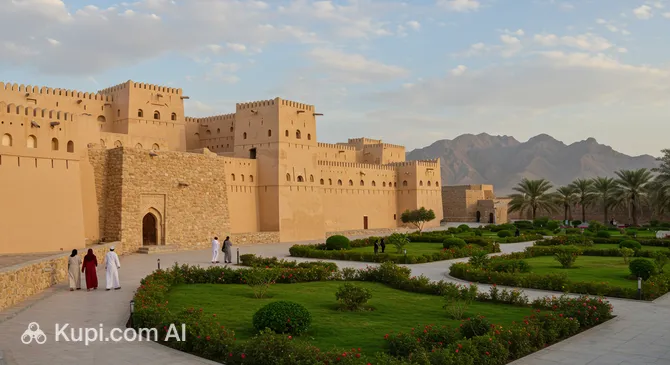
The undisputed symbol of the city is Al Khandaq Fort. This fortress is considered one of the best examples of defensive architecture in the region. The fort got its name, meaning "moat," thanks to the deep moat surrounding its walls, which is a rarity for Omani fortifications. Tourists come here to admire the powerful towers, stroll through the courtyard, and feel the breath of history, as the fort protected the approaches to the oasis for centuries.

Buraimi National Park. Illustration.
Source: Kupi.com AI

Traveler photos:

If you want to take a break from the hot sun and enjoy the greenery, be sure to visit Buraimi Public Park. This is the city's largest green zone, serving as a popular meeting place for both locals and travelers. Here you can have a picnic in the shade of the trees or simply stroll along the well-kept paths, enjoying the contrast between the blooming garden and the desert landscapes beyond the city limits.

Another important historical site is Al Hillah Fort. Unlike the purely military Al Khandaq, this castle served as the residence of the local governor (Wali), so its architecture is more elegant and rich in detail. Having ascended to the upper levels of the fortification, you can enjoy a panoramic view of the old quarters of the city, palm groves, and the neighboring Emirati city of Al Ain.

You should round off your tour of the city at the Old Market (Al Buraimi Souq), located near Al Khandaq Fort. This is not just a place for shopping, but a real attraction that has preserved the atmosphere of traditional Arabian trade. It is interesting to wander among the stalls with spices, incense, and textiles to feel the living rhythm of the city.

Local Cuisine

Al Buraimi's cuisine is a real feast of taste for gourmets, where ancient Bedouin traditions and the aromas of oriental spices intertwine. It is impossible to imagine a trip here without tasting classic Omani dishes. Be sure to try Mashuai—tender roasted fish with spices that literally melts in your mouth, or Maqbous—a fragrant pilaf with chicken or lamb, generously seasoned with saffron. For those looking for authentic flavors, a real discovery will be Harees—a thick and hearty dish made of boiled wheat and meat, cooked over a low fire.

Desserts and drinks occupy a special place in local gastronomy. Fresh dates grown in the region's green oases are considered the main treat here. They are traditionally served with Kahwa—Arabic coffee, to which cardamom and rose water are added. This drink is a symbol of Omani hospitality. Tourists should remember that Oman is a Muslim country, so alcoholic beverages are not sold in ordinary cafes; they can only be ordered in licensed bars and restaurants at large hotels. In everyday life, locals prefer freshly squeezed juices and tea.

The food culture in the city is diverse: from cozy family restaurants to lively street trade. At the Al Buraimi markets, you can grab a quick snack of hot roti flatbreads or buy the famous Omani Halwa—a sweet treat with nuts and spices. If you want to feel how the locals relax, go on a picnic. A popular spot for such alfresco meals is Buraimi Public Park, where families gather for dinner in the evenings, and during holidays, gastronomic festivals often take place here, revealing the full richness of the flavors of an oriental bazaar.

Travel Tips

Al Buraimi is an incredibly hospitable city, but like in any corner of the East, there are cultural and practical nuances, the knowledge of which will make your trip as comfortable as possible. We have prepared a list of useful recommendations to help you feel confident in this ancient oasis and avoid awkward situations.

  1. Clothing and Climate. Given the conservative way of life in the Sultanate of Oman, prefer modest clothing. Shoulders and knees should be covered for both men and women—this is a sign of respect for local traditions. Due to the hot climate, choose loose-fitting clothes made of natural fabrics (cotton, linen). Be sure to bring comfortable shoes for walking along the stony paths of the forts and a hat for protection from the intense sun.
  2. Transport Nuances. Public transport in the city is poorly developed, so the most convenient option will be renting a car. This will give you the freedom to move between attractions. If you use the orange and white taxis, remember an important rule: always agree on the price before getting in. Meters are often not turned on here, and bargaining is a normal practice.
  3. Finances and Cash. The country's currency is the Omani Rial (OMR). Although major supermarkets and hotels accept international cards, you will need cash in small shops, traditional markets (souqs), and taxis. We recommend changing money in advance or withdrawing it from an ATM upon arrival. Tipping is not mandatory, but rounding up the bill in a cafe or taxi will be appreciated.
  4. Health and Safety. Al Buraimi is a very safe city where you can safely walk even in the evening. The main threat to a tourist is the sun: always carry water with you and use sunscreen. Pharmacies (usually marked with a green cross) are frequent, many pharmacists speak English, but it is better to bring specific medications with you.
  5. Communication. English is widely spoken in the service industry, hotels, and large shops. However, in the old market or when communicating with the elderly, it may not help. Learn a few phrases in Arabic, for example, "As-salamu alaykum" (Hello) and "Shukran" (Thank you)—this will immediately win over the locals. For navigation and communication, it is better to buy a local SIM card (Omantel or Ooredoo) as soon as you arrive.
  6. Local Etiquette. Omanis are very polite and appreciate this in others. When entering a room, it is customary to greet everyone present. If you are invited to visit or offered a treat (dates, coffee), it is not customary to refuse—this can offend the host. Remember the "right-hand rule": taking food, handing over money or objects should only be done with the right hand.
  7. What to Avoid. Strictly refrain from public displays of affection (kissing and hugging are not accepted here). It is also categorically forbidden to consume alcohol in public places and on the street—it is only allowed in licensed bars at hotels. Do not photograph locals, especially women, without their explicit permission.
  8. Consider Siesta Time. Life in Al Buraimi comes to a standstill in the middle of the day. Many shops, markets, and small cafes close for a break from about 1:00 PM to 4:00 PM due to the heat. Plan your shopping and active walks for the morning hours or the evening, when the city comes to life again.

Following these simple rules will help you easily blend into the measured pace of life in Al Buraimi. The locals are famous for their cordiality, and by showing a little respect for their culture, you will surely encounter a warm welcome and sincere smiles.

Entertainment & Nightlife

Nightlife in Al Buraimi differs significantly from the noisy parties of European capitals or neighboring Dubai. Here you will not find districts with neon signs and 24-hour discos. Evening leisure in the city is imbued with tranquility and a traditional Eastern way of life. The main activity begins after sunset, when the heat subsides and locals take to the streets to socialize, drink coffee, and enjoy the coolness.

If you are looking for classic bars or clubs, your choice will be limited to licensed establishments at large hotels. In conservative Oman, alcohol is not sold in ordinary shops or street cafes. The center of "European-style" relaxation is often the Al Buraimi Hotel and similar hotel complexes. This is where bars and restaurants are located where you can order alcoholic beverages, listen to music, and spend the evening in a setting familiar to Western tourists. The dress code in such places is usually smart casual.

However, the real soul of the city at night is revealed in its non-alcoholic establishments. Shisha bars and traditional coffee shops scattered along the main streets and in the old market area are a popular format for relaxation. A relaxed atmosphere reigns here: men gather in large groups, discuss the news, and play board games. Tourists are greeted friendly here, and it is a great chance to immerse yourself in the local culture.

One of the main centers of attraction in the evening is Buraimi Public Park. With the onset of darkness, this place is transformed: the lights come on, and kiosks with street food and drinks open. This is an ideal location for safe night walks, where you can see how Omani families relax and try local snacks at very affordable prices. The park stays open late and remains lively even on weekdays.

As for daytime entertainment, it is cultural and educational in nature. There are no large amusement parks in the city, but you can visit historical forts or look into colorful markets. Nature lovers should go dune bashing in the vicinity of the city, which is often offered by local guides.

Practical Tips:

  • Safety: Al Buraimi is an exceptionally safe city. You can safely walk the streets even late at night. However, women are recommended to dress modestly, avoiding overly revealing outfits outside of hotels.
  • Transport: Public transport does not run at night. The most reliable way to get to a hotel or restaurant is by orange and white taxis. It is better to agree on the price in advance before getting in.
  • Opening Hours: Life in the city quietens down by midnight, with the exception of hotel bars, which may stay open until 1:00–2:00 AM.

Parks & Museums

Al Buraimi is often called the "green gateway" of Oman, and this is no coincidence: the city grew up on the site of an ancient oasis where nature has coexisted with human civilization for centuries. For travelers, this means the opportunity to relax in the shade of spreading palm trees after walks in the desert and touch history within the walls of restored fortresses that today serve as the region's main cultural centers.

The green heart of the city is rightfully considered Buraimi Public Park. This is the largest recreational area in the district, where locals and tourists come to escape the daytime heat. The park is a well-maintained space with wide alleys, fountains, and playgrounds. It is an ideal place for a family picnic or a quiet evening stroll, allowing you to see the non-touristy, measured life of the city.

Buraimi National Park. Illustration.
Source: Kupi.com AI

Traveler photos:

However, the main natural treasure remains the historical Al Buraimi Oasis. This is not just a park, but a living ecosystem that exists thanks to the ancient system of irrigation channels—aflaj. A walk among thousands of date palms and fruit trees gives a unique experience: here you can see how crops have been grown for centuries in a dry climate and enjoy the coolness created by the thick foliage. The oasis serves as a natural open-air museum of agriculture.

In Al Buraimi, there are no art galleries familiar to Europeans, but the role of key museums is performed here by majestic fortifications. Al Khandaq Fort is not just a fortress, but a monument of military engineering. Walking through its courtyards and towers, visitors can study the arrangement of traditional defense: from the famous dry moat to ingenious traps for enemies. Temporary exhibitions are often held inside, telling about the life of the garrison and the history of the region.

Another important cultural site is Al Hillah Fort. Unlike the austere Al Khandaq, this structure served as a ruler's residence, so its interiors are more refined. Today, this space functions as an architectural museum: here you can examine the complex geometric patterns decorating the arches and doors, and go up to the observation platforms, which offer a panorama of the old city and palm groves.

For those looking for hidden gems, we advise finding the entrance to Falaj Al Sa'ara. A recently restored section of this underground channel allows you to descend and walk along the stream of water that fed the city for centuries. This is an atmospheric and authentic place where you can take impressive photos and feel the engineering genius of the Omani ancestors.

Getting Around

The public transport system in Al Buraimi has its own characteristics and differs significantly from the usual European model. You won't find a metro, trams, or trolleybuses here. The city infrastructure is primarily oriented towards motorists, so public transport is quite limited. For a tourist, this means that you need to plan your movement in advance, without relying on random bus stops.

The main and most common means of transportation around the city are the orange and white taxis. They can be found at special stands near markets, large shopping centers, or simply stopped with a wave of a hand on the street. An important detail: meters are rarely used or not turned on at all in local taxis. Therefore, the golden rule for a tourist is to agree on the cost of the trip with the driver strictly before getting into the car. Bargaining is appropriate and even expected.

So-called "Baiza buses"—minibuses operating as shared taxis—also run in the city. They travel along certain streets and pick up passengers along the way. This is the cheapest way to get from one point to another, but they do not have a clear schedule or fixed stops—you need to know the route and landmarks. Payment for fares in taxis and minibuses is made exclusively in cash. Bank cards and travel passes are not accepted in this type of transport, so always keep small bills with you for payments.

Classic high-capacity city buses are practically non-existent as a class of intra-city transport in Al Buraimi. The national transport company Mwasalat operates routes connecting the city with other regions, and they have stops within the city, but using them for short trips between attractions is inconvenient due to the infrequent service intervals.

As a modern alternative to traditional taxis, mobile car-hailing apps (e.g., OTaxi) are starting to gain popularity. Using an app removes the language barrier and the need to bargain, as the price is fixed by the system. However, it's worth noting that the waiting time for a car may be longer than in large metropolises.

Given the hot climate and the scattered nature of interesting places, the most comfortable alternative to public transport is renting a car or car sharing (if international services are available). This will give you independence from schedules and the opportunity to explore the city and its surroundings at your own pace, enjoying the air-conditioned interior. Walking is recommended only for short distances in the city center or in parks, as sidewalk infrastructure is not developed everywhere.

Accommodation

Al Buraimi offers travelers a choice of accommodation that is focused more on practicality and home comfort than on extravagant luxury. The city's hotel stock is mainly represented by mid-range hotels and apart-hotels, which are popular in the Middle East. You won't find huge five-star resorts of world chains here, but you can count on clean, spacious rooms and a high level of service characteristic of Omani hospitality.

The city's geography is quite compact, so the choice of neighborhood is not a critical issue—you can quickly reach the main locations from almost any point by taxi or car. The most convenient areas for tourists are considered to be along the main streets leading to the UAE border, as well as the neighborhoods in the city center. Staying here will provide easy access to markets and historical forts. If you prefer a quieter atmosphere and a view of greenery, you should consider accommodation options near a popular recreational area like Buraimi Public Park.

Apart-hotels (hotel apartments) are particularly popular with family travelers. The rooms in them are often equipped with their own kitchenettes and living areas, which makes them ideal for long stays or holidays with children. Classic 3-4 star hotels usually offer guests additional amenities: swimming pools, gyms, and their own restaurants. It is worth noting that it is at the large hotels that the only places in the city where the sale of alcoholic beverages is permitted are often located.

Booking Tip: Although Al Buraimi is rarely as crowded with tourists as the capital, we recommend booking accommodation in advance. This is especially relevant during Oman's national holidays (such as Eid al-Fitr) and in the winter months, when the pleasant weather attracts many guests from neighboring regions.

Overall, the price range in the city can be described as budget and mid-range. The cost of a night here is generally significantly lower than in neighboring Al Ain or Muscat. To find accommodation, it is most convenient to use major international online aggregators—this will allow you to compare prices and read reviews. Direct booking by phone is also possible, but the online option is more reliable for fixing the price and guaranteeing your stay.

Nearby Cities

For those who want to explore the surrounding area, Al Buraimi serves as an excellent starting point for day trips to several interesting nearby places. Thanks to the developed road network, you can easily reach the coast of the Gulf of Oman and get to know other historical centers of the Sultanate.

One of the most attractive destinations for a short trip is the ancient city of Sohar. Located just an hour and a half away, it is considered the legendary birthplace of Sinbad the Sailor. Tourists come here to see the white fort, stroll along the picturesque Corniche, and feel the atmosphere of an important seaport that connected Oman with the outside world for centuries.

If you are interested in grand defensive structures, it is worth visiting As Suwayq. The journey will take just over two hours, but what you see is worth it: the local fort is considered one of the largest in the country. This coastal town is also famous for its long beaches and traditional way of life characteristic of the Al Batinah region.

Below is information about the nearest cities that you can include in your itinerary:

CityPopulationDistance
Al Ain766 93612 km
Shinas43 31281 km
Sohar285 00091 km
Dhank23 46692 km
Kalba37 545101 km

These nearby destinations provide an insight into the region's diverse culture and landscapes, complementing the experience of visiting the Al Buraimi oasis.

Shopping & Souvenirs

General Overview. Shopping in Al Buraimi is an authentic adventure that is very different from visiting the glossy malls of Dubai or Muscat. The city does not claim to be a fashion capital, so you will not find boutiques of world luxury brands here. The main value of local shopping lies in the opportunity to touch the traditional way of life. People come here for high-quality local products, oriental sweets, and handicrafts. Prices here are often lower than in the capital or the neighboring Emirates, and the atmosphere is more soulful and calm.

Main Shopping Areas and Streets. The commercial life of the city is concentrated mainly in the central part, near the historical forts. The main shopping streets are filled with small shops selling everything from textiles and clothing to electronics and household goods. A walk through these quarters allows you to find unexpected treasures, such as high-quality fabrics or traditional Omani perfumery hidden in inconspicuous shops.

Shopping Centers. For those used to a modern shopping format, several shopping complexes operate in the city. The most popular place is LuLu Hypermarket. This is not just a supermarket, but a full-fledged shopping center where you can buy groceries, clothing, electronics, and souvenirs in a comfortable air-conditioned environment. Also worth noting is Al Buraimi Mall, which features mass-market clothing stores and a food court. These are convenient locations to buy everything you need in one place.

Markets. The heart of trade in Al Buraimi is undoubtedly the traditional markets (souqs). The most famous is the Vegetable and Fruit Market, located next to the central mosque. Since the city is an oasis, there is always a huge selection of fresh dates, mangoes, limes, and other fruits grown in local gardens and surroundings, such as the green areas near Buraimi Public Park. Nearby is the old market (Souq Al Buraimi), where spices, incense, and household items are traded. The atmosphere here is lively and colorful, and bargaining is an essential part of the buying process.

Souvenirs. Al Buraimi is famous throughout the region for its Omani Halwa. Several factories and specialized shops operate here, where this sweet treat is prepared according to ancient recipes with the addition of saffron, cardamom, and rose water. This is the best gift you can take home from the city. It is also worth paying attention to elite varieties of dates, high-quality Omani frankincense (luban), ceramics, and traditional daggers (khanjars), which are sold in souvenir shops at the market.

Opening Hours and Payment. Shops in Al Buraimi usually operate from 9:00 AM to 1:00 PM and from 4:00 PM to 10:00 PM, closing for a midday break (siesta) during the hottest time of the day. Large supermarkets and shopping centers work without breaks until late evening. Friday is a day off; many shops open only after evening prayer (after 4:00 PM). Shopping centers accept bank cards, but in markets and small shops, payment in cash Omani Rials (OMR) is preferred.

Tax Free. Oman has a Value Added Tax (VAT) refund system for tourists. If you make large purchases in participating stores (look for the "Tax Free" sticker), you can fill out a tax refund form. However, in a small city like Al Buraimi, there are few such shops, and the refund procedure is usually carried out upon departure from international airports or at major border points when leaving the country.

Reached the end of the page?

That means the route is fully explored