Support

POLIN Museum of the History of Polish Jews

About

The POLIN Museum of the History of Polish Jews is a modern cultural and educational center in Warsaw, dedicated to the thousand-year history of the Jewish community in Poland. The museum's location holds special symbolic meaning: it stands on the site of the former Warsaw Ghetto, making a visit particularly poignant. It is more than just an exhibition space; it is an important venue for studying, preserving, and promoting a rich Jewish heritage.
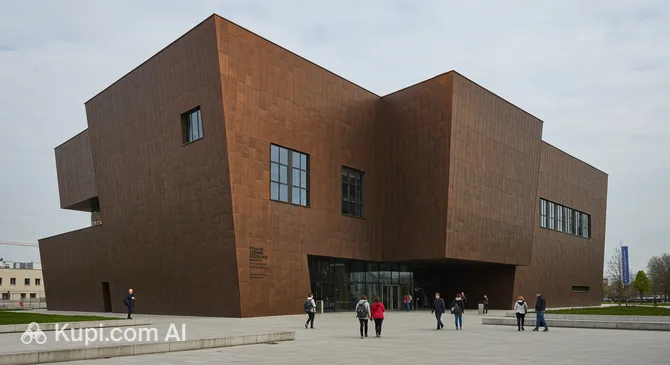
POLIN Museum of the History of Polish Jews. Illustration.
Source: Kupi.com AI

Traveler photos:

The name "Polin" means "Poland" in Hebrew and can also be translated as "rest here." This refers to an old legend about the arrival of the first Jews in Polish lands. The museum opened in 2013, with its core exhibition becoming available in 2014. In 2016, it received the prestigious title of "European Museum of the Year," confirming its high status on the international stage.

The museum's core exhibition is an interactive journey through the centuries. It covers a vast period — from the first Jewish settlements in the Middle Ages to the present day — detailing the most important historical, cultural, and religious aspects of community life. Visitors can walk through a recreated pre-war Jewish street, see a reconstruction of the unique painted roof of the Gwoździec Synagogue, and learn about the contributions of Polish Jews to global science and culture.

Contacts

To get the most up-to-date information regarding opening hours, special exhibitions, or scheduled events, it is best to contact the museum directly. You can use the official contact details provided below for this purpose.

How to contactContact
AddressMordechaja Anielewicza 6, 00-157 Warszawa, Poland
Phone number+48 22 471 03 01
Websitewww.polin.pl

What to Do

To make your visit to the POLIN Museum as comfortable and fulfilling as possible, it is important to plan your time correctly. For a thoughtful viewing of the core exhibition, which takes you through a thousand years of history, we recommend setting aside at least 2–3 hours. Thanks to numerous interactive elements and multimedia panels, the visit will be engaging not only for adults but also for families with children. The exhibits here don't just tell a story; they immerse you in it, allowing you to explore everything at your own pace.

Beyond the core exhibition, the museum boasts a vibrant cultural life. Before your visit, be sure to check the official POLIN website for information on temporary exhibitions, lectures, concerts, or special events that might coincide with your trip to Warsaw. For a deeper immersion into the subject, you can join a guided tour or take an audio guide, available in several languages. This is a great way to discover more details and hear stories that aren't always on the surface.

Getting There

The POLIN Museum of the History of Polish Jews is located in the central part of Warsaw at 6 Mordechaja Anielewicza Street. Its location on the site of the former Warsaw Ghetto is not only symbolic but also convenient for tourists, as it is easily accessible from any part of the city.

The easiest way to reach the museum is by using public transport. Numerous bus and tram stops are located near POLIN. The nearest metro station is Ratusz Arsenał, which is just a few minutes' walk from the museum. This makes it easily accessible for those traveling around the city without a car.

For those who enjoy walking, reaching the museum is also effortless. For example, a walk from the Old Town takes about 20–25 minutes and allows you to get a better feel for the neighborhood. If you are traveling by car, there are parking spaces available near the museum, which is a significant advantage in the busy center of Poland's capital.

Nearest city: Warsaw

History & Facts

There are many remarkable facts behind the creation of the POLIN Museum of the History of Polish Jews, making it more than just an exhibition space, but a true symbol. The building itself, designed by Finnish architects Rainer Mahlamäki and Ilmari Lahdelma, is a masterpiece of postmodern architecture. Constructed from glass, concrete, and copper, it has become one of Warsaw's new architectural landmarks. The first stone was laid in 2007, and the grand opening took place on April 19, 2013 — marking the 70th anniversary of the Warsaw Ghetto Uprising, which added a profound historical depth to the event.

The history of the museum's name is also fascinating. The word "Polin" means "Poland" in Hebrew, but it is also phonetically similar to the phrase "po lin," which translates to "rest here." According to an ancient Jewish legend, these were the words the first Jews to arrive in Polish lands heard from the heavens. They took it as a sign that they could find a new home and refuge here. Thus, the name POLIN embodies the idea of hospitality and the thousand-year history of the Jewish community in the country.

The museum's core exhibition, which opened to visitors in October 2014, is a large-scale narrative spanning an entire millennium. It is divided into eight galleries, each dedicated to a specific historical period — from the Middle Ages to the present day. The exhibition intentionally highlights not only the tragic chapters of history but also the rich culture, religion, and the significant contribution the Jewish community made to the development of Poland. This allows visitors to gain a comprehensive understanding of the long and multifaceted history of Polish Jews.

Time Needed

To fully appreciate the richness of the core exhibition at the POLIN Museum of the History of Polish Jews, you should plan for at least 2–3 hours. This will be enough time to leisurely walk through all eight galleries covering the thousand-year history of the Jewish community in Poland. The exhibition is packed with interactive elements and multimedia installations, so there is no need to rush.

If you wish to dive deeper into the subject, visit temporary exhibitions, or join a guided tour, your visit might last longer. Typically, a guided tour or participation in special events can take up to 4 hours. Therefore, if your schedule allows, it's best to set aside half a day for the POLIN Museum. This will give you the opportunity to not only see all the exhibits but also enjoy a coffee at the local cafe or browse the gift shop, ensuring your visit to this landmark Warsaw site leaves the most complete impression.

Working Hours

The POLIN Museum of the History of Polish Jews is open year-round but follows a standard schedule that is helpful to know when planning your visit. Typically, the museum is open to visitors from Tuesday to Sunday, from 10:00 AM to 6:00 PM. It's worth noting that on Fridays, the opening hours are extended until 8:00 PM, while Monday is the closing day. The schedule may change on public holidays, so it is highly recommended to check the official website for current information before visiting.

To ensure your visit is as smooth as possible, especially during peak tourist season or popular temporary exhibitions, consider purchasing tickets online in advance. This will help you avoid potential queues. It's also useful to know that entry may be free on certain days — for instance, admission to the permanent and temporary exhibitions is free on Thursdays. Before your trip, be sure to visit the museum's official website to confirm the opening hours for your specific date and to review the visitor guidelines.

DayOpening hours
Monday10:00 – 18:00
TuesdayClosed
Wednesday10:00 – 18:00
Thursday10:00 – 18:00
Friday10:00 – 18:00
Saturday10:00 – 20:00
Sunday10:00 – 18:00

Nearby

Visiting the POLIN Museum of the History of Polish Jews is a deep dive into a thousand-year history, but your experience of Warsaw will be incomplete without exploring its surroundings. The museum is located in the Muranów district, which is a living monument to history in its own right. Exploring nearby areas will help you better understand the layers of the Polish capital and see how the past intertwines with the present.

Just a few minutes' walk or a short public transport ride away from the museum are other iconic landmarks, ranging from royal residences to leisure spots for modern Varsovians. Each tells its own unique story, complementing the impressions from your visit to POLIN. Below is a list of interesting sites located nearby.

NameDistance
Kamienica Theatre0.8 km
68 Aquarium Shop1.3 km
Royal Castle in Warsaw1.4 km
Tomb of the Unknown Soldier1.5 km
Norblin Factory1.9 km
Pianka 24-Hour Restaurant2.1 km
Warsaw Uprising Museum2.1 km

Have you reached the end of the page?

So the route has been studied inside and out