Support

Golia Monastery

About

In the heart of the city of Iași rises Golia Monastery—a majestic Orthodox complex that has served as a spiritual landmark and architectural gem for the region for centuries. Built in the mid-16th century, it began as a small church erected by the Logothete Ioan Golia, but over time, it transformed into a powerful fortified monastery surrounded by high walls with defensive towers.
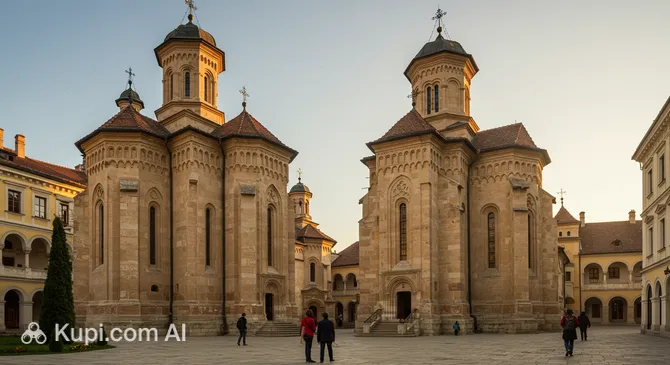
Golia Monastery
Golia Monastery. Иллюстрация. Источник: Kupi.com AI

This monastery is considered one of the most striking examples of the evolution of Moldavian architecture in Romania. Its appearance features a surprising blend of Moldavian Baroque and elements of nascent Classicism. The main church of the complex—the Church of the Ascension—is striking for its rich exterior decor: the facades are decorated with elegant arches, floral ornaments, and classical pilasters, which make it stand out against more austere medieval buildings.

Today, Golia Monastery is an active male monastery and a popular destination for travelers. In addition to its religious significance, the complex is of interest as a cultural center where valuable icons and ancient manuscripts are kept, allowing visitors to touch the living history of the Principality of Moldavia.

Contacts

To inquire about services or organize group tours, you can use the monastery's official contact information.

How to contactContact
AddressStrada Cuza Vodă nr. 51, Iași 700040, Romania
Phone+40 232 216 693
Websitewww.golia.ro

What to Do

The main highlight of the visit will be the Church of the Ascension. Inside, you can see magnificent frescoes and a luxurious Baroque iconostasis, as well as venerate the revered icons dating from the 16th to 18th centuries. Be sure to notice the unusual exterior decoration of the church with its medallions and ornaments—it is an excellent location for aesthetic photos.

For those who want to see the city from above, the monastery bell tower is open for climbing. The upper platform offers an impressive panoramic view of the old city quarters. After descending, it is worth stopping by the local museum, which exhibits rare liturgical books, ancient clerical vestments, and manuscripts telling the history of this place.

A walk through the monastery grounds will allow you to feel an atmosphere of peace: massive fortress walls reliably shield the monastery from city noise. If your visit coincides with service times, you can hear the traditional bell ringing and enjoy spiritual chanting. In the summer, the monastery sometimes serves as a venue for spiritual music concerts, which adds a special solemnity to the visit.

Getting There

Finding Golia Monastery is easy, as it is located in the very heart of the historical center at Strada Cuza Vodă nr. 51. If you are already exploring the central streets, it is only a 10–15 minute walk from the famous Palace of Culture or the cozy Copou Park.

For those who prefer public transport, the "Teatrul Național" and "Târgul Cuțularilor" stops are within walking distance. Trams No. 1, 7, 8, 13, as well as buses No. 28, 36, and 41 stop here. From the stop to the monastery gates, it is no more than a five-minute leisurely walk.

Travelers arriving at Iași Airport (IAS) will find it most convenient to take a taxi or catch bus No. 50, which reaches the city center in about 20–30 minutes. If you are traveling by car, keep in mind that parking in the center is limited, so it is better to leave your vehicle at one of the nearby paid parking lots.

Ближайший город: Iasi

History & Facts

The history of this site began in the mid-16th century when the influential Logothete Ioan Golia founded a stone church on the outskirts of what was then the city. There is a touching legend that Ioan built the church to win the heart of the beautiful Anna—an orphan who vowed to marry only the man who would build a majestic church. She kept her promise, and later, in 1606, she and her son donated the shrine to the Vatopedi Monastery on Mount Athos.

In the mid-17th century, during the reign of Prince (Hospodar) Vasile Lupu, a large-scale reconstruction began. The monastery was not only updated in the Moldavian Baroque style but also turned into a true citadel: massive fortress walls and high defensive towers were built to protect against enemy raids. This ambitious construction was completed by the Prince's son, Stefăniță, in 1660.

Golia Monastery has hosted many historical figures. For instance, in 1711, during the famous Pruth River Campaign, it was visited by Russian Tsar Peter I. The monastery's architectural style is unique because, at the beginning of the 18th century, it first displayed a subtle synthesis of traditional Moldavian forms with classical elements—pilasters, friezes, and elegant panels—making it a model for sacred architecture of that era.

Time Needed

To explore the monastery complex at a leisurely pace, guests usually need about 1 to 2 hours. This is quite enough time to admire the architecture of the main church, study the frescoes, and visit the small local museum.

If you plan to climb the bell tower for panoramic photos of the city and spend some time in the quiet monastery garden, it is better to aim for the upper end of this timeframe. Visiting the museum and examining the unique manuscripts will add about 30 more minutes to your walk.

Working Hours

The monastery gates are open to visitors daily. Access to the grounds is usually possible from 07:00 to 20:00 in the summer and from 08:00 to 19:00 in the winter months. Visiting the church may be limited during religious services.

The monastery museum operates on a separate schedule, most often from 09:00 to 17:00 (closed on Mondays). Since the schedule may change depending on religious holidays, it is recommended to check the current opening hours on the official website or at the entrance before your visit.

Nearby

Golia Monastery is located in an area with a high concentration of historical monuments, making it easy to plan a rich walking route. Exploring the surroundings will help you feel the spirit of old Iași and see how the city's appearance has changed over the centuries.

NameDistance
Casa Joseph Zoller0.6 km
House of Museums0.6 km
Iași Metropolitan Cathedral0.7 km
Piața Unirii Café0.7 km
Beer Zone0.8 km
Boho by London0.8 km
Regina Maria Municipal Museum Burchi-Septilici0.8 km

Reached the end of the page?

That means the route is fully explored