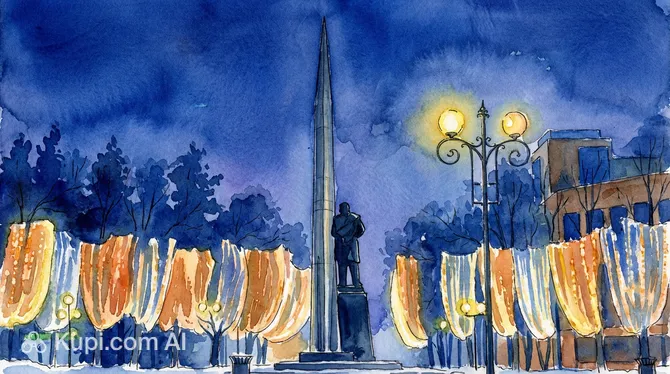
In the heart of the city of Kaluga, on the picturesque Ploshchad Mira, rises one of the most recognizable monuments celebrating human genius. The Tsiolkovsky Monument is not just a tribute to the great scientist, but also a striking symbol of how a bold dream can overcome Earth's gravity. Located in Russia, this federal-level cultural heritage site consistently draws the eyes of tourists and inspires locals.
Traveler photos:
The composition features a bronze figure of the "father of cosmonautics," with an 18-meter stainless steel rocket soaring into the sky behind him. This combination of classical sculpture and industrial style emphasizes Konstantin Tsiolkovsky's contribution to the theory of space flight. The square around the monument was not chosen by chance: it was here, in the quiet of Kaluga's alleys, that the scientist often walked while pondering his fundamental works.
Since its opening in 1958, the monument has become a landmark of the region. It is recognized as one of the finest works of Soviet monumental art, for which the group of creators was awarded a silver medal by the USSR Academy of Arts. Today, it is an essential stop on the itinerary of any traveler interested in the history of science and the exploration of stellar space.