Support

Arco de Santa María

About

The Arco de Santa María (St. Mary's Arch) is more than just an architectural structure; it is a true "gateway to history" located in the very heart of Burgos. Once one of the twelve main entrance points to the medieval city, it is now rightfully considered the most impressive and best-preserved among them.
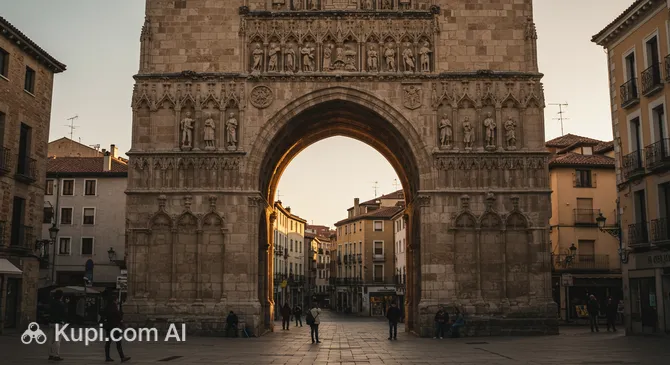
Santa María Arch
Santa María Arch. Иллюстрация. Источник: Kupi.com AI

This monument in Spain is a Renaissance masterpiece. Its facade resembles a stone-carved altarpiece, with statues of legendary figures resting in its niches. Among them, you can recognize Emperor Charles V, the famous hero El Cid, and the city's founder, Diego Rodríguez Porcelos. With its elegant turrets and battlements, the structure looks like a miniature castle guarding the peace of the old quarters.

Today, the Arco de Santa María functions as a cultural center where historical grandeur harmoniously blends with modern exhibitions. It serves as a link between the picturesque Arlanzón riverbank and the majestic Cathedral, creating a unique ensemble for which thousands of tourists visit Burgos every year.

Contacts

To confirm the latest information about exhibitions and events at the Arco de Santa María, you can use the following contact details:

The attraction is highly rated by travelers — 4.7 out of 5 based on more than two thousand reviews.

How to contactContact
AddressPl. Rey San Fernando, 9, 09003 Burgos, Spain
Phone+34 947 28 88 68
Websitewww.aytoburgos.es

What to Do

A visit to the Arco de Santa María offers guests much more than just a view of the facade. Inside the building, there is a cultural space where temporary art exhibitions are regularly held. Be sure to look for the large-scale mural by the famous artist José Vela Zanetti and the unique collection of antique pharmacy equipment that transports visitors back through the centuries.

One of the highlights is climbing to the monument's upper levels. From there, breathtaking panoramic views open up over Burgos Cathedral, the gentle flow of the Arlanzón River, and the lively Paseo del Espolón. The inner halls, with their massive stone walls, allow you to feel the breath of history and imagine how city council meetings were held here hundreds of years ago.

If your walk falls in the evening, don't miss the chance to see the arch illuminated by decorative lights. At twilight, the sculptures on the facade take on a special expressiveness, making it an ideal spot for atmospheric photos. The arch also serves as an excellent starting point for further exploration through the narrow streets of the old city.

Getting There

This majestic landmark is located in the heart of the historic center of Burgos, Spain, at Pl. Rey San Fernando, 9. Thanks to its central location, the arch is within walking distance of most popular tourist routes and hotels in the old town.

If you plan to arrive by public transport, you can take the city buses that stop near Plaza San Fernando. It is also easy to reach by taxi from anywhere in the city; just ask the driver to drop you off at the Cathedral or Paseo del Espolón.

For those traveling by car, it is important to remember that the historic center is a pedestrian zone. It is recommended to leave your vehicle in one of the paid underground parking lots on the edge of the old quarter and continue on foot, enjoying the city's ancient architecture.

Ближайший город: Burgos

History & Facts

The history of this iconic structure in Burgos began back in the 14th century. Originally, it was one of the twelve gates in the massive fortress walls that surrounded the city. However, the magnificent appearance we admire today was acquired between 1536 and 1553, when it was rebuilt in the Renaissance style.

The reconstruction was more than just an architectural update; it was a political gesture. Holy Roman Emperor Charles V commissioned the renovation as a sign of gratitude to the city authorities for their loyalty during the Revolt of the Comuneros. Thus, Spain gained one of the most beautiful civic monuments of that era, symbolizing the power and prestige of Castile.

For a long time, until the 18th century, the city council (consistory) was located inside the arch. In 1943, the site was officially recognized as a national monument, highlighting its exceptional historical and artistic value to the country's cultural heritage.

Time Needed

To simply admire the majestic facade and take some beautiful photos, you will need about 15–20 minutes. However, the Arco de Santa María is well worth stepping inside to explore its interior.

For a complete tour of the indoor exhibitions, viewing the murals, and climbing to the upper levels for a great view of the city, it is best to plan for 45 to 60 minutes. If you are a history and architecture enthusiast, set aside about 1.5 hours to take in every sculptural detail of the facade at your leisure.

Working Hours

When planning your visit to the Arco de Santa María, please check the current opening hours. Note that there is a break in the middle of the day, which is typical for many institutions in Spain.

  • Monday: Closed
  • Tuesday – Saturday: 11:00 AM – 2:00 PM, 5:00 PM – 9:00 PM
  • Sunday: 11:00 AM – 2:00 PM

It is recommended to arrive at least 30 minutes before the end of the morning or evening shift to ensure you have enough time to explore all the interior rooms.

DayWorking hours
ПонедельникЗакрыто
Вторник11:00 – 14:00, 5:00 – 21:00
Среда11:00 – 14:00, 5:00 – 21:00
Четверг11:00 – 14:00, 5:00 – 21:00
Пятница11:00 – 14:00, 5:00 – 21:00
Суббота11:00 – 14:00, 5:00 – 21:00
Воскресенье11:00 – 14:00

Nearby

Exploring the area surrounding the Arco de Santa María will allow you to fully immerse yourself in the atmosphere of the medieval city and see the main architectural treasures of Castile.

Below are several interesting sites located within walking distance:

NameDistance
Santa María Bridge0.1 km
Vermutería Victoria0.1 km
Burgos Cathedral0.1 km
La Espadería0.2 km
Church of San Nicolás de Bari0.2 km
Museum of Burgos0.3 km
CAB Art Center0.3 km

Reached the end of the page?

That means the route is fully explored