Support

Museo de Ciudad Real

About

If you want to embark on an exciting journey through time, the Museum of Ciudad Real is the perfect place to start. It is one of the most important cultural institutions in the Castile-La Mancha region, located in the heart of Ciudad Real. The museum brings together three powerful departments: paleontology, archaeology, and fine arts, offering guests a comprehensive look at the history and nature of this part of Spain.
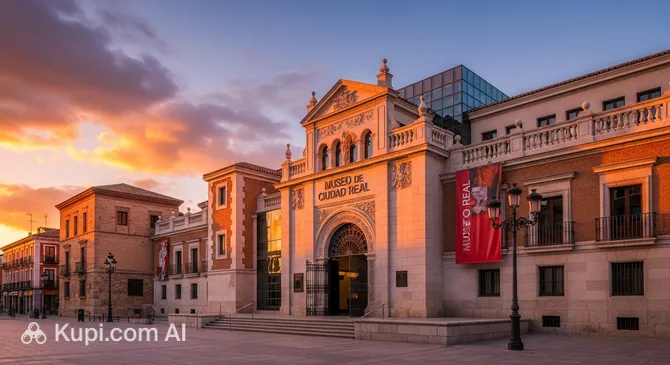
Ciudad Real Museum
Ciudad Real Museum. Иллюстрация. Источник: Kupi.com AI

The museum's collection is distributed between two unique buildings. The main building — Museo Provincial, built in the late 1970s — is impressive for its paleontological finds. Here, you will see the remains of ancient mastodons and the oldest rhinoceros in Europe, dating back millions of years. The archaeological section is equally rich, housing artifacts from the Paleolithic era to the Middle Ages, including exquisite Roman mosaics and Iberian sculptures, such as the famous winged sphinx of Alarcos.

For lovers of aesthetics, the doors of the museum's second site, located in the former Convent of La Merced, are open. This 17th-century Baroque building is an architectural monument in its own right. Its halls display works of art spanning from the 16th century to the present day. Here, you can get acquainted with the works of both classical masters and prominent contemporary Spanish artists, including Antoni Tàpies and Eduardo Chillida.

Contacts

To confirm current information regarding special exhibitions or to book group tours, you can contact the museum administration using the details below.

How to contactContact
AddressPje. Pérez Molina, 2, 13001 Ciudad Real, Испания
Phone+34 926 22 68 96
Websitewww.ciudadreal.es

What to Do

A visit to the museum offers guests a deep immersion into history through both interactivity and contemplation. In the paleontology department, the large-scale skeletons of fossilized mammals are a must-see. The exhibition is complemented by detailed scenography that literally "brings to life" the landscapes of the past, allowing you to see the environments where mastodons and ancient rhinoceroses lived millions of years ago.

The archaeological section of the museum invites you to travel the path from the first stone tools to refined objects of Roman daily life. Here, you can study Bronze Age stelae in detail, examine mysterious Iberian sculptures, and admire the intricate craftsmanship of the ancient mosaics. Thanks to audiovisual materials and scale models, visitors can easily imagine what the region's ancient settlements, such as Sisapo or Alarcos, looked like.

Art enthusiasts should head to the Convent of La Merced building to appreciate the contrast between the historic Baroque architecture and the expression of modern Spanish art. In addition to the permanent exhibitions, the site frequently hosts temporary exhibitions and educational programs. The museum is ideal for a family outing — children are usually thrilled by the ancient giants, while adults can enjoy the tranquility of the convent courtyard and the mastery of the great Manchego artists.

Getting There

Reaching the museum is easy, as it is located in the very heart of the city at Pje. Pérez Molina, 2. If you are already exploring the center, the main buildings are within easy walking distance of iconic landmarks such as the Puerta de Toledo or the city cathedral. Look for signs marked Museo Provincial, which will help you navigate the charming streets of the historic district.

For those arriving from other regions, the most convenient way is to take the AVE high-speed train from Madrid, which takes only about an hour. From the Ciudad Real railway station, you can reach the museum by bus route No. 1 or by taxi in 5–10 minutes. If you arrive at the bus station, the walk to the exhibitions takes about 15–20 minutes, allowing you to appreciate the city's architecture along the way.

Travelers by car should follow the A-4 highway (connecting Madrid and Andalusia), using exits 142 or 145. Public parking lots are located in the city center, in close proximity to the museum. Thanks to its compact size and easy navigation, the city is also excellent for cycling enthusiasts.

Ближайший город: Ciudad Real

History & Facts

The history of this cultural institution began on January 23, 1976, when the provincial museum was officially established by royal decree. The main building seen today on Prado Street was constructed between 1976 and 1978, designed by architect Carlos Luca de Tena y Alvear. However, the path to its opening was not straightforward; a period of inactivity followed the completion of construction, and it wasn't until March 15, 1982, that the first visitors were able to enter its halls.

Interestingly, a decade later, the building required a major renovation. In 1993, commissioned by the Department of Education and Culture, architect Javier Navarro Gallego led the update project. After the work was completed in 1995, the museum reopened its doors, offering a modern and comfortable environment for housing its most precious finds. Since 1984, management of the organization has been handled by the regional government — the Junta of Castile-La Mancha.

Special attention should be paid to the fine arts section building — the former Convent of La Merced, a 17th-century Baroque architectural monument. Following the process of "desamortización" (the confiscation of church lands) in 1843, the building was used as an educational institution for a long time. It was only in 2005, after being transferred to the jurisdiction of the Junta and undergoing meticulous restoration, that it opened as exhibition galleries, blending the historical grandeur of the convent with contemporary art.

Today, the museum serves as the primary guardian of the region's memory, integrating finds from important archaeological centers such as Alarcos and Sisapo into its collections. Its exhibits span an incredible time range — from Cambrian fossils to canvases by modern masters, highlighting the continuity of generations and the richness of the cultural heritage of Castile-La Mancha.

Time Needed

When planning your visit, keep in mind that the museum is split between two separate buildings, each of which deserves a thorough look. For a complete experience of all the collections, the average visitor will need 2 to 3 hours. This time allows for a relaxed exploration of both the ancient artifacts and the modern artworks.

It is recommended to divide your time as follows: approximately 1–1.5 hours for the main building, which houses the paleontology and archaeology sections, and about 1 hour for a stroll through the fine arts galleries in the former Convent of La Merced. If you are traveling with children, you may want to stay longer in the paleontology department to enjoy the interactive installations.

Working Hours

The museum follows a classic Spanish schedule with a siesta break, which is worth considering when planning your trip. Generally, the doors are open to visitors from Tuesday to Saturday from 10:00 to 14:00 and from 17:00 to 20:00. On Sundays, the museum is open only in the morning — from 10:00 to 14:00.

Please note that Monday is a closing day. As seasonal changes or adjustments during holidays are possible, it is recommended to check the official website or inquire at the city tourist office before your visit.

DayWorking hours
понедельникЗакрыто
вторник10:00–14:00, 17:00–20:00
среда10:00–14:00, 17:00–20:00
четверг10:00–14:00, 17:00–20:00
пятница10:00–14:00, 17:00–20:00
суббота10:00–14:00, 17:00–20:00
воскресенье10:00–14:00

Nearby

Ciudad Real is a compact and cozy city, making it easy to combine a visit to the museum with an exploration of other historical and cultural sites. A stroll through the surrounding area will allow you to better experience the atmosphere of La Mancha and see how modern life intertwines with ancient traditions.

Within walking distance of the museum, you will find both ancient gates and interesting modern spaces. Below is a list of attractions located nearby:

NameDistance
Former Casino of Ciudad Real0 km
La Pajarería Wine Bar and Brewery0.1 km
Prado Gardens0.1 km
López Villaseñor Palace0.2 km
Bichos Ciudad Real Aquarium0.3 km
Plaza del Pilar0.3 km
Church of San Pedro0.3 km

Reached the end of the page?

That means the route is fully explored