Support

Hundertwasser House

About

The Hundertwasser House (Hundertwasserhaus) is one of the most unusual and memorable landmarks in Vienna, a true architectural wonder of Austria. This residential building, constructed between 1983 and 1985, is a vivid embodiment of the philosophy of its creator—artist and architect Friedensreich Hundertwasser. He believed that people should not live in identical box-like houses and that architecture should exist in harmony with nature.

The building immediately catches the eye with its "fairytale" appearance. Here, you will not find straight lines, flat walls, or identical windows—every element is unique, as the architect called straight lines the "devil's tool." The facade is painted in bright colors and decorated with asymmetrical patterns, with trees and shrubs growing from windows, balconies, and even the roof. In total, more than 200 plants are planted on the building, which Hundertwasser called "tree tenants," considering them full-fledged residents of the house.
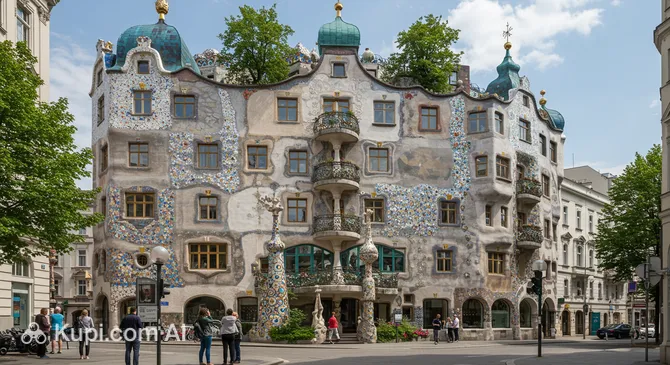
Hundertwasser House. Illustration.
Source: Kupi.com AI

Traveller photos:

Despite the fact that the Hundertwasser House is a private residential complex consisting of 52 apartments and several offices, it has become one of the most popular tourist attractions in the country. Its unique design, which rejects strict rules and celebrates individuality, attracts travelers from all over the world who want to see this masterpiece of "ecological architecture" with their own eyes. While you cannot visit the apartments, the "Hundertwasser Village" is located right across the street—a shopping and exhibition center created in the same style, where you can walk around, visit a café, and browse souvenir shops.

Contacts

Since the Hundertwasser House is a private residential building rather than a managed tourist site, it has no official visitor contact information. You can view this unique building from the outside at any time. For general tourist information about Vienna's attractions, it is recommended to contact the city's information centers or the official tourism portal of the Austrian capital.

How to contactContact
AddressKegelgasse 36-38, 1030 Wien, Austria
Websitewww.hundertwasserhaus.info

What to Do

The main activity at the Hundertwasser House is a close study of its unique facade and, of course, photography. Walk around the building to appreciate it from different angles. Look for unusual details: bright asymmetrical blocks, windows of various shapes, and the famous "tree tenants" growing directly out of the walls and roof. Every perspective reveals new elements, so don't rush and give yourself time for visual exploration.

Try to find at least two identical windows—it's an almost impossible task, as each has its own unique design and framing. Pay attention to the multi-colored columns of irregular shapes and the wavy lines that replace traditional right angles. These details best convey the architect's philosophy of harmony with nature and individuality.

Since the house itself is private property and entry is forbidden to tourists, after exploring the facade, head to the Hundertwasser Village (Hundertwasser Village) located opposite. Here, you can enjoy a cup of coffee in a whimsical café with uneven floors, purchase souvenirs in the same "fairytale" style, and fully immerse yourself in the artist's world, continuing your journey through his work.

Getting There

The Hundertwasser House is located in the 3rd district of Vienna, Landstraße, at Kegelgasse 36-38, on the corner with Löwengasse. Reaching this iconic Austrian landmark is quite easy, as it is conveniently situated and has excellent transport links to the city center and other districts.

One of the most convenient ways is to use public transport. You can take the metro to Landstraße (lines U3, U4) or Rochusgasse (line U3) stations, from which a leisurely walk to the house takes about 10–15 minutes. An alternative option is tram #1, which stops at Hetzgasse, just a couple of minutes' walk from the building. Buses also serve the area, such as route 4A.

If you are planning a trip by taxi or rental car, keep in mind that traffic and parking restrictions may apply in central Vienna. To avoid any hassle, it is recommended to leave your car at one of the public parking lots located nearby and walk the short remaining distance to your destination.

Nearest city: Vienna

History & Facts

The history of the Hundertwasser House is a story of a dream realized and a unique creative partnership. The building was constructed between 1983 and 1986, commissioned by the Vienna city council, which approached the already famous artist Friedensreich Hundertwasser with a proposal to create a residential building. Since Hundertwasser was not a certified architect, Joseph Krawina was appointed to assist him in translating artistic concepts into practical blueprints. Notably, the city authorities gave the artist complete creative freedom, allowing him to realize the boldest ideas he had been nurturing since the 1950s.

At the heart of the project lies Hundertwasser's deep philosophy; he turned to architecture after age 50 as an established painter. He believed that people should not live in soulless boxes, calling straight lines "godless and immoral" and the "devil's tool." The artist sought harmony between man and nature, which is why no two windows in the project are the same, floors and walls are uneven, and about 250 trees and shrubs are planted on the roofs, balconies, and in special niches. These "tree tenants," in his view, were full members of the house, returning to nature the space taken by construction.

Despite the apparent chaos, every element of the house is deliberate and meaningful. This was not shock value for its own sake, but a manifesto against grey and monotonous urban development. An interesting fact: after the completion of construction, Hundertwasser refused a fee, stating that he was happy enough that nothing ugly was built on the site. In 2010, to honor the contributions of both creators, the building was officially renamed the Hundertwasser-Krawina House.

Time Needed

When planning a visit to the Hundertwasser House, you should adjust your time based on your interests. For a quick look at the famous facade, 30 to 60 minutes is usually sufficient. This is enough time to walk around the building leisurely, examine its whimsical architectural details, take some vibrant photos, and soak in the unique atmosphere. Since the house is residential and indoor access is closed, the main focus is viewing this architectural masterpiece from the outside.

If you want to delve deeper into the artist's world rather than just looking at the exterior, feel free to allocate more time. Opposite the main building is the "Hundertwasser Village"—a shopping and exhibition complex designed in the same style. Visiting the local souvenir shops, galleries, and the unusual café with its "wavy" floor can take another hour. Therefore, for a complete and unhurried visit including both the house and the "village," it's best to plan for about 1.5–2 hours.

Working Hours

It is important to understand that the Hundertwasser House is an active residential building, not a museum, so it does not have standard operating hours for visitors. Indoor access in Vienna is closed to tourists; consequently, no booking or prior registration is required. The main advantage is that the exterior facade of the attraction is completely free to view24 hours a day, year-round. To take the best photos and fully appreciate the explosion of colors, it is recommended to visit during daylight hours with good lighting. At the same time, it is important to remember the need to remain quiet and respect the privacy of the residents of this extraordinary house.

Nearby

Visiting the Hundertwasser House is just the beginning of your exploration of this colorful Vienna neighborhood. A walk through the surrounding area will allow you to dive deeper into the city's atmosphere and discover other interesting spots nearby. This small exploration will enrich your experience and make your journey even more fulfilling.

The Landstraße district, home to this architectural wonder, offers visitors to the Austrian capital many other attractions—from famous parks to cultural centers. Many of them are within walking distance, making them a perfect addition to your itinerary.

NameDistance
Prater1 km
Viennese Giant Ferris Wheel1 km
Zoku Vienna1.2 km
Porgy & Bess1.3 km
Reinthaler's Beisl1.8 km
St. Charles Church1.9 km
Belvedere Museum2 km

Reached the bottom of the page?

Looks like you know this route inside out