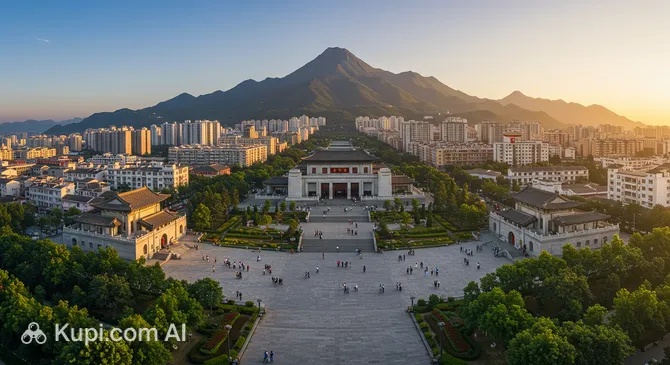
Huanggang is a large and dynamically developing prefecture-level city located in the eastern part of Hubei Province, in the very heart of China. Stretching along the middle reaches of the great Yangtze River, this region represents a unique combination of modern industrial zones, endless agricultural lands, and picturesque river landscapes. With a population of over 6 million people, the city plays an important role in the Yangtze River Economic Belt, situated in close proximity to the metropolis of Wuhan.
The city's geographical location determines its mild but humid climate, typical for the central river valleys of the Middle Kingdom. Huanggang. Illustration.
Source: Kupi.com AI
The relief here varies from gentle plains occupied by rice fields to hilly areas that give the surroundings a special charm. For travelers, Huanggang reveals itself as an authentic slice of modern Chinese life, where industrial progress coexists with the traditional lifestyle of county centers.
The rich history of Huanggang spans more than two millennia. Over the centuries, this territory has been an important administrative and commercial hub. The modern face of the city is formed by its county centers, each of which carefully preserves fragments of the past—from ancient temples to traditional architecture harmoniously integrated into the renewing urban environment. Visiting this region is an opportunity to see the real, non-tourist China, feel its scale, and experience the hospitality of the local residents.
Weather Overview
The climate of Huanggang is classified as humid subtropical, which is characteristic of the entire Yangtze River basin. Travelers should prepare for hot and humid summer months, when temperatures in July and August consistently stay around +30°C, and sometimes higher. During this period, short but intense rains are frequent, providing temporary relief from the heat but increasing humidity levels.
Winter in the city is mild but quite damp. In January, the average temperature is about +5.4°C, while the thermometer rarely drops significantly below zero. The transition seasons—spring and autumn—are considered the most comfortable times to visit, when pleasant warm weather sets in. If you are planning a trip, the weather in Huanggang will please you with an abundance of sunny days in October and November, which are ideal for walks and excursions.
Average monthly temperature
Average monthly precipitation
Interesting Facts
Huanggang hides many surprising details that reveal its complex and multifaceted character. Here are a few facts to help you get to know this city better:
Ancient Roots: The administrative history of the territories within the modern district spans over 2,000 years. Important counties were located here as far back as the early imperial dynasties.
City or Region: According to the Chinese administrative system, Huanggang is not just a city in the conventional sense, but a vast prefecture-level city including one urban district, two county-level cities, and seven rural counties, making its territory extremely diverse.
Economic Specialization: The city is an important industrial hub for Hubei Province. It has developed not only agriculture but also high-tech pharmaceutical and chemical industries.
Connection to the Metropolis:Huanggang is inextricably linked to Wuhan. Many residents of the district commute to the neighboring metropolis daily for work or study, making these cities effectively a single economic agglomeration.
River Gate: Thanks to its position on the Yangtze, the city historically played the role of a key transport hub for the trade of tea and other goods shipped downriver to the coast.
How to Get There
The transport accessibility of Huanggang is largely determined by its proximity to Wuhan, the largest logistics hub in central China. Most travelers arrive in the region through this metropolis, using its international airport or developed network of high-speed trains. From Wuhan, Huanggang is easily reachable by car or intercity bus, and it is worth checking more details on how to get to the city in advance, considering the traffic density at the provincial capital's exits.
The district itself does not have its own international airport, so the main flow of air passengers is serviced through the airports of neighboring cities. The journey from Wuhan to the central Echeng district usually takes from 1 to 1.5 hours. For those who prefer the railway, regular high-speed and conventional train services connect Huanggang with key cities in Hubei Province.
Railway communication is the most reliable way to travel in the region. The district's stations receive trains running along the Yangtze basin, providing convenient links to other industrial and cultural centers. Within the district itself, regular bus routes run between county towns, allowing you to reach even the most remote corners of the region.
While Huanggang is not among the country's most popular tourist destinations, it holds a special charm for those seeking the authentic atmosphere of provincial China. The main attractions of the district are concentrated in its county centers and along the embankments of the Yangtze. Travelers are drawn to historical quarters where time seems to slow down, and traditional architecture recalls the region's centuries-old heritage as an important trade route.
One of the city's key features is its connection to the river. Walks along the embankments allow visitors to appreciate the scale of engineering structures, such as the grand bridges over the Yangtze, and observe the busy river traffic. In the district's county centers, one can find ancient temples and pagodas that have served as spiritual landmarks for local communities for many generations. These places are interesting for their understated beauty and the opportunity to witness the daily rituals of the townspeople without the tourist bustle.
The natural landscapes around Huanggang also deserve attention. Hilly areas and numerous lakes in the city's vicinity offer excellent opportunities for leisurely walks and getting to know the rural life of Hubei. Visiting local markets and central squares will be an excellent addition to the itinerary, allowing you to plunge into the rhythm of life of a modern industrial-agricultural center and feel the true flavor of Central China.
Local Cuisine
The gastronomic traditions of Huanggang are an integral part of the rich cuisine of Hubei Province, known for its skill in preparing dishes from river bounty. Freshwater fish, shrimp, and lotus root—which the numerous lakes and tributaries of the Yangtze are so rich in—play the leading role on the local table. Dishes here are characterized by moderate spiciness and an emphasis on preserving the natural taste of products, often using slow-stewing techniques and high-heat stir-frying.
When in Huanggang, be sure to try the signature lotus root and pork rib soup and various fish delicacies. Local street food deserves special attention: morning markets and small shops serve hot noodles with spicy sauces, steamed baozi buns, and fried flatbreads. The food culture here is deeply democratic—the best taste experiences can often be found in modest family restaurants where the menu is handwritten, and the atmosphere is as lively and informal as possible.
As for drinks, locals prefer traditional varieties of green tea and local types of rice wine. Pale Chinese beer is widely available in restaurants and perfectly complements spicy and salty snacks. Although the coffee culture in Huanggang is only beginning to develop, modern coffee shops can be found in shopping centers. A gastronomic journey through the city is a path of discovery for those ready to experiment with new flavors in the very heart of river China.
Travel Tips
Preparing for a trip to Huanggang requires attention to detail, as this region is primarily oriented toward the domestic market. These practical tips will help you feel more confident and make your journey as comfortable as possible.
Clothing and Essentials: Summer in the region is hot and very humid, so choose clothing made of light natural fabrics. In winter, it can be damp and chilly, so a windproof jacket will be useful. Be sure to bring a universal power adapter and comfortable shoes for long walks.
Transport: The best way to get around the city is by taxi or ride-hailing services via apps. For travel between cities, use high-speed trains from neighboring Wuhan.
Finance: The main currency is the Chinese yuan. International cards are rarely accepted, so be sure to set up Alipay or WeChat Pay before your trip and have a reserve of cash.
Health and Safety: The city is generally safe, but keep an eye on your personal belongings in crowded places. Pharmacies are common, but medicine names will be in Chinese—have a list of necessary medications with their Latin names.
Communication: English is almost non-existent in the city. Install an offline translator and always carry a hotel card with the address in Chinese characters.
Local Etiquette: Greet people with a slight nod. Tipping is not customary in restaurants—it may be perceived as a mistake.
What to Avoid: Do not engage in political discussions and try not to photograph military or restricted sites. Exercise caution when crossing roads, as drivers do not always yield to pedestrians.
Ecology: On windless days, smog levels may rise. If you have sensitive lungs, monitor the Air Quality Index (AQI) via special apps.
Following these simple rules will allow you to focus on exploring the city and enjoy the unique atmosphere of Central China. Have a great trip!
Entertainment & Nightlife
The entertainment scene in Huanggang is primarily oriented toward the tastes and preferences of local residents, making it an excellent place to immerse oneself in the real daily life of a Chinese city. Evening life here is centered around central squares and shopping districts, where numerous street markets and eateries open after sunset. This is the time when townspeople gather with their families to enjoy the cool air and socialize.
For those looking for classic evening entertainment, Huanggang and its largest counties offer modern cinemas, billiard clubs, and, of course, karaoke halls (KTV)—a favorite pastime in China. These establishments have a relaxed atmosphere, and the service is usually aimed at a domestic audience. Small bars and cafes can be found in business centers; however, for larger-scale parties and dance clubs, the district's youth often head to neighboring Wuhan.
Nighttime safety in the city is high, typical of most Chinese cities. Central streets are well-lit, and taxis are easily summoned via mobile apps even in late hours. Nevertheless, for tourists, visiting Huanggang in the evening is primarily a chance to see "square dancing," try exotic street food, and feel a measured pace of life that differs significantly from the bustle of first-tier megacities.
Parks & Museums
The natural areas and parks of Huanggang are quiet oases amidst the district's industrial landscape. Since the region is rich in lakes and rivers, many green zones are located along the shorelines. City parks in county centers serve as the main leisure spots where you can see traditional Chinese gardens, winding walking paths, and areas for collective gymnastics. These places are especially picturesque in the early morning or at sunset when soft light reflects in the waters of the Yangtze.
The city's cultural heritage is presented in local history museums. Their exhibitions are usually dedicated to the district's centuries-old history, the development of agriculture, and industry in the middle reaches of the Yangtze. Although such museums are mainly oriented toward a domestic audience and schoolchildren, they are interesting for their sincerity and the opportunity to see artifacts found during archaeological excavations in this region. There are no major international-level galleries here, but local exhibition halls often host calligraphy and folk craft exhibitions.
For those who appreciate natural beauty, the surroundings of Huanggang offer rural landscapes with rice fields and hills. In recent years, more attention has been paid to creating ecological zones and improving embankments in the region, making walks more comfortable. Visiting such places allows you to feel the city's connection with its natural origins and understand why the Yangtze River has always played such an important role in the lives of local residents.
Getting Around
The transport system of Huanggang is typical for a large Chinese district, where the main load falls on bus services and taxis. The city bus network connects major residential areas with industrial zones and administrative centers. Routes cover not only central streets but also provide connections between the district's various counties. For tourists, the bus is the most budget-friendly way to get around; however, it should be noted that all navigation and announcements are conducted exclusively in Chinese.
There is currently no metro in Huanggang itself, so for fast trips within the city, guests most often choose taxis. A car can be hailed directly on the street or via popular mobile apps like Didi. This is a convenient and relatively inexpensive option, especially if you need to reach remote attractions or the railway station. Payment in taxis is usually made via QR codes of payment systems, but drivers also accept cash.
Electric scooters and bicycles are widely used within the district by locals for short trips. The road network is actively developing, connecting Huanggang via high-speed highways with Wuhan and other provincial neighbors. Pedestrians should be careful: traffic in the city can seem chaotic, and road priority is not always strictly observed as it is in Europe. When planning trips during rush hours, allow extra time for possible congestion near bridges and major interchanges.
Accommodation
The hotel infrastructure in Huanggang is primarily geared toward business travelers and domestic tourists, which determines the nature of local accommodations. Here you will find a wide selection of mid-range and budget hotels that offer comfortable conditions at very affordable prices. The most modern complexes are concentrated in central areas and near large administrative centers, providing a standard set of services for a comfortable stay.
Major international chains have a limited presence in the city, but Chinese hotel brands offer a very decent level of service. For those planning a long stay or preferring a more home-like environment, apartment rentals are available through local platforms. It should be noted that in such accommodation options, the staff most often speaks only Chinese, so using online translators will be extremely helpful.
When planning a trip to Huanggang, it is recommended to book accommodation in advance, especially if your visit coincides with major Chinese national holidays or industrial exhibitions. When choosing an area to stay, look for proximity to transport hubs or shopping centers to minimize travel time around the city. Overall, staying here will cost significantly less than in neighboring Wuhan while maintaining a decent level of comfort.
Nearby Cities
Huanggang serves as an excellent starting point for exploring the surroundings and key cities of Hubei Province. Thanks to a developed transport network, travelers can reach large metropolises and historical centers located along the Yangtze in a short time, discovering new facets of life in central China.
The absolute favorite for a day trip is Wuhan—a colossal metropolis offering endless opportunities for shopping, cultural leisure, and learning about the region's history. It is also worth visiting neighboring Ezhou, which is literally on the other side of the river, and the industrial center Huangshi, known for its industrial heritage and natural parks. Another interesting destination could be the city of Daye, located just a few dozen kilometers away.
Exploring the surrounding cities allows you to see how diverse this region is: from futuristic skyscrapers and busy embankments to quiet county towns and rural landscapes. Each of these destinations is easily accessible by train or car, making short excursions from Huanggang convenient and full of impressions.
Shopping & Souvenirs
Shopping in Huanggang is primarily an introduction to the daily life of a modern Chinese city. The main shopping opportunities are concentrated in the district center and large county towns, where modern shopping malls coexist with traditional street markets. In the shopping centers, you will find a standard set of popular Chinese and some international brands of clothing, electronics, and cosmetics. The atmosphere here is lively, especially on weekends when families come here not just for shopping but also for entertainment.
If you are looking for something truly authentic, head to the local food and clothing markets. Here you can find the freshest products of the Hubei region, from famous tea to local spices and snacks. Traditional markets are the best place to see the real life of the city, haggle, and purchase daily goods at low prices. Local delicacies in vacuum packaging, bamboo products, or high-quality local textiles are often brought back as souvenirs from Huanggang.
Shops in the city usually operate from early morning until late evening without lunch breaks. Payment is most often made through popular Chinese payment systems (Alipay, WeChat Pay), so tourists should take care of setting up these applications in advance or have cash in yuan with them. Large shopping centers may accept international cards, but this is more of an exception. Shopping here will not offer you the luxury of boutiques in world capitals, but it will please you with affordable prices and the genuine flavor of Central China.