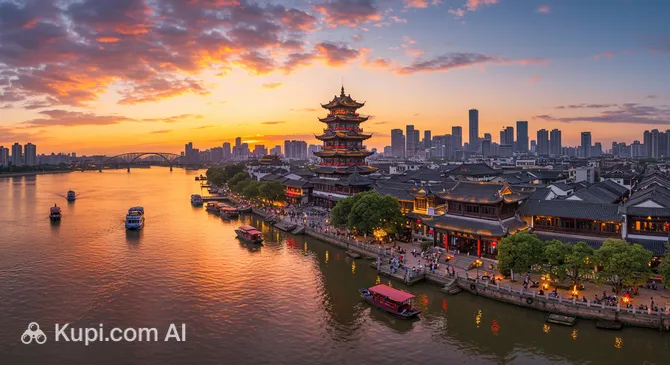
Located on the picturesque banks of the great Yangtze River in Hubei Province, Wuxue is a typical and uniquely charming corner of modern China. As an important administrative and economic center of the Huanggang prefecture-level city, this city attracts visitors not with the glitz of tourist facades, but with its authentic, steady rhythm of daily life in the Middle Kingdom. The city's population exceeds 644,000, making it a lively and dynamic county-level center.
The city's geographical position largely defines its appearance: the flat terrain and proximity to the country's largest waterway create a unique landscape. While Wuxue is not a global tourist magnet, it offers travelers a rare opportunity to see provincial Chinese life "unfiltered." Here, you can stroll along the embankment, watching the movement of ships on the Yangtze, or explore the bustling central neighborhoods where old traditions coexist with modern developments.
Wuxue. Illustration.
Source: Kupi.com AI
If you want to gain a deeper understanding of the region's heritage and feel the true pace of life in the central provinces, Wuxue will be an excellent stop on your itinerary. It is a city for those who appreciate quiet walks, authentic cuisine, and the sincere hospitality of the locals. We invite you to discover this modest but welcoming land, where everyone will find something of their own in the silence of the parks or the hustle and bustle of local markets.
Weather Overview
The city of Wuxue is located in a subtropical monsoon climate zone, which is typical for the central regions of China. This means that travelers should expect distinct seasonality with hot, humid summers and cool, often overcast winters. Precipitation is distributed unevenly: most rain falls in the warm months, which can sometimes lead to an increase in the water level of the Yangtze River.
A typical summer in Wuxue (especially in July and August) is characterized by high temperatures reaching +30–35°C and high humidity, which creates a "sauna" effect. Winter, on the other hand, is quite mild by global standards but piercing due to the dampness: the average January temperature fluctuates around +4–7°C. If you are planning a trip, be sure to check the detailed weather forecast for Wuxue to choose your wardrobe correctly.
The best time to visit the city is considered to be spring (April–May) and autumn (September–October). During these periods, comfortable temperatures around +18–25°C are established, and the amount of precipitation decreases significantly. Autumn is especially pleasant for its stable dry weather, ideal for walks along the embankment and exploring the surroundings without the summer heat or winter dampness.
Average monthly temperature
Average monthly precipitation
Interesting Facts
The name of the city Wuxue (武穴) literally translates from Chinese as "Martial Cave," which gives its history an aura of mystery, although the exact legends behind this name are not widely known to tourists.
The city occupies a strategically important position in eastern Hubei Province, right on the banks of the Yangtze River, which historically made it a significant transport hub for regional river shipping.
Unlike many of China's industrial giants, Wuxue maintains its status as a "residential" county center, where life flows slower and the level of noise and bustle is much lower than in neighboring metropolises.
For business travelers and the occasional tourist, the Wuyue International Hotel operates in the city and is considered one of the most comfortable accommodation options in the district.
Wuxue uses the postal code 435400, and the city is administratively subordinate to Huanggang, while maintaining its unique identity as an independent county-level city.
How to Get There
The city of Wuxue is located in the eastern part of Hubei Province and is an easily accessible point for those traveling through central China. Despite the lack of its own airport, the region's transport infrastructure allows for easy access to the city by both rail and bus. To plan your route, you can use the section describing Wuxue's transport accessibility.
The nearest major aviation hub is Wuhan Tianhe International Airport (WUH). After arriving in Wuhan, travelers can transfer to a high-speed train, which will take them to Wuxue in just 1–1.5 hours. This is the fastest and most comfortable way to reach the city from other regions of the country or from abroad.
Rail travel is the backbone of transportation in Wuxue. The city's Wuxue Railway Station serves both regular and high-speed trains from major cities in the province. Intercity buses from Huanggang and Wuhan are also popular. The bus journey along the G50 highway takes about 3–4 hours, offering picturesque views of the Hubei countryside.
The city of Wuxue is primarily oriented toward the daily life of its residents, so it is difficult to find classic world-class tourist sites here. Nevertheless, for the inquisitive traveler, the city offers its own unique points of interest. One of the main areas of attraction is the city embankment along the Yangtze River. It is an ideal place for walks, where you can observe the powerful current of the river and the industrial majesty of passing cargo ships.
In the very center of the city are administrative squares and wide avenues that turn into mass recreation areas in the evening. Here, you can see a scene typical of modern China: groups of locals dancing outdoors or playing board games. The city's architecture is a mix of functional residential blocks and modern shopping complexes, allowing you to feel the atmosphere of a rapidly developing county center.
Despite the lack of ancient temples or famous museums within the city itself, the local markets of Wuxue can be a real adventure for a tourist. These are lively, noisy spaces where life is in full swing from early morning. Walking through such places allows you to see the real everyday life of Hubei residents and find interesting local goods that you won't encounter in large metropolises.
Local Cuisine
A gastronomic journey to Wuxue is a wonderful opportunity to experience the traditions of Hubei cuisine, which is famous for its river fish dishes and abundance of spices. Proximity to the Yangtze River dictates the menu: be sure to try steamed fish in spicy sauce or braised river creatures with local herbs. These dishes are notable for their freshness and rich flavor.
Among the local specialties, it is worth highlighting zongzi rice dumplings and various tofu soups, which are prepared here according to special home recipes. In Wuxue, the food culture is simple and soulful: locals prefer to dine in small family restaurants in the city center or buy snacks at lively markets. Street food is represented by various noodles and fried snacks prepared right in front of you.
As for drinks, locally produced green tea is very popular in the region, as is traditional rice wine. Restaurants at major hotels offer a more standard Chinese menu suitable for foreign guests. Overall, the city's gastro scene does not claim to be sophisticated, but it wins you over with its authenticity and honest, traditional flavors of central China.
Travel Tips
A trip to Wuxue will allow you to see the real China without embellishment, and to make your journey as comfortable as possible, use our practical tips.
Clothing and belongings: Wuxue has a subtropical climate, so in summer take light cotton clothing, and in winter—warm items, as the damp cold can be quite piercing. Comfortable shoes are essential for walks along the embankment and markets.
Transport: Get around the city by taxi using the Didi app—it's convenient and inexpensive. For trips to neighboring cities, use high-speed trains from Wuxue Station.
Finance: The primary currency is the Chinese yuan. We recommend installing Alipay in advance and linking an international card, but always have a supply of cash for markets and small shops.
Health and Safety: The city is safe, but keep an eye on your bags in crowded places like railway stations. Pharmacies are easy to find in the center, but medicine names will be in Chinese, so bring a basic first-aid kit with you.
Communication: English is practically not spoken in Wuxue. Be sure to download an offline translator and save your hotel address in Chinese characters.
Local Etiquette: Chinese people in the provinces are friendly but may show curiosity toward foreigners. A polite nod and a smile are the best ways to communicate. It is customary to remove your shoes when entering a home.
What to Avoid: Do not engage in discussions on political topics and try not to photograph military or restricted sites if you encounter them.
Extra Tip: Be sure to visit a local market early in the morning—it's the best way to see the real life of the city and try the freshest street fast food.
Have a great trip and bright discoveries in this welcoming corner of Hubei Province!
Entertainment & Nightlife
The entertainment scene in Wuxue is characterized by the tranquility and modesty typical of provincial county centers. You won't find world-famous noisy night clubs or huge concert venues here. Instead, the city offers a traditional Chinese leisure format — KTV (karaoke bars). Local karaoke centers are the main attractions for youth and groups of friends, offering private rooms and a wide selection of drinks and snacks.
For evening relaxation, residents most often choose walks along the central illuminated streets or visits to modern cinemas located in shopping centers. In these complexes, you can find not only the latest movie releases but also game zones, which are very popular. The atmosphere in these establishments is usually friendly and relaxed, and average prices are significantly lower than in giants like Wuhan or Shanghai.
Fans of more active nightlife should keep in mind that establishments in Wuxue close relatively early. If you want large-scale fun with dance floors and bars, the most convenient option would be a trip to nearby Huanggang or even Wuhan, which can be reached quickly by high-speed train. For safe travel around the city at night, it is recommended to use the Didi taxi app, as public transport stops running by midnight.
Parks & Museums
The green zones of Wuxue are quiet oases amidst the dense urban development. Small central city parks are the main places for residents to relax. Here you can see traditional Chinese gardens with pavilions where elderly people play mahjong and young people exercise. Despite the lack of grand landscape ensembles, these recreation areas are endearing for their coziness and the opportunity to observe the life of the local community in an informal setting.
As for cultural institutions, Wuxue is primarily an administrative center, so there are no large world-class museums or galleries here. However, for those interested in the history of the region, small local history exhibits or temporary exhibitions in municipal buildings can be of interest, sometimes telling the stories of local production successes and the development of the county.
For a more enriching cultural holiday and visits to large-scale museums, travelers usually head to neighboring Huanggang or Wuhan. However, a walk along the Yangtze embankment in Wuxue can itself replace a trip to an open-air museum, offering a glimpse into the living history of river shipping and the daily labor of people inextricably linked to the great river.
Getting Around
The public transport system in Wuxue is simple and efficient for a city of its size. The basis of internal communication is city buses. The route network covers all key areas, from residential blocks to the railway station and markets. The frequency of service is usually 10–20 minutes, making moving around the city quite convenient. It should be noted that during morning and evening rush hours, buses can be very crowded due to the large flow of passengers commuting to work.
A popular and accessible alternative to buses is the taxi. The most convenient way to call a car is to use the Didi app. Prices for trips around the city are low, and thanks to Wuxue's compactness, traffic jams rarely occur here. You can also find many electric scooters and bicycles in the city center, which locals use for short trips.
Wuxue Railway Station is the most important transport hub connecting the county to the regional transport network. Bus fares can most often be paid in cash (by dropping coins or bills into a special box near the driver) or using QR codes from popular Chinese services. For tourists, it is recommended to always have small change, as change is usually not given on buses.
Accommodation
The hospitality sector in Wuxue is primarily oriented toward business travelers and local residents, so the choice of accommodation here consists mostly of budget and mid-range options. There are virtually no luxury five-star resorts in the city itself, but guests can expect modern hotels with a basic set of services and a decent level of comfort.
The most popular accommodation option is considered to be the Wuyue International Hotel, which offers quality service and standard amenities for visitors. Additionally, the central part of the county is home to many small guesthouses and apartments that are ideal for short-term stays or business trips. They are characterized by affordable prices and proximity to transport hubs.
When choosing accommodation, we recommend focusing on the city center, as the main infrastructure, shops, and restaurants are concentrated there. It is better to book rooms in advance through popular Chinese services, especially if your trip coincides with national holidays, when the flow of business tourists and local travelers increases significantly.
Nearby Cities
Thanks to its location in the densely populated Hubei Province, Wuxue serves as an excellent starting point for exploring nearby cities, each with its own unique character. Railway and bus connections make day trips simple and convenient for any tourist.
Just 43 kilometers away is the major city of Jiujiang, located in the neighboring Jiangxi Province. It is famous for its views of Mount Lushan and the great river, offering a more extensive cultural program. Also of interest for a short trip are the towns of Lianhe and Duanshan, where you can see the life of small Chinese settlements that have preserved their traditional way of life.
For those looking for something on a larger scale, we recommend heading to Huangshi or the administrative center of the district, Daye. These cities offer more developed urban infrastructure, shopping centers, and parks. Exploring the surroundings of Wuxue will allow you to form a complete picture of the diversity of the regions along the course of the Yangtze.
Shopping & Souvenirs
Shopping in Wuxue is primarily an introduction to the everyday commerce of modern China. The city is not a high-fashion hub, so you shouldn't look for world-brand boutiques here. Main commercial activity is concentrated on the central streets and in small shopping centers where you can buy clothes, electronics, and household goods at very affordable prices.
The real highlight of the city is its food and clothing markets. Here, the atmosphere of lively bargaining prevails, and the stalls are overflowing with fresh vegetables, fruits, and local delicacies. Wuxue's markets are the ideal place to buy high-quality green tea from Hubei Province or products made by local craftsmen. While there are few typical tourist souvenirs, you can bring back sets of traditional sweets or tea accessories as a commemorative gift.
Shops usually operate from early morning until late evening (around 20:00–21:00). Large retail outlets accept cards and modern payment systems such as Alipay and WeChat Pay, but it is always better to have some cash yuan with you in markets and small shops. The Tax Free system is not represented in the city, but the low prices and absence of tourist markups more than compensate for this.