Support

Albi Cathedral

About

Albi Cathedral, officially known as the Cathedral of Saint Cecilia (Cathédrale Sainte-Cécile d'Albi), is the main cathedral and a landmark of the city of Albi, located in southern France. Majestically perched on a rocky bank above the Tarn River, it is one of the most outstanding architectural monuments in the region. The cathedral's foundation was laid in the 13th century, and it was built over approximately two centuries.

The cathedral's main feature is its austere and powerful appearance, which more closely resembles a medieval fortress than a traditional Gothic temple. It is the world's largest brick building, constructed from local material of a characteristic red color. The cathedral is a striking example of the Southern Gothic style, characterized by monumentality and severe, almost defensive features.

Despite its external austerity, the interior is stunningly luxurious. Its vaults and walls are covered with magnificent Renaissance frescoes, covering nearly 18,500 square meters—the largest such ensemble in all of France. It also houses the country's largest and oldest depiction of the Last Judgment, located beneath the famous 18th-century classical organ.
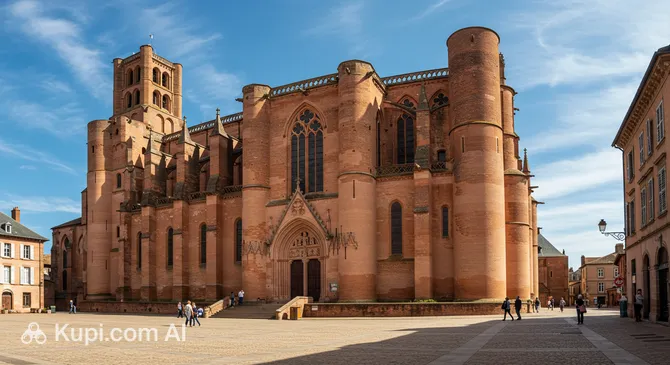
Albi Cathedral. Illustration.
Source: Kupi.com AI

Traveler photos:

In 2010, Albi Cathedral, along with the surrounding Episcopal City, was added to the UNESCO World Heritage list, confirming its exceptional cultural and historical value.

Contacts

To plan your visit to Albi Cathedral, check current opening hours, ticket prices, or event schedules, it is recommended to consult the official tourist sources for the city of Albi. Since direct contact details for the cathedral itself are not publicly available, the most reliable way to obtain accurate information is to contact the tourist information center upon arrival in the city or look for details on-site.

How to contactContact
Address5 Bd Général Sibille, 81000 Albi, France
Phone number+33 5 63 38 47 40
Websitewww.albi-tourisme.fr

What to Do

A visit to Albi Cathedral offers a unique opportunity to immerse yourself in the world of medieval art and spirituality. Behind the austere fortress-like facade lies an interior of breathtaking splendor. The first things to catch the eye are the grand 15th-16th century frescoes that cover almost every surface of the walls and vaults. The painted ceiling is particularly impressive, executed in rich blue and gold tones with scenes from the Old and New Testaments. The total area of the paintings is approximately 18,500 square meters, making this ensemble the largest in France.

The monumental fresco of the "Last Judgment", located on the west wall under the famous organ, deserves special attention. It is one of the largest and oldest depictions of this subject in the world, striking in its detail and scale. Travelers can examine the numerous sculptures, the carved stone choir screens in the Flamboyant Gothic style, ancient stained glass windows, and the decoration of the side chapels. An essential part of the visit is seeing the monumental 18th-century organ by Christophe Moucherel, recognized as one of the best in France for both its decoration and its sound.

Albi Cathedral is not just a static monument of architecture, but a living cultural center. Organ concerts are frequently organized for visitors, allowing them to fully appreciate the acoustics and power of the historic instrument. Additionally, the cathedral hosts temporary exhibitions and themed tours that help provide a deeper understanding of its history and artistic significance. This makes every visit rich and educational.

Getting There

Saint Cecilia Cathedral is located in the heart of the historic center of Albi, making it easily accessible for travelers. The most convenient way to reach the city is from Toulouse, a major transport hub in the south of France. A train or bus ride from there takes about one hour, making Albi an excellent destination for a day trip.

Upon arrival at Albi Ville railway station, the cathedral can be reached on foot in 15–20 minutes. A stroll through the picturesque streets of the old town is an experience in itself and allows you to immediately immerse yourself in its unique atmosphere. For those who prefer public transport or want to save time, there are buses running through the city, with stops located near the cathedral. Of course, you can always use a taxi.

If you are traveling by car, there are public parking lots near the historic center where you can conveniently leave your vehicle. The city is perfectly suited for walking, and the banks of the Tarn River offer the best views of the majestic cathedral, so the walk there will become an integral part of your introduction to this amazing place.

Nearest city: Albi

History & Facts

The history of Albi Cathedral is inextricably linked to the dramatic events of the 13th century, namely the Albigensian Crusade. Its construction, which began in 1282, was initiated by Bishop Bernard de Castanet, who also served as the Vice-Inquisitor of Languedoc. The main goal of erecting such a monumental structure was to assert the power and inviolability of the Catholic faith after the suppression of the Cathar heresy. This is why the cathedral resembles an impregnable fortress more than a temple: it was intended to serve as a symbol of the church's victory and a reliable defense against potential attacks.

The construction process took nearly two centuries and was only completed by the end of the 15th century—around 1480 or 1512, according to different sources. The architectural design is striking in its solidity: the thick brick walls reach 4.5 meters in places, and the structure includes defensive elements such as machicolations (overhanging battlements) and narrow, slit-like windows. This austere and formidable exterior intentionally contrasts with the luxurious interior, carrying deep symbolism: the rugged "fortress of faith" on the outside hides a spiritual and artistic treasure within.

Over time, the cathedral's importance only grew. In 1947, Pope Pius XII granted it the honorary status of a minor basilica, highlighting its special role in the Catholic world. Historically, Albi Cathedral became not just a religious center, but a true architectural manifesto. It demonstrated the power and authority of the bishops, who at that time answered directly to the Pope rather than to secular rulers. Thus, every brick in its walls is part of a story about the assertion of power and the triumph of faith.

Time Needed

When planning a visit to Albi Cathedral, you should allow for 1.5 to 2 hours. This will be enough for a full and unhurried tour of the cathedral's main treasures. You will have time to appreciate the grand scale of the world's largest brick church, examine the famous Renaissance frescoes in detail—including the country's largest depiction of the "Last Judgment"—admire the carved stone decoration of the choir, and enjoy the sight of the monumental organ.

If you want to delve deeper into the atmosphere of this unique place, your visit might take longer. For example, if your visit coincides with an organ concert or if you decide to join a themed tour, feel free to set aside up to 3 hours. Art and history enthusiasts will undoubtedly want to spend even more time here, studying the intricate carvings and paintings for which this masterpiece of Southern Gothic is so famous.

Working Hours

Albi Cathedral is generally open to visitors year-round. Typical visiting hours are Monday to Saturday from 10:00 AM to 6:00 PM and Sunday from 12:00 PM to 5:30 PM. However, remember that it is an active place of worship, so the schedule may change depending on the season and may be interrupted for church services and events. Entry to the main part of the cathedral (the nave) is usually free.

To get the most accurate and up-to-date information, it is highly recommended to check the cathedral's official website or contact the Albi tourist office before your visit. Please note that a ticket is required for access to certain parts of the cathedral, such as the magnificent choir and the treasury. Advance booking for individual visits is generally not required, but it may be necessary for special tours or organ concerts.

DayOpening hours
Monday10:00 – 18:00
Tuesday10:00 – 18:00
Wednesday10:00 – 18:00
Thursday10:00 – 18:00
Friday10:00 – 18:00
Saturday10:00 – 18:00
Sunday1:00 – 17:30

Nearby

Visiting Saint Cecilia Cathedral is undoubtedly a key moment in getting to know Albi. However, to fully experience the atmosphere of this unique city in the south of France, it is worth spending some time in its surroundings. The cathedral is the heart of the Episcopal City—an entire district listed as a UNESCO World Heritage site, where every corner holds its own history.

Thanks to the compact nature of Albi's historic center, most iconic sites are within walking distance of the cathedral. This makes it easy to combine a tour of the grand brick temple with visits to museums, palaces, and picturesque bridges. A leisurely stroll through the ancient streets will allow you to discover many interesting details and enjoy the unique character of this place.

NameDistance
Palace of the Berbie0.1 km
Au Hibou0.1 km
Toulouse-Lautrec Museum0.1 km
La Forge du Vieil Alby0.1 km
Old Bridge0.3 km
National Garden of Albi0.5 km
Hôtel les Pasteliers0.8 km

Have you reached the end of the page?

So the route has been studied inside and out