Support

Count's Castle

About

The Count's Castle (Château Comtal) is the heart of the famous medieval fortress of Carcassonne, located in the city of Carcassonne in southern France. This majestic fortification, built in the 12th century by Viscount Bernard Aton IV Trencavel, is a striking example of medieval military architecture and a key point of attraction for everyone interested in history and the era of knights.
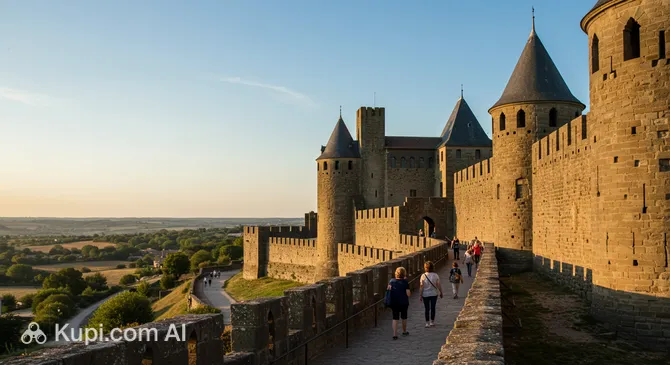
Count's Castle. Illustration.
Source: Kupi.com AI

Traveler photos:

The Count's Castle occupies a central position inside the Carcassonne citadel and is surrounded by a double ring of powerful fortress walls, which in the Middle Ages made it a practically impregnable stronghold. A walk along its walls and towers allows you to immerse yourself in the atmosphere of the past and imagine the life of the defenders of this legendary fortress. Inside the castle, you can see an archaeological museum with a collection of artifacts found during restoration work.

The Carcassonne fortress itself, of which the Count's Castle is an integral part, is considered one of the best-preserved and most impressive medieval fortified cities in Europe. Situated on a hill rising 150 meters above the surrounding landscape, it provided its inhabitants with a strategic advantage and control over all approaches to the city. The entire complex, including the castle and its fortifications, is recognized as a historical monument of France and is under state protection, attracting thousands of tourists from all over the world every year.

Contacts

To find out current opening hours, ticket prices, and information about tours at the Count's Castle, we recommend visiting the official website of the Carcassonne fortress or the tourist information centers in the city of Carcassonne. There, you can obtain the latest data to plan your visit to this outstanding historical site.

How to contactContact
Address11000 Carcassonne, France
Phone number+33 4 68 11 70 70
Websitecarcassonne.monuments-nationaux.fr

What to Do

A visit to the Count's Castle is a true journey through time. You can immerse yourself in the medieval atmosphere by exploring its well-preserved towers, powerful walls, and inner chambers. One of the most exciting activities is a walk along the famous double fortress walls. Truly magnificent panoramic views of the surrounding landscapes and the so-called New Town, or Bastide, sprawling at the foot of the fortress, open up from here.

Inside the fortress walls, much of interest awaits you. Be sure to check out the "lices" (lists) — the special area between the walls where knightly tournaments likely took place in the past — and imagine the shine of armor and the sound of hooves. Take your time to inspect the numerous towers; each is unique, holds its own history, and features distinct architectural details. It is important to remember that the main historical part, where the castle is located, is known as the Cité, and it is of the greatest interest to researchers of medieval fortification and history buffs.

Getting There

The Count's Castle is located in the very heart of the famous medieval fortress of Carcassonne, known as the Cité Médiévale. Reaching this historic part of the city, situated on a hill on the right bank of the Aude River, is quite simple, as it is the main tourist magnet of Carcassonne and all of France.

If you are staying or located in the "new town" of Carcassonne, which is called the Bastide Saint-Louis and is situated at the foot of the hill, the most picturesque way to reach the Cité is a walk. It will take about 20–30 minutes, depending on your pace, and will allow you to cross the Old Bridge (Pont Vieux) over the Aude River, which offers magnificent views of the fortress walls. Small city shuttle buses (navettes) also run between the Bastide and the Cité, with routes usually indicating the direction to "Cité Médiévale".

For those who prefer more comfort, are traveling with small children, or have limited time, a taxi is a good option. The trip from the Carcassonne central railway station (Gare de Carcassonne) to the main entrance of the Cité, the Narbonne Gate (Porte Narbonnaise), will take about 5–10 minutes. If you are arriving by car, please note that entry and parking inside the medieval fortress itself are strictly restricted for private transport. There are several paid parking lots around the Cité, from where you will need to walk a few minutes to the fortress entrance and, accordingly, to the Count's Castle.

Once inside the majestic walls of the Cité, finding the Count's Castle (Château Comtal) is easy. It is the dominant structure inside the fortress, and numerous signs in French and English will help you find your way. Walking through the narrow, cobbled streets of the Cité, past souvenir shops and cozy cafes, is an exciting adventure in itself on the way to the main historical gem of Carcassonne.

Nearest city: Carcassonne

History & Facts

The history of the Count's Castle and the entire Carcassonne fortress is rooted in deep antiquity, spanning about 2,800 years. The first traces of human presence on this strategically important hill date back to around 800 BC, when a primitive settlement emerged here. Much later, in 70 AD, this place turned into a prestigious Gallo-Roman city, and it was the Romans who laid the foundation for the future impregnable citadel by erecting the first fortifications, the remains of which can still be traced today.

In the 5th century, in 419, Carcassonne became part of the Visigothic Kingdom. The new owners did not destroy what had been created before them; instead, they strengthened and updated the existing towers and walls using Roman foundations. In the 8th century, in 725, the fortress briefly passed under Arab control, but as early as 759, it was reconquered by the Franks and became part of the Carolingian Kingdom. By the 9th century, the city reached the status of a county capital in the powerful Carolingian Empire, emphasizing its growing importance.

In the second half of the 11th century, the fate of Carcassonne became closely intertwined with the powerful Trencavel family, who owned the city for several generations. It was during this period, at the beginning of the 12th century, that Viscount Bernard Aton IV Trencavel undertook large-scale construction, resulting in the appearance of the Count's Castle (Château Comtal) itself, which became the heart of the citadel. He also completed the construction of a powerful fortress wall, turning the city into one of the most protected fortresses of its time.

However, peaceful development was interrupted by tragic events. In 1209, during the crusade against the Albigensians (Cathars) who were supported by the Trencavels, Carcassonne was forced to surrender to the forces of Simon de Montfort. An attempt by Raimond Trencavel to win back his possessions in 1240 failed. As punishment for supporting their lord, the residents who inhabited the upper city (Cité) were evicted and founded a new settlement at the foot of the hill — the future Bastide Saint-Louis, or "lower city". After these dramatic events, the Count's Castle and the entire Carcassonne fortress finally entered the royal domain of France, beginning a new chapter in its centuries-old history.

Time Needed

To fully explore the Count's Castle in Carcassonne, a typical visitor should allocate approximately 1.5–2.5 hours. This time is usually enough to leisurely see the main parts of this impressive medieval structure, including the courtyards, accessible towers, and to walk along the section of the fortress walls belonging directly to the castle.

The duration of your visit may vary depending on several factors. If you plan to study all the exhibits of the small museum located on the castle grounds in detail, or use an audio guide for a deeper immersion into history, then the time may increase slightly. It is also worth considering possible queues at the entrance, especially during the peak tourist season, and your desire to simply enjoy the atmosphere and views without rushing.

It is important to remember that the Count's Castle is a key part, but only one part, of the vast medieval fortress of the Carcassonne Cité. If you want to explore the entire territory of the Cité, including a walk along the outer walls (some of which are accessible separately from the castle), a visit to the Basilica of Saints Nazarius and Celsus, as well as simply wandering through the ancient streets, it may take half a day or even more. However, for the Count's Castle itself, the indicated time will be quite sufficient for a substantial visit.

Working Hours

The Count's Castle in Carcassonne is generally open to visitors year-round, but operating hours may vary depending on the season. Typically, during the summer period (approximately from April to September), the castle stays open longer, while in winter (from October to March), visiting hours may be reduced. For example, in summer, the castle might be open from 9:30 or 10:00 AM until 6:00 or 6:30 PM, whereas in winter, it might close earlier, around 5:00 PM.

Since the exact schedule can change, and there are days when the castle may be closed (e.g., January 1, May 1, November 1 and 11, December 25), it is highly recommended to check current opening hours on the official website of the monument (usually the National Monuments of France website) or verify the information at the Carcassonne tourist office before your visit. During the peak tourist season and on weekends, it is recommended to purchase tickets online in advance to avoid queues.

10:00 – 18:30

Nearby

Visiting such an iconic site as the Count's Castle is undoubtedly the central event of a visit to Carcassonne. However, to truly soak up the spirit of this medieval city and enrich your experience, it is worth taking the time to explore its surroundings. Often it is the small details, hidden streets, or neighboring attractions that help complete the picture and make the trip unforgettable.

Fortunately, the medieval walled city of the Cité, where the Count's Castle is located, is a treasure trove of historical monuments in its own right, and many of them are in the immediate vicinity. This makes it easy to combine a tour of the castle with a walk to other interesting sites without spending much time on travel. Below is a list of some nearby attractions, indicating the approximate distance from the Count's Castle.

NameDistance
City of Carcassonne0.1 km
Castle and Ramparts of the City of Carcassonne0.1 km
Porte d’Aude0.1 km
La Demeure du Cassoulet0.1 km
Narbonne Gate0.2 km
Basilica of Saints Nazarius and Celsus0.2 km
Ramparts of Carcassonne0.3 km

Have you reached the end of the page?

So the route has been studied inside and out