Support

City of Carcassonne

About

The city of Carcassonne is not just a city, but a piece of living history frozen in stone. Located in southern France, in the picturesque Occitanie region, it is one of the most impressive and well-preserved examples of medieval fortress architecture in Europe. This is a place where every stone breathes legends, and narrow streets invite you to immerse yourself in the atmosphere of the age of chivalry.
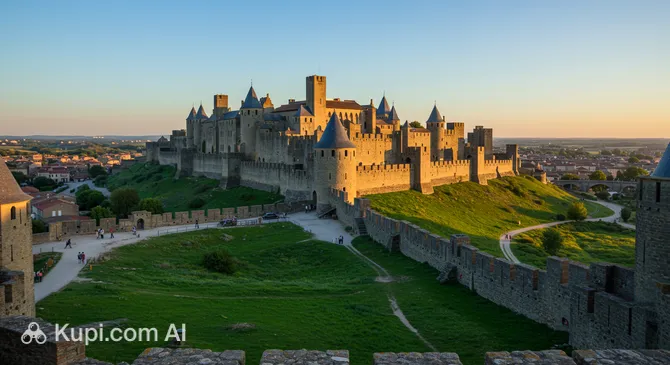
City of Carcassonne. Illustration.
Source: Kupi.com AI

Traveler photos:

The main gem is, without a doubt, the Cité de Carcassonne, surrounded by a double ring of massive walls with a total length of about 3 kilometers. Fifty-two towers rise proudly over the surroundings, creating a unique silhouette recognizable worldwide. This exceptional preservation and historical significance earned Carcassonne a place on the UNESCO World Heritage list in 1997.

A walk through the Cité is a true adventure. Inside the fortress walls, you will find not only ancient houses but also the majestic Count's Castle (Château Comtal) and the elegant Basilica of Saints Nazarius and Celsus. Cobbled streets lead to cozy craft workshops, souvenir shops, and cafes where you can relax and enjoy the views. Despite its museum status, the fortress remains alive—people reside here permanently, which adds a special charm to the place.

Contacts

Since the medieval fortified city of Carcassonne is an extensive historical district, it does not have a single information center. To obtain the most accurate and up-to-date information, such as the opening hours of the Count's Castle (Château Comtal) and other museums, as well as to book guided tours, it is recommended to visit the official website of the Carcassonne Tourist Office. On this resource, you will also find useful information on the best ways to reach the fortress and where to park.

How to contactContact
Address1 Rue Viollet le Duc, 11000 Carcassonne, France
Phone number+33 4 68 11 70 70
Websitewww.remparts-carcassonne.fr

What to Do

A visit to the fortress of Carcassonne is an immersion into a medieval fairy tale where everyone will find something to their liking. The main activity here is a leisurely walk along the massive fortress walls and towers, offering breathtaking views of the lower town and the picturesque surroundings. Explore the labyrinth of ancient streets and cozy courtyards of the Cité to fully experience the atmosphere of the past and feel like a character in a knight's romance.

Be sure to visit the Count's Castle (Château Comtal), located in the very heart of the fortress. Fascinating exhibitions telling the story of this unique place await you here, and its inner galleries offer magnificent panoramic views. Equally noteworthy is the Basilica of Saints Nazarius and Celsus—a gem of Gothic architecture, famous for its stunning stained glass windows and majestic organ music.

Many events are organized for tourists in Carcassonne: from guided tours and theatrical performances to craft workshops and spectacular knight tournaments, which are especially popular during the summer season. To make your experience complete, it's worth visiting one of the many restaurants and trying the famous cassoulet—a hearty bean and meat stew that is the signature dish of the local cuisine. You can complement your meal with a glass of excellent wine from the Languedoc region.

Getting There

Getting to the famous fortress of Carcassonne, located in the south of France, is quite simple thanks to a well-developed transport network. If you are traveling by car, the most convenient route is via the A61 motorway (La Languedocienne). For those who prefer more scenic roads, a journey through the vast landscapes of the Languedoc region will provide plenty of impressions. At the foot of the fortress, convenient parking lots are provided for tourists, from which you can reach the gates of the medieval city on foot in a few minutes.

Travelers who prefer public transport can use the trains of the national railway company SNCF. Carcassonne station is located in the "new town," at some distance from the historical part. From there, the fortress can be reached in several ways: by taking a pleasant walk that takes about 20–30 minutes, or by taking a local bus or taxi to reach your destination quickly.

In addition, Carcassonne has its own small airport, which accepts flights from several major cities in France and Europe. This makes the city even more accessible for international tourists. From the airport to the medieval fortress, you can also easily get there by taxi or a special shuttle bus.

Nearest city: Carcassonne

History & Facts

The history of the city of Carcassonne is rooted in deep antiquity—the first fortified settlements on this strategically important hill existed as far back as the Neolithic era and the Gallo-Roman period. However, the fortress began to acquire its legendary appearance in the Middle Ages. It was then that two powerful rings of walls were erected: the inner one, built by the Visigoths in the 5th century on the foundations of Roman fortifications, and the outer one, added in the 13th century under the French kings. These walls, featuring 52 towers, made Carcassonne one of the most impregnable citadels of its time.

During the Middle Ages, the city played a key role in defending the southern borders of France, especially after the Albigensian Crusades, when it became an important royal bastion on the border with Aragon. There is a beautiful legend about the origin of the city's name. During a siege by the troops of Charlemagne, when the defenders of the fortress had fallen, the wife of the Saracen ruler, Dame Carcas, resorted to a trick. She fed the last remaining pig the last sack of grain and threw it over the wall, showing the enemy that the city was full of food. The siege was lifted, and Dame Carcas joyfully rang the bells ("Carcas sonne"—"Carcas rings").

By the 19th century, the fortress had fallen into disrepair and was threatened with total demolition. Its rescue became a matter of honor for the outstanding restoration architect Eugène Viollet-le-Duc. Under his leadership, large-scale restoration work began in 1853, returning Carcassonne to its majestic medieval appearance. Although some of the architect's decisions, such as the conical roofs of the towers—more characteristic of northern France—caused controversy, it was his work that allowed this unique monument to be preserved for posterity.

Due to its exceptional preservation and historical value, the entire Cité fortress was included in the UNESCO World Heritage list in 1997. This recognition confirmed Carcassonne's global status as an outstanding example of medieval military architecture, which today attracts millions of tourists from all over the world who wish to experience living history.

Time Needed

To fully get to know the city of Carcassonne, it is worth setting aside anywhere from half a day to a full day. This will be enough time to enjoy its unique atmosphere without rushing. The specific duration of your visit depends on your pace and interests, but even in a few hours, you can manage to see the essentials. For example, standard walking tours of the fortress usually last about an hour and a half to two hours.

In half a day, you can take a walk along the ramparts, visit the main attractions such as the Count's Castle and the Basilica of Saints Nazarius and Celsus, and take some memorable photos. If you have a full day at your disposal, you can dive deeper into the history of the place. This will allow you not only to see the key sites but also to peek into the craft shops, enjoy a leisurely lunch in one of the cozy restaurants, and buy souvenirs to remember your trip to this corner of France.

Working Hours

Access to the territory of the medieval city of Carcassonne is open year-round and at any time of day, allowing tourists to freely wander its ancient streets. However, specific opening hours are set for visiting the main attractions—the Count's Castle (Château Comtal) and the fortress walls. Generally, they are open daily: during the high season from April to September, from 10:00 to 18:30, and in the low season from October to March, from 9:30 to 17:00. It is highly recommended to check the current schedule on the official website before your trip, as it may change, and access may be closed on certain holidays, such as January 1, May 1, and December 25.

A ticket is required to enter the castle and the walls. To avoid long lines, especially during the peak tourist season, it is recommended to book tickets online in advance. This will save you time and guarantee entry. Keep in mind that the last entry is usually allowed 45-60 minutes before closing, so plan your visit with enough time to enjoy all the beauty of this historical site.

10:00 – 18:30

Nearby

Visiting the famous fortress is undoubtedly the main highlight of any trip to Carcassonne, but you shouldn't stop there. Exploring the immediate surroundings and other iconic sites inside and around the walls can significantly enrich your experience. Every street, tower, and square in this amazing corner of France holds its own secrets and stories, completing the overall picture of the medieval city.

In the immediate vicinity of the main tourist routes, there are many interesting sites literally just a few steps away. They allow you to dive deeper into the atmosphere of the past and see Carcassonne from different angles. Below is a list of some attractions that are easily accessible on foot.

NameDistance
Count's Castle0.1 km
Castle and Ramparts of the City of Carcassonne0.1 km
Narbonne Gate0.1 km
Porte d’Aude0.1 km
Basilica of Saints Nazarius and Celsus0.1 km
Ramparts of Carcassonne0.2 km
Hôtel du Château Night Club0.2 km

Have you reached the end of the page?

So the route has been studied inside and out