Support

Duisburg

About

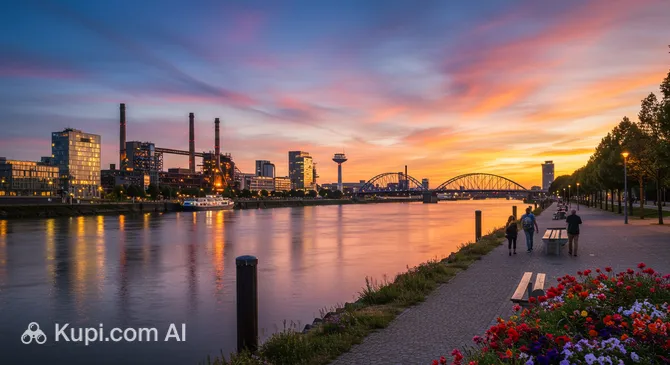
Duisburg is a surprising city located at the confluence of two great rivers: the Rhine and the Ruhr. This unique geographical position has turned it into a major transport hub in western Germany. Today, it is not just the industrial center of North Rhine-Westphalia, but a city where industrial power harmoniously intertwines with picturesque parks, creating a unique landscape.

Duisburg. Illustration.
Source: Kupi.com AI

With a population of around half a million people, Duisburg is one of the largest and most vibrant cities in the region. Its status as the owner of the largest river port in Europe gives it a special dynamic. Despite its industrial past, the city is rightfully considered the "green heart" of the Ruhr area: here traditions coexist with modernity, and the multicultural atmosphere makes the streets lively and welcoming.

The city's atmosphere is built on contrasts. Walking here, you can see how futuristic art objects sit alongside historic buildings, and former factory halls are transformed into trendy creative spaces. The fascinating history of Duisburg, inextricably linked with metallurgy, today appears to tourists in a new light: industrial monuments have become part of landscape parks where it is pleasant to spend time with the whole family.

Duisburg is worth visiting to see how the city knows how to change while maintaining its unique charm. Cozy waterfront cafes in the Inner Harbor, walks along the canals, and an amazing combination of nature and technology will give you an unforgettable travel experience.

Weather Overview

The climate in Duisburg is temperate and mild, making the city accessible for visits almost all year round. Summer here is pleasant, without exhausting heat: in the warmest months, July and August, daytime temperatures usually rise to a comfortable 23–24°C. This is the best time for outdoor sightseeing and walks along the Rhine.

Winters in the region are cool but not severe. In January and December, the thermometer rarely drops significantly below zero, staying in the range of 2°C to 6°C. Expect a warm summer with occasional rain and cool winters with high humidity. Precipitation is distributed fairly evenly across the seasons: even in the driest month, June, there are about 11 rainy days, and in winter, their number increases to 17–18.

Spring comes gradually: while it is still cool in March (about 7°C), by May the air warms up to 18°C. To make your trip as comfortable as possible, we recommend studying the detailed weather in Duisburg in advance and bringing an umbrella, regardless of the chosen season.

Average monthly temperature

Average monthly precipitation

Interesting Facts

In addition to its main attractions, Duisburg holds many fascinating secrets and unexpected records. Here are a few facts that reveal the unique character of this German city:
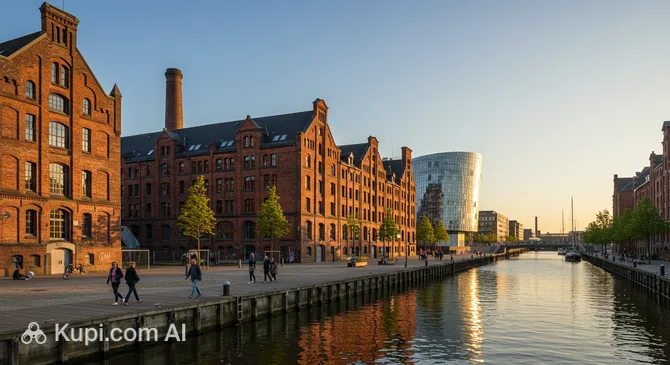
Duisburg Inner Harbour. Illustration.
Source: Kupi.com AI

Traveler photos:

  • More bridges than Venice: Duisburg boasts an impressive record—there are more than 650 bridges within the city limits. This number exceeds those of the famous Venice, which is explained by an incredibly complex and branched network of rivers, canals, and railway tracks.

  • A pedestrian "roller coaster": Here you can find a unique art object called "Tiger and Turtle – Magic Mountain." This sculpture looks like a real amusement ride with loop-the-loops but is designed for walking. Once you climb it, you can admire a breathtaking panorama of the city and its industrial landscapes.

  • The birthplace of modern cartography: The city is closely linked with the name of Gerardus Mercator, the great 16th-century cartographer who gave the world the map projection of the Earth we are used to today. A memorial in his honor is installed in Duisburg, and the local university bears the scientist's name.

  • Second life for factories: The industrial past here is harmoniously integrated into modernity. A former steel plant has been transformed into the Landschaftspark Duisburg-Nord, where gardens are laid out among old workshops, and a real diving pool is equipped in a massive gasometer.

How to Get There

Duisburg has excellent transport accessibility thanks to its location in the densely populated Rhine-Ruhr region. Many route options are available to travelers, whether by plane or train. You can learn more about how to get to Duisburg by studying all available methods and choosing the most comfortable one for you.

There is no airport in the city of Duisburg itself, but you can fly into Düsseldorf International Airport (DUS) in the city of Düsseldorf, which is just 17 km from Duisburg. This is the nearest and most convenient air hub. A taxi or commuter train trip from here will take very little time—about 20–30 minutes. The airport handles a vast number of flights and is considered one of the key hubs in Germany.

An alternative option is Cologne/Bonn Airport (CGN), located in the city of Cologne, about 67 km from the destination. This is also a major international hub receiving many flights. The journey to Duisburg by car or public transport will take about an hour. Also, for budget travelers, Weeze Airport (NRN) may be of interest, as it is often used by low-cost airlines; it is located 47 km from the city.

For clarity, here is a summary of the main airports:

AirportPassenger trafficDistance
Dusseldorf International Airport20 mln17 km
Weeze Airport2.0 mln47 km
Dortmund Airport3.1 mln60 km
Cologne Bonn Airport10 mln67 km
Maastricht Aachen Airport230 93291 km

Railway connections in the region are excellent. If you haven't found a direct train to Duisburg Central Station, you can use major hub stations nearby. For example, Düsseldorf Hauptbahnhof in the city of Düsseldorf is 24 km from Duisburg. This is one of the busiest stations with a huge passenger flow, from which regional trains run regularly.

Another important transport hub is Essen Hauptbahnhof in the city of Essen, located at a distance of about 18 km. Arriving at this station, you can easily reach Duisburg by taxi or local commuter train in less than half an hour.

Below is information on the nearest major railway stations:

StationPassenger trafficDistance
Essen Hauptbahnhof55.5 mln18 km
Krefeld Station18 km
Düsseldorf Hauptbahnhof91.3 mln24 km
Dormagen Railway Station2.2 mln38 km
Venlo Station2.8 mln42 km

Main Attractions

Duisburg offers travelers a non-trivial set of experiences, where industrial heritage is transformed into works of art, and nature areas neighbor modern architecture. To truly get to know this city, it is worth visiting its iconic locations that reflect its history and present day.

One of the most popular places for family recreation is Duisburg Zoo. It is known far beyond the region thanks to its dolphinarium and unique koala breeding program. A walk here is an opportunity to see rare animals in conditions as close as possible to their natural ones. The zoo is located in a wooded area, making it a great place for long and comfortable walks in the fresh air at any time of year.

Special attention should be paid to the Duisburg Inner Harbor. Once an industrial port, it has turned into a trendy district with restaurants, offices, and cultural sites. This is an ideal place for an evening promenade, dinner by the water, and getting to know the modern city life that has emerged from the ruins of the industrial era.

Right here in the harbor, connoisseurs of contemporary art should visit the Küppersmühle Museum (MKM). This building is a vivid example of how industrial architecture gains a new life: a former grain silo was rebuilt into a world-class exhibition space. The museum houses an impressive collection of post-war German art, and the structure itself, with its massive brick walls, serves as a magnificent backdrop for photographs.

Given the city's status as the largest river port in Europe, it is impossible to ignore the German Inland Waterways Museum. The exhibition tells the history of navigation from the Stone Age to the present day. The location of the museum itself is curious: it is housed in a former swimming pool building in Art Nouveau style, which gives the excursion a special atmosphere.

For those who want to take a break from the city bustle, Rhinepark is the perfect spot. This is a spacious green zone created on the site of former industrial territories, with direct access to the river. The park is great for picnics, cycling, and watching ships passing along the Rhine, allowing you to feel the rhythm of the great river.

Local Cuisine

Duisburg's cuisine is a direct reflection of its industrial history and cultural diversity. Hearty and honest dishes typical of the Ruhr region prevail here. Travelers should definitely try local meat delicacies, stewed cabbage, and potatoes in a wide variety of ways. However, the real symbol of local gastronomy is Currywurst—a fried sausage under a spicy curry sauce. This dish is so popular that it is served everywhere: from street stalls to cozy restaurants.

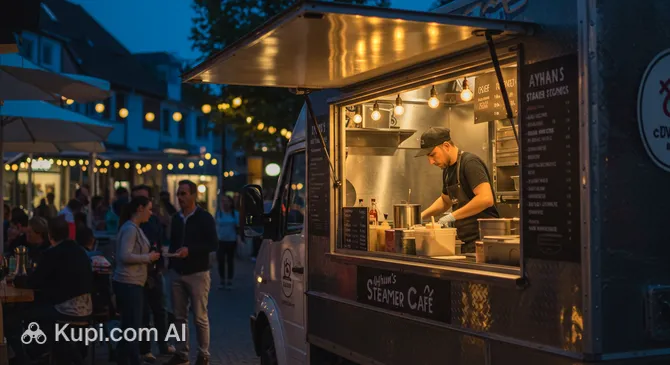
Thanks to its location at the confluence of the Rhine and Ruhr, as well as the presence of a massive river port, the city has a special relationship with fish dishes. On the menus of local establishments, you can often find fried pike-perch, smoked eel, or rich fish soups prepared according to old recipes. For those looking for an unusual atmosphere by the water, an interesting place could be Ayhan's Cafe Steamboat, where a meal is accompanied by river views.

Ayhan's Steamer Café. Illustration.
Source: Kupi.com AI

Traveler photos:

For those with a sweet tooth, Duisburg offers traditional German pies, strudels, and aromatic pastries with nuts and poppy seeds, which can often be found at farmers' markets. As for drinks, the city sacredly honors German beer traditions. In numerous pubs (Kneipe) and bars, there is always fresh craft or classic beer, which locals prefer to drink in the company of friends after a workday.

The food culture here is very democratic. Tourists and residents alike enjoy visiting gastronomic festivals such as the annual "Duisburger Stadtfest," where you can try culinary experiments from the best chefs. For a quick and filling snack, the street food format is excellent, for example, the popular House of Doner Duisburg Center, reflecting the modern multicultural rhythm of the city.

Travel Tips

Duisburg is a city of industrial contrasts, and to feel confident here, it is worth knowing about some local characteristics in advance. These practical tips will help you plan a comfortable trip to this unusual corner of Germany and avoid common mistakes.

  1. Clothing and weather. The climate here is changeable, so the best principle in clothing is layering. Even in summer, a light windbreaker or raincoat won't hurt, as rains can start suddenly. Be sure to bring comfortable, broken-in shoes: you will have to walk a lot, especially if you plan to explore the massive Landscape Park or climb the "Tiger and Turtle" sculpture. Sockets here are of the standard European type (Type F), so if your devices have other plugs, bring an adapter.
  2. Transport. The public transport system in Duisburg (DVG) and the Rhine-Ruhr region (VRR) is excellently developed. Renting a car for moving within the city makes little sense due to traffic jams and parking difficulties. It is more convenient to use trams, buses, and the suburban train (S-Bahn). Tickets are valid for all transport; they can be bought at machines or via the VRR App. Don't forget to stamp paper tickets before your trip, as fines for fare evasion are very high.
  3. Finances and payment. The currency is the Euro (EUR). Despite the city's modernity, Germany remains a country where cash is still held in high regard. In large supermarkets, cards are accepted without problems, but in small bakeries, street food stalls, or souvenir shops, "cash" may be required. ATMs (Geldautomat) are available everywhere. Tips in restaurants are not automatically included in the bill; it is customary to round up the amount or leave about 5–10% for good service.
  4. Health and safety. Duisburg is a safe city, however, as in any large transport hub, you should be more careful with your belongings in the area of the central station (Hauptbahnhof), especially in the dark. Pharmacies are marked with a red letter "A" (Apotheke). They work according to regular store hours, but in each district, there is always one 24-hour on-duty pharmacy (information about shifts is posted on the doors).
  5. Communication. The official language is German. The level of English among young people and tourism workers is high, but learning a couple of phrases, like "Guten Tag" (Good day) or "Danke" (Thank you), will be a sign of respect for the locals. For internet access, it's convenient to use free Wi-Fi in the city center or buy a prepaid SIM card at any supermarket (passport required for registration). Download the DB Navigator app—it is indispensable for planning train trips.
  6. Local etiquette. Germans value punctuality, so it's better to arrive on time for excursions or meetings. On Sunday (Ruhetag), most shops, including grocery supermarkets, are closed—plan your shopping in advance. It is customary to greet those present when entering small shops or an elevator.
  7. What to avoid. The main taboo for a pedestrian is bicycle lanes. They are often highlighted by color or paving on the sidewalk. Never stand or walk on them: cyclists ride fast and can be quite sharp in their expressions if you block their path. Also, do not cross the road on a red light, even if there are no cars—this is considered bad form, especially if children are nearby.
  8. Light show (tip). If you visit Landscape Park Duisburg-Nord, try to stay there until dark. On weekends and holidays (and sometimes on weekdays), a fantastic light installation by British artist Jonathan Park turns on, transforming the old metallurgical plant into a magical object shimmering with lights. This spectacle is completely free.

Duisburg opens up to those who are ready to look behind the facade of industrial architecture. By following these simple tips, you can easily join the rhythm of the city and get the most out of its unique flavor and hospitality.

Entertainment & Nightlife

Duisburg's nightlife is not like the noisy parties of Berlin or Hamburg; it is more calm, atmospheric, and inextricably linked to the city's industrial aesthetic. The epicenter of evening leisure here is the Inner Harbor (Innenhafen). It is here that old grain silos and warehouses have been transformed into a stylish "gastronomic mile" with dozens of bars, restaurants, and cocktail lounges that come alive after sunset.

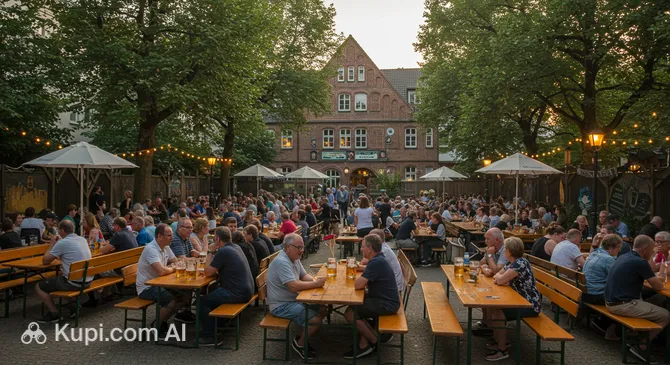
The atmosphere in the harbor's establishments is democratic and relaxed. It is customary to gather here in large groups after work or study. There is no strict dress code in most places; a smart casual style will be appropriate everywhere. If you want to enjoy an evening in the fresh air with a view of the river, Biergarten Mühlenweide Duisburg is an excellent choice. This is a classic beer garden where you can try local beers and soak up authentic German comfort (Gemütlichkeit).

Biergarten Mühlenweide Duisburg. Illustration.
Source: Kupi.com AI

Traveler photos:

For those who prefer a more intimate setting and Eastern notes, it is worth stopping by Restaurant Tabule. This is a popular place for dinner that flows into long gatherings, where you can appreciate a variety of flavors in a modern interior. Besides the harbor, the Dellplatz district is of interest. It is a center of alternative culture with an independent cinema and cozy pubs where live music often plays and creative youth gather.

For fans of active entertainment, Duisburg offers great options for having fun with friends. If dance floors aren't your thing, head to Superfly Duisburg—a huge trampoline park open until late where you can let off some steam. Another option for team leisure is LaserZone Lasertag Duisburg, offering dynamic games in futuristic settings.

The daytime cultural program in the city is also rich. Art lovers should definitely visit the Lehmbruck Museum, known for its outstanding collection of modern sculpture. It is located in a beautiful park, allowing you to combine cultural leisure with a walk.

Practical tips and safety: Duisburg is a fairly quiet city, and walks along the Inner Harbor are safe even late at night. However, as in any large city, it is worth exercising caution around the Central Station (Hauptbahnhof) during dark hours. Public transport operates reliably: night express buses (NachtExpress) run on weekends, covering the main districts. It is better to call a taxi through official apps or by phone; an average trip around the center will cost 10–15 euros.

Parks & Museums

Contrary to stereotypes of an industrial city, Duisburg surprisingly pleases with an abundance of green zones and a rich cultural life. City parks here often intertwine with historical sights, and museums offer not only classical exhibitions but also unique open-air art objects.

For those who want to enjoy the view of the Rhine and feel the power of river navigation, Mühlenweide Park is an ideal spot. It is located in the Ruhrort district, right on the bank, and serves as an excellent observation deck: from here, you can infinitely watch the passing barges and ships. This is a spacious area where city holidays and festivals are often held, while on ordinary days, a peaceful atmosphere prevails, perfect for picnics and walks by the water.

If you are looking for solitude among ancient trees, head to Kaiserberg. This is not just a park, but a real forest on a hill, which is one of the highest points in the city. There are convenient hiking trails, a botanical garden, and old monuments here. These are the "green lungs" of Duisburg, where locals love to spend weekends playing sports or just walking with their families. Also, for a quiet holiday within the city, Meiderich City Park is perfect, offering well-kept alleys and recreation areas.

Duisburg's cultural scene is no less interesting. The jewel of the city is considered to be the Lehmbruck Museum, located in the center in Immanuel Kant Park. It is a world-famous center of sculpture named after the outstanding expressionist Wilhelm Lehmbruck.

The museum is unique in that art here goes beyond the walls: dozens of sculptures are integrated into the surrounding landscape park, creating a harmony of nature and creativity. Inside the building, an impressive collection of works by modernists and contemporary artists is presented, making it a mandatory stop for art connoisseurs.

Another iconic object that can be called an open-air museum is the sculpture Rheinorange. This monumental bright orange steel stela is installed at the confluence of the Rhine and Ruhr rivers. It symbolizes structural changes in the region and serves as a magnificent background for photos, especially at sunset, when the bright color contrasts with the water and sky.

Insider tip: Walking through Immanuel Kant Park around the Lehmbruck Museum, notice how the sculptures change their perception depending on the lighting and the time of year. This is one of the few places in the city where high art is available completely free of charge right during a walk.

Getting Around

Moving around Duisburg is easy and convenient: the city has a developed and intuitive public transport system that is part of the unified Rhine-Ruhr transport association (VRR). The foundation of urban mobility is formed by light rail lines (Stadtbahn or U-Bahn), classic trams, and an extensive network of bus routes. The operator is DVG, so schedules and service standards are uniform throughout the city.

The main artery for many tourists and locals is the U79 light rail line. This is not just a city route, but a convenient connection to neighboring Düsseldorf, allowing you to reach the exhibition center or airport without transfers. Inside Duisburg itself, the 901 and 903 tram lines play a key role, connecting northern and southern districts with the central station. For trips to remote corners or industrial parks, buses running strictly according to schedule are best.

The fare system is based on zones. For trips within the city, you will need a ticket for tariff zone A (Preisstufe A). For tourists, it is most profitable to purchase day passes (24- or 48-StundenTicket), which allow an unlimited number of trips within the selected time. If you only need to travel a couple of stops (up to 3), you can save money by buying a "Kurzstrecke" (short trip) ticket.

Tickets can be purchased from machines at stations (accept cash and cards), at DVG customer service centers, or from bus drivers (but not on trams!). The most modern and convenient way is to use mobile apps such as the VRR App or DB Navigator. An important nuance: paper tickets bought from machines must be validated (stamped) before the start of the trip. Look for orange or red stamp boxes at metro entrances or inside the cabins of ground transport. Fines for traveling without validation are quite significant.

Public transport starts operating early in the morning, around 04:30, and finishes closer to midnight. On Friday and Saturday, night buses (NachtExpress) run, allowing you to get home safely after a party. Intervals during the day are usually 10–15 minutes, increasing to 30 minutes in the evening.

As an alternative to public transport, bicycle rental is popular in Duisburg. The metropolradruhr system allows you to rent a bike through an app and leave it at any official station in the city. Given the flat terrain, this is an excellent way to see the parks and embankments. Classic taxis (usually cream-colored) and car-sharing services are also available, although finding parking in the center can be challenging.

Accommodation

The choice of accommodation in Duisburg is quite wide and usually pleases travelers with more democratic prices compared to neighboring Düsseldorf. The city is oriented towards both business tourists and those traveling through the Ruhr region for cultural purposes. Modern 3-4 star business hotels, chain hotels with predictable service quality, as well as cozy private guest houses (Pensionen) and apartments for family stays predominate here.

When choosing an area to stay, you should be guided by the purpose of your visit. The most convenient option for most tourists is the City Center (Stadtmitte) and the adjacent Dellviertel district. Staying here, you will be within walking distance of the Central Station, which is ideal for trips around the surrounding areas. Moreover, life is buzzing here: the main shopping streets and the popular Forum Duisburg, where you can not only shop but also find many cafes, are nearby.

If you are looking for a more romantic and stylish atmosphere, look at hotels in the Inner Harbor (Innenhafen) area. This is a trendy quarter where former industrial warehouses have been turned into lofts and offices. Staying here will allow you to enjoy water views and dine at the city's best restaurants literally two steps from your room. For those who prefer peace and historical flavor, the Ruhrort district, located at the confluence of the rivers, is suitable, although you will have to take a tram to get to the center from there.

Price range and booking:

  • Budget segment: The city has several quality hostels and inexpensive hotels where a night will cost a reasonable amount. This is an excellent choice for students and backpackers.
  • Middle class: Most offers fall into the "comfort" category with a cost affordable for the average tourist. A hearty German breakfast is usually included in this price.
  • Luxury: There are practically no five-star grand hotels in Duisburg, but the best business hotels offer high levels of service, saunas, and fitness rooms.

It is most convenient to book accommodation through popular international online platforms. Important tip: always check the exhibition calendar in neighboring Düsseldorf (Messe Düsseldorf). During major international fairs, the demand for housing in the entire region rises sharply, and prices in Duisburg can increase 2–3 times. During such periods, you should book a room several months before the trip.

Nearby Cities

For those who want to explore the surrounding area, Duisburg serves as an excellent starting point for day trips to several interesting nearby locations:

CityPopulationDistance
Oberhausen209 5669 km
Moers103 7259 km
Mülheim170 9219 km
Dinslaken67 52515 km
Ratingen87 29716 km

Just a few minutes away by train is Düsseldorf—the capital of the federal state and a center of fashion. It's worth coming here for a stroll along the luxurious Königsallee, visiting art museums, and relaxing in the historic center (Altstadt), which is famous for its lively atmosphere and hundreds of traditional pubs.

Lovers of industrial romance and history should definitely visit Essen. The main point of attraction here is the Zollverein coal mine—a UNESCO World Heritage site called "the most beautiful coal mine in the world." Today, it is a massive cultural complex with museums, design exhibitions, and a park.

Very close to Duisburg is Oberhausen. This city attracts tourists primarily with the Gasometer—a giant former gas storage tank turned into a unique exhibition hall—and one of Europe's largest shopping centers, CentrO, where you can have a great time shopping.

These nearby destinations provide an insight into the diverse culture and landscapes of the region.

Shopping & Souvenirs

Shopping:

Shopping in Duisburg is a pleasant and untiring activity that allows you to combine purchases with walks along wide pedestrian zones. Although the city does not claim to be a fashion capital like neighboring Düsseldorf, it offers an excellent selection of stores: from democratic international brands to cozy shops with local products. Practicality and comfort are valued here, and prices can often be slightly lower than in the region's more tourist-heavy centers.

The heart of the city's commercial life is Königstraße. This spacious pedestrian alley stretches from the central station to the historical part of the city and is known as the "Mile of Fountains" due to its numerous water sculptures. Walking here, you will find major department stores, bookstores, clothing, and shoe boutiques. The street is landscaped and equipped with benches, making shopping here relaxed and pleasant.

For those who prefer shopping in malls, the main point of attraction is Forum Duisburg. This modern complex, located in the very center of the city, impresses with its architecture and the golden staircase at the entrance. Inside, dozens of stores for electronics, fashion, cosmetics, as well as a large food court where you can have a snack after a boutique marathon, are gathered.

In the Rheinhausen district, the Rheinhausen Shopping Center is popular. This is a convenient local mall with a good selection of convenience stores, a supermarket, and services. Also, on Königstraße, it's worth looking into the Königsgalerie shopping gallery, which is famous for its elegant atmosphere and interesting selection of tenants.

The special flavor of Duisburg can be felt at its markets. Traditional farmers' markets (Wochenmarkt) operate in different parts of the city several times a week. The largest of them unfolds in the center on Tuesdays, Thursdays, and Saturdays. Here, locals buy fresh vegetables, fruits, flowers, artisanal cheeses, and meat delicacies. This is the best place to find high-quality products from the Rhine-Ruhr region.

As souvenirs from Duisburg, tourists often bring back products from the famous local brewery König Pilsener—beer glasses or gift sets will make an excellent gift for connoisseurs. Attributes of the football club "Duisburg" (MSV Duisburg), known for its striped jerseys for which the team was nicknamed the "zebras," are also popular. Also pay attention to industrial-themed souvenirs: miner figurines or stylized pieces of coal are reminders of the region's industrial past.

Most shops in the city center are open from Monday to Saturday from 10:00 to 20:00. Large supermarkets may work until 21:00 or 22:00. It is important to remember that Sunday in Germany is a day off, and practically all shops, including grocery stores and shopping centers, are closed. The only exceptions are small shops at the station and gas stations. Cards (Visa, Mastercard) are widely accepted for payment, but in small bakeries, kiosks, or at the market, having cash (euros) is still desirable.

Tourists residing permanently outside the European Union can use the Tax Free system. If you make a purchase over 50 euros in a store marked with a Global Blue sign or similar, ask the seller to issue a special check for a value-added tax refund upon leaving the country.
Reached the end of the page?

That means the route is fully explored