Support

Olympic Park Munich

About

Munich Olympic Park is more than just a landmark; it is an entire world spread across a vast area in Munich. This impressive complex was built for the 1972 Summer Olympic Games and represented a revolutionary architectural solution at the time. Designed by the Günter Behnisch architectural firm, the park transformed a former wasteland into one of the main cultural and sports hubs of Germany, which still impresses today with its futuristic design and harmony with nature.

Today, the Olympic Park is a favorite leisure spot for both locals and tourists. Everyone can find something to enjoy here: from massive sports venues like the Olympic Stadium and the Velodrome to scenic walking areas, ice rinks, and an artificial lake. The park regularly hosts concerts by world stars, festivals, and various public events, making it a center of attraction year-round.

The architectural centerpiece of the complex is the famous 291-meter-high Olympic Tower (Olympiaturm). From its observation deck, you can enjoy breathtaking panoramic views of all of Munich, and on clear days, even spot the majestic Alps. This is where you get the best view of the stadium's unique roof, designed like a giant steel spider web.
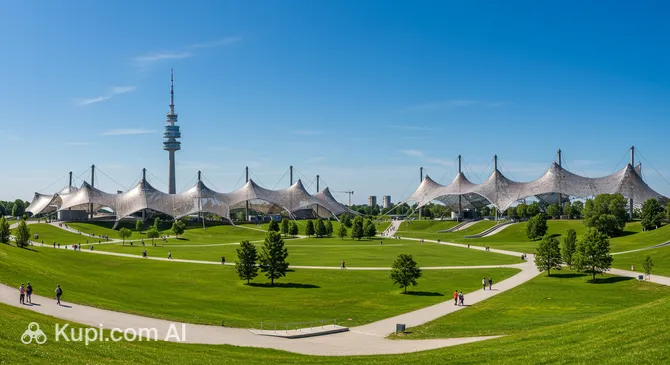
Olympic Park Munich. Illustration.
Source: Kupi.com AI

Traveler photos:

Contacts

For the most up-to-date information on events, opening hours for specific facilities, and ticket prices, it is recommended to visit the official park website. Below are the main contact details for reaching the Olympic Park administration in Munich.

How to contactContact
AddressSpiridon-Louis-Ring 21, 80809 München, Germany
Phone number+49 89 30670
Websitewww.olympiapark.de

What to Do

Munich Olympic Park offers visitors a wealth of experiences and activities for every taste. It is a true center of cultural and sporting life in the city, regularly hosting concerts by international stars, colorful festivals, and various urban events. The park's sports facilities, including the famous Olympic Stadium—which served as the home arena for FC Bayern Munich until 2005—continue to host various competitions and shows today.

Active recreation enthusiasts will find plenty to do here. Scenic paths ideal for walking, jogging, and cycling crisscross the entire area. The park also features a velodrome and ice rinks for skating. For those seeking thrills, extreme tours of the Olympic Stadium’s unique roof are organized, including a rope descent.

One of the main tourist draws is the Olympic Tower (Olympiaturm). By ascending to its observation deck, you can enjoy spectacular panoramic views of Munich and its surroundings. A revolving restaurant is also located here, making dinner an unforgettable way to end the day. In clear weather, the tower offers magnificent views of the Bavarian landscape and even the snow-capped peaks of the Alps.

Getting There

Getting to the Olympic Park in Munich is easy thanks to its excellently developed public transport system. The park is located in the northern part of the city and is highly accessible from any point in Munich. For most tourists, the quickest and most convenient way is the metro (U-Bahn), though the park can also be reached by tram and bus.

The simplest way to get to the park is by metro. You will need the U3 line (towards Moosach), which takes you directly to the Olympiazentrum station. From the metro exit, it is only about a 10-minute walk to the main park landmarks, such as the Olympic Stadium or the tower. The metro ride from the central Marienplatz square takes approximately 12 minutes. You can also reach this station via the U8 line.

In addition to the metro, other routes lead to the Olympic Park. For example, trams No. 20 and No. 21 stop at "Olympiapark West." You can also take tram No. 27 or buses No. 173, No. 177, and No. 178 to the "Petuelring" stop, which is about a 5-minute walk from the park. Bus No. 144 runs along the park with stops at the Olympic Lake ("Olympiasee") and Olympic Hill ("Olympiaberg"). If you prefer more comfort, a taxi ride from the city center takes about 10-15 minutes, depending on traffic.

Nearest city: Munich

History & Facts

The history of the Olympic Park in Munich is a striking example of urban space transformation in Germany. It all began in 1966 when the city won the right to host the Summer Olympic Games, beating competitors such as Montreal and Madrid. An unusual site was chosen for the future complex: the Oberwiesenfeld area, which served as an airfield until 1938. After World War II, the airfield was restored and used until 1968, when massive construction began.

One of the most remarkable facts relates to the park's landscape. Its famous hill, the Olympiaberg, is man-made. After the war, rubble from Munich’s Old Town—destroyed by bombing—was brought here, resulting in the creation of a hill about 56 meters high between 1948 and 1957. Over time, the area became a landfill where local residents cultivated hundreds of small garden plots. Thus, the place that is now a symbol of sports and recreation was literally born from ruins.

Construction work started in 1968, and in just a few years, the abandoned wasteland was transformed into a modern sports city. Interestingly, one of the park’s key structures, the Olympic Tower, was built even before the main project began—its construction started in 1965 and was completed in 1968. During the 1972 Olympics, it played a vital role, serving as a television and radio broadcasting center for the entire world.

Time Needed

When planning a visit to the Olympic Park in Munich, consider how much time you are willing to dedicate to exploring it. For a brief introduction, including a leisurely walk through the picturesque grounds, viewing the famous architectural structures from the outside, and relaxing by the lake, 2-3 hours will be enough. This will allow you to fully feel the atmosphere of this unique place, appreciate its scale, and take beautiful photos.

If you want to dive deeper into the world of the Olympic Park, you should plan for a longer visit. For instance, ascending the Olympic Tower (Olympiaturm) to enjoy panoramic views of the city takes about an hour. A tour of the grand Olympic Stadium lasts roughly 60-90 minutes. For thrill-seekers, stadium roof tours are available and take about two hours. If your plans include visiting the Sea Life aquarium, allow for another 1.5-2 hours.

Therefore, for a complete visit including one or two key attractions, it is best to set aside at least half a day. This will let you enjoy your chosen activities without rushing. If you want to cover several sites—such as the tower, the stadium, and the aquarium—exploring the Olympic Park could take an entire day filled with vivid impressions and discoveries.

Working Hours

The Olympic Park in Munich is a vast complex, and the opening hours of its various facilities may differ. The park grounds themselves are open to the public 24/7, allowing you to walk along its picturesque paths at any time. However, access to main attractions like the Olympic Stadium and Olympic Tower follows a schedule. For example, the stadium is typically open to visitors from 9:00 AM to 4:00 PM but may be closed on event days. The Olympic Tower, which offers panoramic views of the city, was open daily from morning until midnight; however, since June 1, 2024, it has been temporarily closed for renovation until 2027.

As schedules can change, especially due to concerts, sports competitions, or festivals, it is highly recommended to check the latest information on the official Olympic Park website before your visit. This will also help you find out if you need to pre-book tickets for excursions, such as the popular stadium roof tours or the Sea Life aquarium. Planning ahead will help avoid disappointment and ensure you make the most of your time in this iconic Germany landmark.

Open 24 hours

Nearby

Visiting the Olympic Park is just one part of an exciting journey through Munich. To fully experience the atmosphere of this district and all of Germany, it is worth exploring other iconic sites located in the immediate vicinity. Discovering the surroundings will not only enrich your experience but also provide a more complete picture of the city's diverse cultural and entertainment life.

World-famous museums, modern exhibition centers, and other interesting sites are within walking distance of the park. Thanks to its convenient location, you can easily combine a walk through the park with a visit to neighboring attractions without spending much time traveling. Below is a list of places that might interest you.

NameDistance
BMW Welt0.4 km
BMW Museum0.5 km
Garden Arena1 km
Alte Pinakothek3.3 km
Lenbachhaus3.3 km
Odeonsplatz4 km
Nymphenburg Palace4.1 km

Have you reached the end of the page?

So the route has been studied inside and out