Support

Munich Residenz

About

The Munich Residence is not just an attraction, but a city within a city located in the very heart of Munich. This grand palace complex once served as the home and center of power for Bavarian dukes, electors, and kings. Today, it is the largest city palace in all of Germany and one of Europe's most important art museums, inviting guests on a journey through the pages of history.
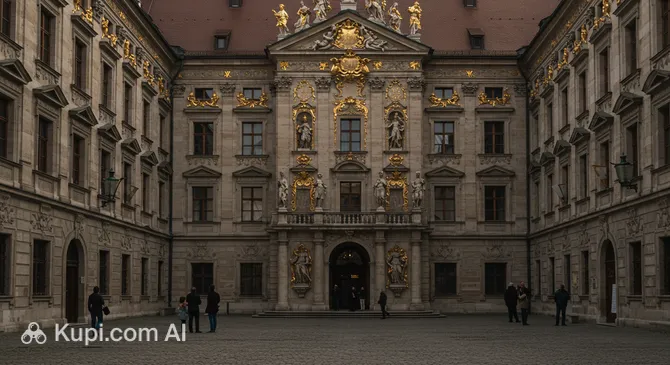
Munich Residenz. Illustration.
Source: Kupi.com AI

Traveler photos:

The construction and expansion of the residence spanned several centuries, from the 16th to the 19th, resulting in a whimsical blend of Renaissance, Baroque, Rococo, and Neoclassical styles in its architecture. The complex consists of many buildings and ten courtyards, divided into three main parts: the Königsbau (King's Tract), the Alte Residenz (Old Residence), and the Festsaalbau (Banqueting Hall Tract) facing the Hofgarten garden. Every ruler left their mark on the palace's appearance, turning it into a treasury of art and architecture.

A visit to the Munich Residence is a unique opportunity to see the luxurious halls where historic decisions were made and to get a glimpse into the daily lives of monarchs. The Residence Museum features about 130 rooms open to the public, including the famous Antiquarium—a magnificent Renaissance hall decorated with frescoes and sculptures. Additionally, it houses the Treasury, which stores royal regalia, jewels, and unique works of goldsmithery from the Wittelsbach dynasty.

Contacts

To plan your visit, check current opening hours, or learn about temporary exhibitions, it is recommended to consult official sources. All necessary information for visitors is usually available on the palace complex website or by contacting the administration.

How to contactContact
AddressResidenzstraße 1, 80333 München, Germany
Phone number+49 89 290671
Websitewww.residenz-muenchen.de

What to Do

A visit to the Munich Residence is an immersion into the world of Bavarian history and art. Most of the visit is self-guided, thanks to a convenient audio guide provided with your ticket purchase. This allows you to explore the complex's two main treasures at your own pace: the Residence Museum and the Treasury. The museum impresses with a suite of over a hundred halls, rooms, and galleries, where every interior tells its own story. The Treasury houses priceless royal regalia, jewelry, and artworks that belonged to the Wittelsbach dynasty for centuries.

The Antiquarium deserves special attention—it is the oldest hall in the residence, built back in the 16th century. It was originally intended to house an extensive collection of ancient sculptures, which gave it its name. Today, it is one of the most impressive Renaissance halls north of the Alps; its 66-meter-long space is adorned with lavish frescoes and stucco, creating a truly majestic atmosphere. Walking through the Antiquarium allows you to feel the scale and ambition of the Renaissance-era Bavarian rulers.

After touring the luxurious interiors, be sure to visit the adjacent Hofgarten palace garden. A stroll along its manicured paths, surrounded by early 17th-century arcades, is a perfect way to end your visit. In the center of the garden sits the elegant "Diana Temple" pavilion, and the frescoes on the arcade walls tell the history of Bavaria. A pleasant bonus is that entry to the garden is completely free, making it a popular relaxation spot for both tourists and locals.

Getting There

Thanks to its location in the heart of Munich, the Munich Residence is easily accessible for visitors. The most convenient and fastest way to reach this grand palace complex is to use the city's efficient public transport system. The attraction's central position means it is within walking distance of many key points in the old town, turning your journey into a pleasant stroll.

The main transport hub near the residence is the square and station of the same name, Odeonsplatz. You can reach it via the subway (U-Bahn) on lines U3, U4, U5, and U6. City buses also stop here, including the number 100 tourist route, often called the "Museum Line." Another convenient option is to take the suburban train (S-Bahn) to the central Marienplatz station, from which the residence is just a leisurely 5–10 minute walk. This path itself serves as a mini-tour of the historic center.

For those who prefer surface transport, trams stop right near the residence. The nearest stop is Nationaltheater, served by several tram routes. If you are staying in the city center, a taxi ride is a quick but more expensive alternative. However, it is better to avoid traveling by private or rental car: finding parking in this area of Germany can be extremely difficult and costly.

Nearest city: Munich

History & Facts

The history of the Munich Residence dates back to the 14th century, though it began not as a luxurious palace but as a powerful Gothic fortress. The first mentions of the Neuveste castle, established by the Wittelsbach dynasty, date back to 1385. In those turbulent times, it served as a reliable refuge for the Bavarian dukes seeking protection from city uprisings. Initially, the castle was surrounded by a moat, and entry was only possible via fortified bridges, highlighting its purely defensive nature.

Over time, the appearance and purpose of the castle began to change as it gradually lost its fortress-like features. From the 16th century onwards, each successive ruler contributed to its expansion and transformation, turning it into a magnificent palace complex. For more than four centuries, from 1508 to 1918, the Residence was the heart of political and cultural life in Munich, serving as the home and seat of government for Bavarian dukes, electors, and kings.

The 20th century brought severe trials to the Residence. During World War II, the palace complex was significantly destroyed as a result of numerous bombings. Of the former grandeur spanning 23,000 square meters, only about 50 remained intact. However, because much of the interior decor and treasures had been evacuated, a massive restoration began in the post-war years. Today's visitors can admire the luxury and richness of the decoration, which is the result of one of the most impressive restoration projects in post-war Germany.

Time Needed

When planning a visit to the Munich Residence, be prepared for the fact that exploring it can take a significant amount of time. To get a full sense of the scale and richness of this palace complex, it is best to allocate at least a half-day. The total duration of your visit depends heavily on which parts of the complex you wish to see, as it includes three main tourist sites: the vast Residence Museum, the famous Treasury, and the exquisite Cuvilliés Theatre.

If you want to explore every corner thoughtfully, aim for the following timeframes. A leisurely tour of the Residence Museum, which features over a hundred rooms including the impressive Antiquarium, will take at least 2.5–3 hours. To visit the Treasury, where royal regalia and jewelry masterpieces are displayed, about one hour is usually sufficient. A tour of the magnificent Rococo Cuvilliés Theatre, if you are not attending a performance, will take approximately 30 minutes.

Thus, for a full immersion in the atmosphere of the residence covering all three parts, you will need about 4–5 hours. If your time is limited, you can choose just one. For example, you could limit yourself to the Treasury or choose a short route through the museum's main halls, which takes about 1.5–2 hours. For the convenience of visitors, combined tickets are available, allowing entry to several parts of the complex—the most cost-effective option for those planning a thorough visit.

Working Hours

The Munich Residence is open to visitors year-round, but opening hours depend on the season. During the summer period, roughly from April to mid-October, the Residence Museum and the Treasury welcome guests daily from 9:00 AM to 6:00 PM. In the winter season, from mid-October to March, hours are reduced to 10:00 AM to 5:00 PM. It is important to remember that entry usually stops one hour before closing, so plan your visit with plenty of time to spare.

To avoid queues, especially during peak tourist season, it is recommended to purchase tickets online in advance. This will help you not only save time but also better plan your day. Keep in mind that on certain days (e.g., January 1, December 24, 25, and 31), the complex may be closed. Before your trip, it is always a good idea to check the official Munich Residence website for up-to-date information on opening hours, potential changes, and special events.

Nearby

A visit to the Munich Residence is just the beginning of your acquaintance with the rich history and culture of central Munich. Thanks to its location, the palace complex serves as an ideal starting point for a walking tour of the city's most iconic sites. Exploring the surrounding area will allow you to dive deeper into the atmosphere of the Bavarian capital and see how closely the fates of the royal residence and its surrounding city are intertwined.

Just a few steps from the residence are other key attractions, each deserving of attention. A walk through these places won't take much time but will significantly enrich your experience of your trip to Germany. Below is a list of interesting sites located in the immediate vicinity of the palace.

NameDistance
Odeonsplatz0.3 km
Fünf Höfe0.3 km
Hofbräuhaus Munich0.5 km
Marienplatz0.6 km
Ratskeller Munich0.6 km
Isartor0.8 km
Alte Pinakothek1 km

Have you reached the end of the page?

So the route has been studied inside and out