Support

Deutsches Museum

About

The Deutsches Museum in Munich is not just an attraction, but a true world of scientific discovery and technical achievement located in the heart of Germany. As the world's largest museum of science and technology, it attracts over one and a half million visitors annually. The museum is located on the picturesque Museum Island on the Isar River and is a grand complex designed to popularize science.

The museum's collection is impressive in its scale: it contains about 28,000 exhibits covering more than 50 fields of science and technology. Visitors can go on a fascinating journey through the history of innovation—from astronomy, aviation, and chemistry to transport, energy, and musical instruments. Among the unique artifacts are Karl Benz's first car from 1886, the laboratory table where the atom was first split, and even early examples of aircraft.

The Deutsches Museum is particularly interesting for its interactivity. Here, you can do more than just look at the exhibits; you can interact with them: press buttons, turn levers, and participate in demonstrations, such as watching the creation of real lightning. For the youngest explorers, "Kids' Kingdom" is open—a special space with educational games and puzzles. In addition to the exhibition halls, the complex includes a research institute and one of the largest science and technology libraries in Europe.
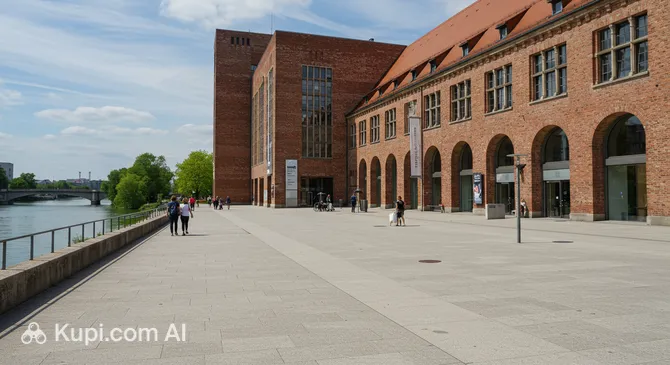
Deutsches Museum. Illustration.
Source: Kupi.com AI

Traveler photos:

Contacts

To plan your visit and check up-to-date information on opening hours, ticket prices, and special events, it is recommended to visit the official website of the Deutsches Museum. All necessary contact information is gathered in the table below.

How to contactContact
AddressMuseumsinsel 1, 80538 München, Germany
Phone number+49 89 2179333
Websitewww.deutsches-museum.de

What to Do

A visit to the Deutsches Museum is an exciting adventure where the guests themselves become the main characters. Unlike many traditional exhibitions, active participation is encouraged here: visitors can not only study the history of science and technology but also personally participate in interactive experiments. Many exhibits are allowed and even recommended to be touched, allowing for a better understanding of how they work. This is a unique opportunity to independently conduct simple physics and chemistry experiments, turning learning into an exciting game.

Scientific demonstrations and large-scale experiments, which are held for guests every hour, give a special dynamic to the visit. This makes the visit particularly interesting for adults as well as children and students. The exhibition covers many topics: special attention is paid to aviation and maritime technology, energy, space exploration, and telecommunications. Also, you can learn a lot about musical instruments, computing technology, and medical achievements.

In addition to the permanent exhibition, the Deutsches Museum regularly hosts temporary exhibitions, scientific lectures, and workshops that broaden horizons and allow for a deeper dive into a topic of interest. For the maximum convenience of visitors, there are cafes on-site where you can rest and have a snack, as well as souvenir shops. To ensure you don't miss anything important, you can use an audio guide available in different languages.

Getting There

The Deutsches Museum is conveniently located in the very heart of Munich, on the picturesque Museum Island (Museumsinsel) in the middle of the Isar River. Thanks to this location, it is easy to reach by public transport. The nearest S-Bahn station is Isartor, which is just a few minutes' walk from the museum entrance. Tram No. 16 and Bus No. 132 also stop nearby, making the route even more flexible. A trip from Munich Central Station (Hauptbahnhof) will take no more than 10–15 minutes.

If you prefer walking and want to get a better feel for the city's atmosphere, the path from central squares like the famous Marienplatz to the museum takes about 15–20 minutes of pleasant walking. For those traveling by car, there are parking lots nearby; however, keep in mind that spaces are limited and can be difficult to find during peak hours. Given this, public transport remains the most reliable and convenient way to reach the Deutsches Museum.

Nearest city: Munich

History & Facts

The history of the Deutsches Museum is inextricably linked with the name of the outstanding engineer Oskar von Miller. The idea of creating a large-scale polytechnic museum that would introduce the general public to the achievements of science and technology in an accessible way was presented by him at a meeting of the Association of German Engineers and received support. June 28, 1903, is considered the museum's founding date. The initial collections were housed in temporary premises, and the first exhibitions for the public opened as early as 1906.

A scenic island on the Isar River, previously known as Coal Island (Kohleninsel), was chosen for the construction of the main building. In 1906, the first stone was laid for the foundation of the future grand complex. The official opening took place only in 1925, and the museum building became one of the first large reinforced concrete structures in Munich. Interesting fact: museum founder Oskar von Miller believed that visitors should be able to interact with the exhibits, so the principle of interactivity was built into the concept from the very beginning.

In the following years, the complex continued to expand: a library was opened in 1932, and the Congress Hall in 1935. The museum was seriously damaged during World War II, but was reopened to visitors as early as 1948. Since then, it has been renovated several times and expanded with new branches, including the Aviation Center and the Transport Center, confirming its status as the world's largest museum of science and technology.

Time Needed

When planning a visit to the Deutsches Museum, be prepared for it to take up a significant part of your day. To get a general idea of the main exhibitions, it is recommended to set aside at least 4–6 hours. This is enough time to briefly see the most iconic halls, such as aviation, maritime, and energy, and get a vivid impression of the collection's scale.

It is important to understand that the Deutsches Museum is enormous. Many visitors note that it is practically impossible to walk through all its halls in one day, and a deep dive into the collections may require several visits. If you are interested in specific areas of science and technology, it makes sense to plan your route in advance and focus on 2–3 thematic sections. This approach will allow you to enjoy the interactive exhibits and demonstrations that make this museum in Munich so special without rushing.

Working Hours

The Deutsches Museum is open to visitors year-round and operates daily from 9:00 to 17:00. This makes it easy to include in your Munich sightseeing itinerary. Last entry to the museum is at 16:30. It is worth noting that the museum is closed on certain public and religious holidays, such as New Year's Day, Good Friday, Christmas, and others. Before your visit, it is highly recommended to check the current schedule on the official website to avoid any surprises.

While buying tickets on-site is possible, it is strongly recommended to purchase them online in advance, especially if you plan to visit during the peak tourist season or on weekends. This will help you avoid long ticket lines and guarantee entry to one of Germany's most popular museums. Online booking is a simple way to save time and make your introduction to the world of science and technology as comfortable as possible.

9:00 – 17:00

Nearby

Visiting the Deutsches Museum is just the starting point for exploring Munich. Thanks to its location on Museum Island in the heart of the city, you are surrounded by many other interesting places. A stroll through the surrounding area will allow you to immerse yourself deeper into the atmosphere of the Bavarian capital, discovering both famous landmarks and cozy corners hidden from the main tourist routes.

Exploring what is nearby will enrich your trip and help create a more complete and vivid image of the city. Just a few minutes' walk away, you can find historical monuments, lively squares, traditional beer halls, and modern venues. Below is a list of some attractions located within walking distance of the museum.

NameDistance
Boazn – Public Restroom Bar0.4 km
Isartor0.6 km
Giorgia Trattoria0.8 km
Hofbräuhaus Munich0.9 km
Marienplatz1 km
Ratskeller Munich1 km
Luffy Pancake Café1.2 km

Have you reached the end of the page?

So the route has been studied inside and out