Support

Camera di San Paolo e Cella di Santa Caterina

About

In the very heart of Parma lies a true Renaissance treasure — the Saint Paul's Chamber and Saint Catherine's Cell museum complex. Located within the walls of the ancient Benedictine Monastery of San Paolo, this site features the remarkably well-preserved private apartments of Abbess Giovanna da Piacenza.
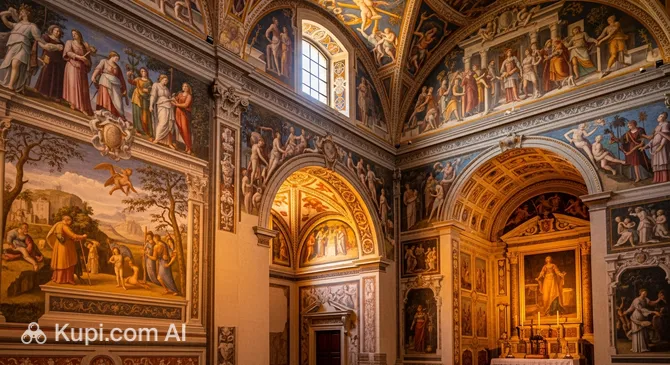
Chamber of Saint Paul and Cell of Saint Catherine
Chamber of Saint Paul and Cell of Saint Catherine. Иллюстрация. Источник: Kupi.com AI

The main draw for travelers in this part of Italy is the Camera della Badessa (Abbess's Chamber), painted by the genius artist Correggio. His frescoes, created in the early 16th century, captivate the imagination with complex mythological symbolism and masterly execution, transforming an ordinary room into a philosophical open-air garden.

Today, visitors can see two unique rooms: one adorned with the elegant works of Alessandro Araldi, and the second — the acclaimed masterpiece by Correggio. In addition to the living quarters, the museum route includes an ancient refectory converted into a chapel, where you can immerse yourself in history while admiring the antique wooden choir stalls and 15th-century frescoes.

Contacts

To ensure your introduction to these Renaissance masterpieces goes flawlessly, we recommend saving the museum's contact details in advance. Finding this unique complex in the historic part of the city is easy if you follow the official address. We suggest paying close attention to the details and contacting information centers if any questions arise.

How to contactContact
AddressStrada Macedonio Melloni, 3, 43121 Parma PR, Италия
Phone+39 0521 218215
Websitewww.parmawelcome.it

What to Do

The main reason to visit this complex is the opportunity to see firsthand the legendary paintings by Correggio in the Camera della Badessa. Be sure to look up at the ceiling, where charming putti "play" amidst intertwined branches and leaves, while mythological characters are depicted in the lunettes. This unforgettable visual experience will be the highlight of your visit.

In Saint Catherine's Cell, works by another master, Alessandro Araldi, await you. Here, take a close look at the scenes "St. Catherine's Dispute before Emperor Maximinus" and "St. Catherine and St. Jerome," which showcase the refined style and religious devotion of the era. Don't miss Araldi's copy of the "Last Supper" on display in one of the halls.

Beyond the wall paintings, the museum features a collection of Renaissance majolica from various Italian workshops. The circular tour concludes in the ancient refectory, where you can admire the masterfully crafted 16th-century wooden choir. This immersion into the lifestyle and aesthetics of high-ranking clergy of the past offers a unique sense of connection across time.

Getting There

The Camera di San Paolo museum complex is conveniently located at Strada Macedonio Melloni, 3, making it easily accessible for those already in the center. If you are walking through the city's historic quarters, the journey to the former monastic apartments will take only a few minutes.

For those preferring public transport, several bus routes run in the vicinity, connecting the central squares with the train station and the outskirts. You can also use taxi services, ordering a car directly to the monastery's main gates or to the nearest major pedestrian zone.

If you are planning a trip by private or rental car, please note the GPS coordinates for your navigator: 44.8041321, 10.3288. Keep in mind that the site is located in a limited traffic zone (ZTL), so it is best to look for parking in advance on the outskirts of the historic core.

Ближайший город: Parma

History & Facts

The history of the San Paolo monastery dates back to the late 10th century, when it was founded as a convent for Benedictine nuns. A significant turning point occurred in 1187 when, thanks to Pope Gregory VII, the institution received a special status exempting it from the authority of the local bishop, granting the abbesses great freedom of action.

The complex reached its peak during the rule of two extraordinary women — Cecilia Bergonzi and Giovanna da Piacenza. It was under their leadership that the monastery became a true center for culture and art. In 1514, the construction of the abbess's private apartments was completed, which we know today as the magnificent painted rooms that became milestones in the history of European painting.

Interestingly, Correggio's legendary frescoes, created around 1518–1519, remained hidden from the public eye for a long time. In 1524, a strict enclosure (clausura) was introduced at the monastery, and for the next two and a half centuries, only the nuns had access to these halls. This allowed the frescoes to be preserved in their original state to this day.

Only in the modern era, starting in April 2021, did management of the complex pass to the municipality, and the rooms opened as a full-fledged museum. Today, this place serves as a living reminder of a time when the boundaries between religious humility and the secular humanism of the Renaissance were remarkably thin.

Time Needed

To fully appreciate the depth and symbolism of the frescoes, we recommend setting aside approximately 1.5–2 hours for your visit. This amount of time will allow you to study the details of the paintings in both rooms without rushing and explore the museum's additional exhibits.

Do not hurry, as the special atmosphere of the former monastic apartments encourages a contemplative mood. If you are a connoisseur of Renaissance art, you may need a little more time to examine the mythological themes encoded by Correggio in detail.

Working Hours

The museum is open to visitors most of the week, though the schedule may change depending on the season or cultural events. Typically, the complex is open from 09:30 AM to 05:30 PM on weekdays and until 06:30 PM on weekends. Please note that Tuesday is the closing day.

We strongly suggest checking the official website or inquiring at the city's tourist office before planning your visit to ensure your cultural outing goes smoothly without any disappointments.

DayWorking hours
понедельник09:30–17:30
вторникЗакрыто
среда09:30–17:30
четверг09:30–17:30
пятница09:30–17:30
суббота09:30–18:30
воскресенье09:30–18:30

Nearby

A walk through the city center offers many additional opportunities for cultural enrichment, as Parma is literally dotted with architectural monuments. You can feel the rhythm of life in the region simply by turning onto a neighboring street after exploring the cells.

NameDistance
Piazza della Pace0.1 km
Palazzo della Pilotta0.2 km
National Gallery of Parma0.2 km
Parma Cathedral0.2 km
Teatro Regio0.2 km
Baptistery of Parma0.2 km
Basilica of Santa Maria della Steccata0.2 km

Reached the end of the page?

That means the route is fully explored