Support

Camposanto

About

On the northern side of the famous Square of Miracles in Pisa sits the Monumental Cemetery (Camposanto Monumentale)—a Gothic architectural masterpiece. It is not just a burial ground, but a true open-air museum that completes the monumental ensemble of the cathedral square. Its snow-white walls and elegant arches create an atmosphere of solemn tranquility.
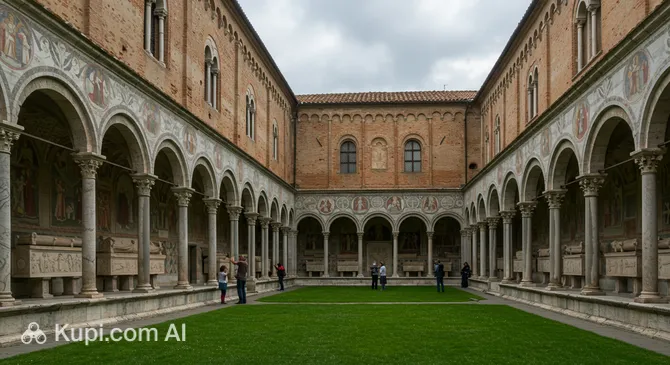
Camposanto Monumentale
Camposanto Monumentale. Иллюстрация. Источник: Kupi.com AI

The defining feature of Camposanto is its name, which translates as "Holy Field." According to tradition, the structure was built around earth brought from Jerusalem after the Fourth Crusade. This sacred connection made the cemetery one of the most revered sites in Italy, where noble citizens and artists found their final rest over the centuries.

The building is a vast rectangular cloister with an inner gallery decorated with tracery windows and magnificent frescoes. Visitors are drawn not only by the architecture but also by the extensive collection of ancient sarcophagi and medieval artworks, making it a must-visit for history enthusiasts.

Contacts

To plan your visit and check current rules, we recommend reviewing the official information. Below are the contact details to help you find your way and contact the administration of this landmark in Pisa.

Detailed contact information is provided below for your convenience:

How to contactContact
AddressPiazza del Duomo, 17, 56126 Pisa PI, Italy
Phone+39 050 835011
Websitewww.opapisa.it

What to Do

The main reason to visit the Monumental Cemetery is for a leisurely stroll through its covered galleries. You can admire the exquisite white marble arches and study the unique collection of Roman sarcophagi, which served as resting places for the local nobility for centuries. The medieval frescoes will certainly catch your eye, particularly the works of Benozzo Gozzoli, which are being carefully restored after past damage.

Be sure to step inside the complex's three main chapels. In the Aula Chapel, you can see the famous "Galileo's lamp"; legend has it that by watching its oscillations, the scientist discovered the law of the isochronism of the pendulum. The Ammannati and Dal Pozzo chapels feature magnificent altars and religious artifacts that highlight the spiritual significance of the site.

The central part of the cemetery is an open courtyard filled with holy soil. An atmosphere of silence and peace reigns here, making it an ideal spot for photography and reflection away from the bustling tourist crowds at the Leaning Tower. For a deeper immersion, we recommend using an audio guide to uncover the symbolic details of the tombstones and epitaphs.

Getting There

The attraction is located at Piazza del Duomo, 17, in the very heart of the city's pedestrian zone. If you are arriving at Galileo Galilei Airport, the most convenient option is the LAM Rossa bus, which will take you to the Pisa, Torre Pendente stop in about 15–20 minutes, followed by a short five-minute walk.

From the Pisa Centrale railway station, you can take the PIT LAM Rossa or PIT 1 buses, a journey of just 10–15 minutes. For those who prefer walking, the route from the station takes about 20–25 minutes through the picturesque streets of Via Francesco Crispi and Lungarno Galilei.

If you are traveling by car, please note that the city center is a pedestrian zone. It is best to leave your vehicle at the Piazza dei Miracoli Parking, located near the square. Bicycles and electric scooters are also popular and eco-friendly ways to get there from the station, with the trip taking no more than 10 minutes.

Ближайший город: Pisa

History & Facts

The history of this remarkable place began in 1278 under the direction of architect Giovanni di Simone. The project was the final, fourth element of the Piazza dei Miracoli (Square of Miracles) ensemble. Although construction lasted nearly two centuries and was only completed in 1464, the building maintained a unified Gothic style.

The cemetery earned its name, which translates as "Holy Field," from a legend involving Archbishop Ubaldo Lanfranchi. It is believed that in the 12th century, following a crusade, he brought soil to Pisa from Golgotha itself. This sacred earth was used to fill the central courtyard, and for a long time, it was believed that bodies buried here would decompose completely in just 24 hours due to its holy properties.

Until the end of the 18th century, the Monumental Cemetery served as the final resting place for the city's elite and distinguished university scholars. Over time, several chapels were built within, such as the Aula Chapel, which once housed the lamp that inspired Galileo Galilei to study the laws of pendulum oscillation. Today, it stands as one of the most significant cultural sites in Italy, blending architecture, faith, and scientific history.

Time Needed

To thoughtfully explore the galleries and appreciate the unique frescoes, a typical visitor will need between 1 and 1.5 hours. This is enough time to take a leisurely stroll through the courtyard, look into the chapels, and examine the ancient Roman sarcophagi.

If you plan to study the history of each tombstone in detail or use an audio guide, your visit might extend to 2 hours. Since the site is part of the Piazza dei Miracoli complex, many tourists choose to combine their visit with other attractions on the square, for which you should set aside at least half a day.

Working Hours

The Monumental Cemetery is open to visitors daily. The landmark operates on a convenient schedule, allowing guests to choose the best time for their visit:

  • Monday — Sunday: 9:00 – 20:00

Please note that during the winter period (October to February), the closing time may be moved up to 18:00, so it is worth checking for the latest information before your visit. Remember that last entry is permitted 1 hour before the complex officially closes.

9:00 – 20:00

Nearby

Visiting the Monumental Cemetery is just one part of exploring the rich heritage of this area. The Square of Miracles is a unique architectural ensemble where each building complements the next, creating an unmistakable atmosphere of medieval grandeur.

A stroll through the surrounding area will allow you to see world-famous monuments and quiet city corners, all located just a few steps from each other.

NameDistance
Piazza del Duomo0.1 km
Pisa Baptistery of St. John0.1 km
Pisa Cathedral0.1 km
Leaning Tower of Pisa0.2 km
Museum of the Opera del Duomo0.2 km
Orto and Botanical Museum0.5 km
L'Ostellino0.5 km

Reached the end of the page?

That means the route is fully explored