Support

Barcola Fountain

About

The Fountain of the Four Continents (Fontana dei Quattro Continenti) is one of the most famous sculptural compositions adorning Trieste, a charming city in northeastern Italy. Located in the heart of the city on Piazza Unità d'Italia, this magnificent fountain was created by the talented Bergamo master Giovanni Battista Mazzoleni in the mid-18th century, specifically between 1751 and 1754. Since then, it has been not only an essential part of the city's architectural ensemble but also a true magnet for residents and tourists alike.
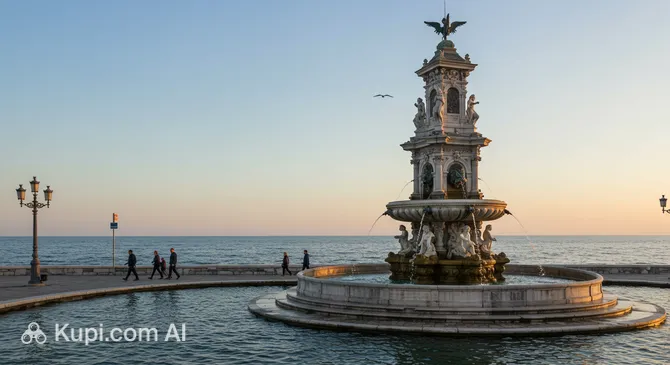
Barcola Fountain. Illustration.
Source: Kupi.com AI

Traveler photos:

Compositionally, the fountain is an expressive pyramid topped by an elegant winged female figure. This figure is not accidental – she symbolizes the hospitality and openness of Trieste, a city with a rich maritime history. Her majestic image draws the eye and invites reflection on the city's significance as a major naval hub and cultural center of the Adriatic.

Various attributes are skillfully arranged around the central figure, highlighting the city's commercial role: bales of goods, barrels, and crates. These details serve as a reminder of Trieste's key importance as a major trading port for many centuries. Interestingly, the choice of a female figure to personify the city is linked to the nuances of the Italian language, where city names are traditionally feminine, adding another cultural layer to the perception of this beautiful monument.

Contacts

Since the Barcola Fountain is a public landmark in Trieste, it generally does not have a dedicated contact service. For more information about the fountain or to plan your visit, you can contact the Trieste tourist information center.

How to contactContact
AddressPiazzale Biagio Marin, 34136 Trieste TS, Italy

What to Do

By visiting the Fountain of the Four Continents in Trieste, you can first and foremost admire its famous sculptural groups. This fountain, which graces the central Piazza Unità d'Italia, offers a unique opportunity to touch history. Take your time to examine the four allegorical statues in detail: they represent Europe, Asia, Africa, and America – the continents known to Europeans in the 18th century.

Studying these skillful sculptures is a fascinating activity in itself. Try to imagine how distant lands appeared to the people of Italy at that time, when Australia and Antarctica remained unexplored. Of course, the Fountain of the Four Continents is also a wonderful spot for memorable photos. Capture yourself against the backdrop of this historic monument and the grand architecture of one of Trieste's main squares.

Piazza Unità d'Italia surrounding the fountain is not just a beautiful backdrop but also an important public space. Here you can take a break, observe the city's rhythm, and soak up its unique atmosphere. Many people begin their exploration of Trieste right here, as it's easy to set off from the fountain to discover other interesting sites in this charming Italian city.

Getting There

The Barcola Fountain is conveniently located in the heart of Trieste, making it easily accessible to visitors. This fountain is situated in one of the city's main squares – Piazza Unità d'Italia. Its central location makes getting here very straightforward.

If you are exploring the central part of Trieste, the most convenient way to reach Piazza Unità d'Italia, where you can find the Barcola Fountain, is on foot. Such a stroll allows you to better experience the city's atmosphere. Additionally, you can reach the square by public transport – various bus routes pass through the city center and have stops nearby.

For those arriving in Trieste by train, the walk from the railway station to Piazza Unità d'Italia takes approximately 15-20 minutes. It is a pleasant walk that immediately immerses you in city life. Of course, you can always take a taxi to reach the Barcola Fountain quickly and comfortably from anywhere in the city.

Nearest city: Trieste

History & Facts

The Barcola Fountain in Trieste stands as a witness to a significant historical period in the city's life. According to historical sources, its creation is directly linked to one of the key events of the 18th century – the granting of "porto franco" (free port) status to Trieste by the Austrian Emperor Charles VI in 1719. This event served as the starting point for the city's economic boom. In honor of this momentous decision, the fountain was erected in 1754, complementing the statue of the Emperor installed earlier in 1728. Thus, the fountain originally served as a symbol of a new era of prosperity for Trieste.

The fate of the Barcola Fountain has not always been simple, reflecting the turbulent pages of Trieste's history. A notable fact is its dismantling in 1938. This was done to clear the square for Benito Mussolini's visit to the city – an event that left its mark on the city's appearance. Fortunately, this was not the end of its story: the monument was returned to its historical site in 1970, symbolizing restoration and respect for the past.

Today, the Barcola Fountain is not just an element of the Trieste cityscape, but also an important historical symbol. It serves as a reminder of the city's significant role as an international port hub and a crossroads of trade routes. For many residents and visitors of Trieste, the fountain is more than just a beautiful structure; it is a living testament to the rich and sometimes complex history of this unique city on the Adriatic coast, which is part of Italy.

Time Needed

To view the Barcola Fountain and take a few souvenir photos, a typical visitor usually needs relatively little time. You can count on 15-30 minutes – this should be enough to take a close look at the fountain itself, appreciate its architectural features, and enjoy the view.

When planning your visit to the Barcola Fountain, also consider its location within the city of Trieste. Such urban landmarks, especially in countries as rich in history and culture as Italy, are often surrounded by other interesting sites or simply set in picturesque locations. Therefore, if you wish to take a leisurely stroll around the area, soak in the atmosphere, or stop at a nearby cafe with a view, your total time in the vicinity may pleasantly increase.

Working Hours

The Barcola Fountain in Trieste is a public attraction, as it is located in an open city square. As a result, the fountain is available for viewing 24/7, any day of the week and any time of year. No tickets or prior booking are required to visit – access is completely free.

To best appreciate all the details of the Barcola Fountain sculptural composition, it is recommended to visit during daylight hours. Evening visits can also offer a pleasant experience, as the fountain is often beautifully illuminated, creating a special atmosphere in the square.

Open 24 hours

Nearby

When you find yourself at the Barcola Fountain in Trieste, don't limit yourself to just seeing the fountain. Exploring the surroundings will allow you to dive deeper into the atmosphere of this unique city and discover even more interesting spots. Often, it's the short walks through nearby streets or visits to neighboring attractions that provide the most vivid and unexpected impressions of a trip.

Several notable sites are located near the Barcola Fountain, which can complement your cultural itinerary and make your stay in Trieste even more rewarding. Below is a list of some of them, along with their distances.

NameDistance
Barcola Pinewood0.1 km
Victory Lighthouse1.2 km
Immaginario Scientifico2.4 km
Caffè Vatta3.1 km
Audace Pier3.8 km
Gopcevich Palace3.9 km
Old Lanterna Lighthouse4 km

Have you reached the end of the page?

So the route has been studied inside and out