Support

Palazzo Gopcevich

About

Palazzo Gopcevich is an elegant 19th-century building located in the very heart of Trieste, Italy. Built in 1850 in an eclectic style, this palace became one of the city's most significant architectural landmarks of the Habsburg era. The building's facade is decorated with exquisite stone carvings and statues symbolizing the heroes of an important historical event — the Battle of Kosovo.
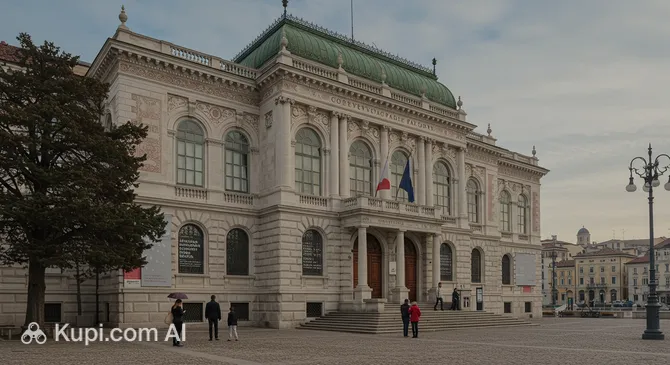
Gopcevich Palace
Gopcevich Palace. Иллюстрация. Источник: Kupi.com AI

Since 1998, the palace has been managed by the municipality and serves as the home of the Carlo Schmidl Civic Museum of Theatre. Its collections are dedicated to the history of performing arts and music starting from the 18th century. The halls display rare musical instruments, stage costumes, posters, and photographs that allow tourists to immerse themselves in the rich cultural atmosphere of the past.

The interior of the palazzo has preserved the spirit of an aristocratic home: majestic staircases with wrought-iron details and original parquet floors create a sense of authenticity. Unlike busier tourist spots, Palazzo Gopcevich offers guests the opportunity for a quiet and thoughtful exploration of history and art in a cozy setting.

Contacts

To plan your visit to Palazzo Gopcevich and check details regarding special exhibitions, it is worth reviewing the current contact information. The museum staff is always ready to help visitors navigate the current cultural program. The main contact details and the exact address are provided in the table below.

How to contactContact
AddressVia Gioacchino Rossini, 4, 34121 Trieste TS, Италия
Phone+39 040 675 4039
Websitewww.museoschmidl.it

What to Do

The best way to begin exploring Palazzo Gopcevich is by examining its facade, where statues representing Commerce and Navigation stand out among the decorative elements. Once inside, be sure to notice the grand staircase with its wrought-iron elements—it is considered one of the finest examples of 19th-century Trieste craftsmanship. On the first floor, the museum halls await, featuring collections of antique musical instruments and sketches of theatrical sets.

On the second floor, the exhibition continues with a section on mechanical instruments and the personal archive of the legendary director Giorgio Strehler. History buffs can explore a reconstruction of luthier Francesco Zapelli's workshop or examine archival photographs of famous opera singers. The palace's inner courtyard is famous for its excellent acoustics, so evening concerts are often held here, giving guests an unforgettable experience.

You can complement your walk by exploring the cultural quarter: the majestic Serbian Orthodox Church and historic cafes that have preserved the old city atmosphere are located nearby. Entry to the palazzo building is usually free, though please note that visiting some of the museum's special exhibitions may require a fee.

Getting There

Palazzo Gopcevich is located in the heart of the historic center at Via Gioacchino Rossini, 4. The easiest way to get here is on foot, as the palace is just a few minutes' walk from the city's main square. A walk from the Trieste Centrale railway station will take about 15–20 minutes through the city's picturesque streets.

If you prefer public transport, you can use bus lines No. 2, No. 8, or No. 10, which stop in the immediate vicinity of the Grand Canal. You can also reach the central part of the city by taxi; however, keep in mind that parking in the historic zone can be limited, and walking is often more convenient for tourists.

For those arriving from Ronchi dei Legionari Airport (TRS), the most practical option is to take a shuttle bus to the central station and then take a short walk toward the waterfront. The palace is easy to recognize by its distinctive facade overlooking the canal, making it an excellent landmark during your walk.

Ближайший город: Trieste

History & Facts

The history of Palazzo Gopcevich began in 1850 when architect Giovanni Andrea Berlam started work on an ambitious project. It was commissioned by Spiridone Gopcevich, the head of a prominent Serbian family, who sought to emphasize the high status of his community in Trieste, which was a flourishing port of the Habsburg Monarchy at the time. Construction was completed in 1854, revealing a building that combines features of Lombard Romanticism and the Renaissance.

The sculptures on the facade, referencing the Battle of Kosovo in 1389, are of particular significance. These are not merely decorations but a tribute to national heroes and the cultural heritage of the Serbian people, whose representatives made an enormous contribution to the city's trade development. In those days, the palace was a center of social life, symbolizing the "golden age" of Trieste's merchant class and the region's cultural diversity.

A new chapter for the building began in 1998 when it became city property. The Carlo Schmidl Civic Museum of Theatre, founded back in 1924, moved here only at the end of 2006. Previously, the collection was housed in the Teatro Verdi and Palazzo Morpurgo. Today, the palace walls preserve two centuries of local performing arts history, blending the architectural grandeur of the past with a vast archive of musical and theatrical art.

Time Needed

To leisurely explore Palazzo Gopcevich, visitors usually need 1.5 to 2.5 hours. This is quite enough time to study the details of the facade, climb the grand staircase, and carefully examine the permanent exhibition of the theatre museum on both floors of the building.

If you plan to visit one of the temporary exhibitions or wish to spend more time in the archive rooms for a deeper study of musical history, it is worth adding an extra half hour to your schedule. Also, keep in mind that musical events are sometimes held in the courtyard, and attending them can extend your visit to this cultural space.

Working Hours

You can visit the museum and see the palace interiors from Wednesday to Sunday, 10:00 AM to 5:00 PM. Please note that the institution is closed on Mondays and Tuesdays, and visitor access is not available during those times.

The opening hours may change during public holidays or during exhibition changeovers. Before planning your visit, we recommend checking the official website of the Schmidl Museum to confirm the current visiting hours and any potential restrictions.

DayWorking hours
понедельникЗакрыто
вторникЗакрыто
среда10:00–17:00
четверг10:00–17:00
пятница10:00–17:00
суббота10:00–17:00
воскресенье10:00–17:00

Nearby

The palace's location on the banks of the Grand Canal makes it an ideal starting point for further exploration of the city. In almost every block, you will find architectural monuments, cozy squares, and museums revealing the multifaceted history of this port metropolis.

A walk through the surrounding area will allow you to see both ancient ruins and majestic buildings from the Austro-Hungarian era. Below is a list of the most interesting places that can be reached on foot within minutes.

NameDistance
Grand Canal of Trieste0.1 km
Serbian Orthodox Church of Saint Spyridon0.3 km
Piazza della Borsa0.3 km
Piazza Unità d'Italia0.4 km
Roman Theatre of Trieste0.4 km
Audace Pier0.4 km
Al Ciketo0.5 km

Reached the end of the page?

That means the route is fully explored