Support

Muggia

About

Muggia is a remarkably picturesque and cozy town located in the far south of the province of Trieste. As the only Italian settlement on the Istrian peninsula to have preserved a truly Venetian charm, it attracts travelers with its authenticity and the tranquil atmosphere of a fishing port on the Adriatic coast.
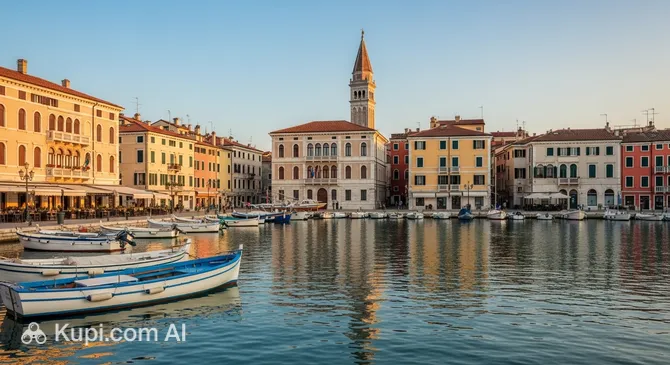
Muggia
Muggia. Иллюстрация. Источник: Kupi.com AI

This historic location in Italy is famous for its medieval center, where narrow streets intertwine in a whimsical labyrinth leading to elegant squares. The main highlight of the town is the Gothic Cathedral of Saints Peter and Paul, while an ancient castle stands proudly above the bay, guarding the peace of locals and guests for many centuries.

The significance of this site lies in its unique location between the mountains and the sea, as well as its rich cultural heritage that blends Roman ruins and Venetian architecture. There is none of the usual hustle and bustle of large tourist centers here, which makes a walk along the embankment overlooking the Gulf of Trieste truly special.

Contacts

To get the latest information about events or visiting specific sites, you can contact the tourist office or use the contact details provided below. It is recommended to check the availability of special tours to the castle in advance, as it is privately owned.

How to contactContact
Address34015 Муджа, Триест, Италия
Phone+39 040 282 0932

What to Do

Begin your visit with a leisurely stroll through the medieval center, where every building facade recalls the days of the Venetian Republic. Be sure to stop by the main square to appreciate the elegance of the Gothic cathedral, and then climb the winding paths to Castello di Muggia. From here, you'll find perhaps the best views of the port and the endless blue of the Adriatic Sea.

For history buffs, the Muggia Vecchia Archaeological Park is a must-visit. Here you can see the foundations of ancient buildings and Roman-era artifacts discovered during excavations. The castle itself often hosts exhibitions and cultural events under the auspices of its owner, providing an opportunity to experience art within a historical setting.

In the late afternoon, head to the port's waterfront. This is the perfect time to watch the fishing boats in the golden light of the setting sun. Photographers will appreciate the play of shadows in the narrow alleys, while those seeking peace will enjoy the chance to relax away from busy tourist routes, soaking in the sea breeze.

Getting There

Reaching this charming spot from the center of Trieste is quite simple: a trip on bus No. 20 takes about 30–40 minutes, allowing you to enjoy the coastal scenery along the way. There is also the historical Strada Vicenza route, which has connected these two settlements for centuries.

If you prefer a more scenic journey, take a ferry or boat that regularly crosses the gulf, offering magnificent views of the town from the sea. For those traveling by car, the SS15 highway is the best route, and parking can be found right at the port or near the historical center.

The attraction can also be comfortably reached by ordering a taxi from the city center or the nearest metro station. Despite its proximity to the Slovenian border, transport links remain regular and convenient for tourists.

Ближайший город: Trieste

History & Facts

The history of this place dates back to ancient times: the first fortified settlements appeared here as early as the 8th century BC. Later, the Romans, having established themselves in Aquileia, turned Istria into their province and built a powerful fortress here, known as Castrum Muglae. Traces of that era are still carefully preserved in the local archaeological park.

During the Middle Ages, the town developed under the strong influence of the Venetian Republic, which defined its architectural appearance for centuries to come. Muggia Castle (Castello di Muggia), built in the 14th century, served as a key defensive hub and was repeatedly rebuilt and expanded to protect residents from the raids and wars of that era.

Interestingly, the ancient settlement of Muggia Vecchia gradually fell into decline by the end of the 15th century, and the center of life finally shifted to the coast. Since 1991, the ancient castle has found a new life—it passed into the ownership of the sculptor Villyano Bossi, who transformed the historic walls into a space for art and cultural gatherings.

Time Needed

To leisurely soak up the atmosphere of this place, most travelers need between 2 and 4 hours. This is plenty of time to stroll along the waterfront, visit the central cathedral, and head up to the castle for panoramic photos.

If you plan a detailed study of the archaeological park or want to stay for lunch at one of the local restaurants specializing in seafood, you should set aside half a day for the trip. The town invites slow contemplation, especially during the pre-sunset hours.

Working Hours

Since Muggia is a residential town, access to its streets and squares is open 24/7 and is free of charge. This allows tourists to enjoy the architecture and seascapes at any convenient time, whether at early dawn or late evening.

However, sites such as the cathedral or the castle have their own operating schedules, which may change depending on the season or private events. It is recommended to check current visiting hours on the official websites of the attractions or at the information center before starting your trip.

Nearby

Exploring the surroundings of this coastal town can significantly enrich your trip. Its proximity to a major port center makes it easy to combine a quiet walk through medieval streets with visits to grand palaces and museums.

Below are the most interesting locations within a few kilometers that are worth including in your itinerary:

NameDistance
Muggia Castle0.3 km
Risiera di San Sabba National Monument and Museum2.7 km
Rustiko4.9 km
Revoltella Museum4.9 km
San Giusto Castle5 km
Arch of Riccardo5 km
Civic Museum of Natural History of Trieste5 km

Reached the end of the page?

That means the route is fully explored