Support

Cheonggyecheon

About

Cheonggyecheon (Korean: 청계천) is not just a stream, but the true green heart of modern Seoul, the bustling capital of South Korea. Once hidden under a layer of asphalt and concrete, today it is a stunning public space for relaxation and walking that snakes for 11 kilometers through the central part of this dynamic metropolis. It is a striking example of how a city can harmoniously integrate nature into the urban landscape.
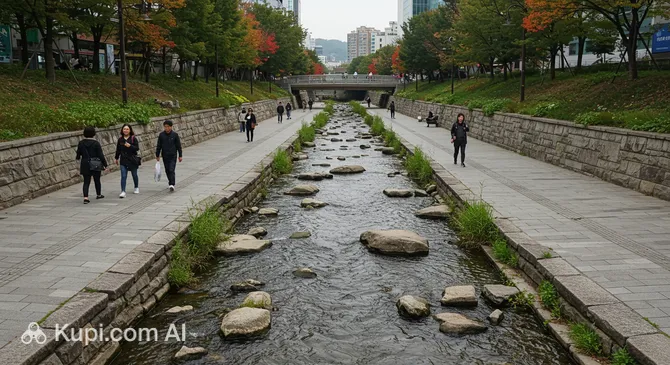
Cheonggyecheon. Illustration.
Source: Kupi.com AI

Traveler photos:

This unique linear park, whose open section measures 8.4 kilometers, quickly became one of the city's main and most beloved landmarks. After an impressive reconstruction completed in 2005, Cheonggyecheon was transformed into a picturesque oasis with pedestrian paths, bridges, and small waterfalls, literally breathing new life into the surrounding areas and fundamentally changing the face of Seoul. It is extremely popular with both locals seeking a corner of tranquility amidst the city bustle and tourists wanting to see the modern side of the Korean capital.

The Cheonggyecheon Stream flows through central Seoul from west to east, creating a pleasant contrast with the high-rise buildings surrounding it. Its waters flow slowly to join the small Jungnangcheon River. Jungnangcheon, in turn, is a tributary of the larger Han River, which carries its waters further to the Yellow Sea, located about sixty kilometers from the city. Thus, Cheonggyecheon is not only a place for recreation but also an important part of the region's water system.

Contacts

Cheonggyecheon is an extensive public space, so it doesn't have a single contact center. To get the latest information on events or the status of specific sections of the stream, we recommend visiting the official Seoul tourism website or tourist information points directly in the city. The stream is easily accessible by subway, as many stations are located near its embankments.

How to contactContact
AddressJongno District, Seoul, South Korea
Phone number+82 2-2290-7111
Websitewww.sisul.or.kr

What to Do

A walk along Cheonggyecheon is a true immersion into an oasis of calm in the middle of bustling Seoul. Visitors can enjoy the view of numerous waterfalls and fountains designed with Eastern traditions in mind. Notable among them are compositions like the firework fountain, an elegant two-tier fountain, and the symbolic candle fountain. After dark, all of them are illuminated, turning the embankment into a truly magical place, perfect for leisurely evening strolls and taking beautiful photos.

You can cross the stream not only by one of the 22 bridges, each with its own unique design and history, but also by carefully placed stepping stones in various spots, which adds an element of light adventure to the walk. In the crystal-clear waters of Cheonggyecheon, you can enjoy watching schools of fish, which is especially popular with families with children and anyone seeking peace in the heart of the metropolis. It's a wonderful place to take a break from the city noise, sit on the specially built ledges by the water, and just enjoy the moment.

Along the banks of the stream, several commemorative "walls" and installations have been set up, which are of historical and cultural interest, telling visitors about the past of this iconic Seoul site. Many tourists and locals prefer to start their walk from the picturesque Cheonggye Plaza, located at the very beginning of Sejong-no Street. This plaza is considered the symbolic source of the restored stream and is a popular starting point for exploring the entire route along Cheonggyecheon.

Getting There

Getting to the Cheonggyecheon Stream in Seoul is quite easy, as it stretches through the central part of the city and is well-served by public transport. The most convenient way is, undoubtedly, the Seoul subway, known for its efficiency and extensive network. Since Cheonggyecheon is quite long, you can access it from many stations located along its flow.

The choice of subway station will depend on which part of the stream you want to visit. For example, to reach the start of the stream at Cheonggye Plaza, you can use City Hall (lines 1, 2), Gwanghwamun (line 5), or Jonggak (line 1). For central sections, Euljiro 1-ga (line 2) or Euljiro 3-ga (lines 2, 3) are ideal. If your destination is the eastern part of the stream, near Dongdaemun Market, you can get off at Dongdaemun History & Culture Park (lines 2, 4, 5). It's recommended to check a map beforehand to see which part of Cheonggyecheon interests you and choose the nearest station.

Besides the subway, various points along the Cheonggyecheon Stream can be reached by numerous city buses. Routes and stops can be easily found using navigation apps or the official Seoul transportation website. Of course, a taxi is always an option, which will take you directly to the desired bridge or embankment section. However, keep in mind that traffic jams can occur in the city center during rush hour. In any case, once you reach one of the access points, further exploration of Cheonggyecheon involves a pleasant walk along its banks.

Nearest city: Seoul

History & Facts

For centuries, the Cheonggyecheon Stream served as the main waterway of Seoul, being an integral part of city life. However, by the mid-20th century, the historical quarters where the capital of South Korea began fell into decline. The stream itself, once the pride of the citizens, turned into a neglected drainage ditch, and its banks were haphazardly built up with shanties, creating a bleak picture in the heart of the metropolis.

In 1968, a radical decision was made: Cheonggyecheon was completely covered underground, and a modern (for the time) two-tier elevated highway was built over its former bed. This concrete thoroughfare served the city for about thirty years, symbolizing the era of rapid industrialization. But over time, there came a realization of the need to return the city's natural heritage and correct the urban planning mistakes of the past.

The turning point came in 2003, when a large-scale and bold reconstruction project was launched at the initiative of the then-President of South Korea. The concrete slabs were removed, the highways relocated, and the stream bed was thoroughly cleaned and transformed. Its banks were decorated with greenery and stones, turning the former transport artery into a recreational area. By 2005, the project, which cost around 280-300 million dollars, was completed, and the renovated Cheonggyecheon reopened to the public. Curiously, the removal of the expressway in central Seoul not only didn't worsen the traffic situation but, contrary to expectations, even sped up movement through the city—a striking example of the so-called Braess's paradox.

Time Needed

The time needed to explore the Cheonggyecheon Stream depends on your pace and how deeply you want to immerse yourself in its atmosphere. For a pleasant sightseeing walk through the most popular and photogenic sections—to see key fountains, several interesting bridges, and simply enjoy this green oasis in the center of Seoul1-2 hours is usually sufficient. This time will allow you to get a general impression and feel the unique character of the place.

If you want to explore Cheonggyecheon more thoroughly, walk a significant part of it, take a closer look at all 22 bridges, historical installations, and enjoy the changing landscapes, then you should set aside 2-3 hours or even half a day. Considering that the developed walking area of the stream stretches for several kilometers (the total length of the open section is about 8.4 km), there is indeed plenty of space to spend time, leisurely walking from the starting point at Cheonggye Plaza and beyond.

Working Hours

Cheonggyecheon is a public space, so access is generally open 24/7 and year-round. You can walk along the stream at any time convenient for you, enjoying its views both during the day and in the evening when the fountains and bridges are lit up. No special ticket booking or advance registration is required to visit Cheonggyecheon, as it is a recreation area open to everyone.

While the main part of the stream is accessible at all times, keep in mind that the operating hours of individual installations (for example, certain fountains or light shows, if they are held) may be limited. There may also be temporary access restrictions to some sections during special events or maintenance work. For the most up-to-date information on the opening hours of specific features within Cheonggyecheon or planned events, it is recommended to visit the official Seoul tourism website or check with local tourist information centers.

Open 24 hours

Nearby

A walk along the picturesque Cheonggyecheon Stream is a wonderful start to getting to know Seoul, but you shouldn't stop there. The surroundings of this unique urban space hide many other interesting places that can significantly enrich your experience of the capital of South Korea. Exploring nearby attractions will allow you to dive deeper into the culture, history, and modern life of the city.

Given Cheonggyecheon's central location, many iconic Seoul landmarks are within walking distance or easily accessible by public transport. From historical palaces and museums to trendy districts and gastronomic corners, everyone will find something to their liking, complementing their walk with new discoveries. Below is a list of some interesting places located nearby.

NameDistance
Charles H0.3 km
Four Seasons Hotel Seoul0.3 km
Deoksugung Palace0.5 km
Myeongdong Korean BBQ0.6 km
Gwanghwamun Gate0.8 km
National Palace Museum of Korea0.9 km
Bound Bar1 km

Have you reached the end of the page?

So the route has been studied inside and out