Support

Neptune's Fountain

About

Neptune's Fountain is, without exaggeration, the heart and one of the most recognizable symbols of Gdańsk. Located on the famous Długi Targ (Long Market) street, directly opposite the entrance to the historical Artus Court, this fountain is a must-see on every traveler's itinerary. Created back in the 17th century, it still draws the eye today with its majestic beauty and rich history.
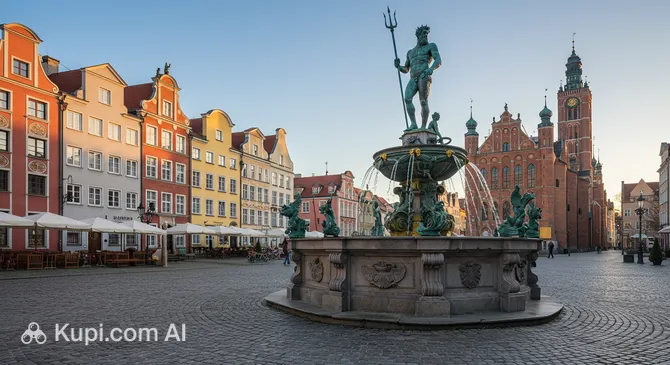
Neptune's Fountain. Illustration.
Source: Kupi.com AI

Traveler photos:

This architectural monument is designed in the exquisite style of Flemish Mannerism and is considered an outstanding example of Renaissance sculpture in Poland. The central figure of the composition is a powerful bronze statue of the sea god Neptune, who, according to the creators' vision, bowed his head in a sign of respect for the city. The fountain symbolizes Gdańsk's inseparable connection to the Baltic Sea, its maritime power, and its prosperity as a major trading port.

An interesting local legend is associated with the fountain regarding the origin of the famous Gdańsk liqueur "Goldwasser." It is said that Neptune, angered by people throwing coins into the fountain, struck the water with his trident and shattered the gold into tiny flakes, which became the signature decoration of this herbal drink. Today, Neptune's Fountain is not just a historical landmark but a place where you can feel the spirit of the old city, take memorable photos, and enjoy the atmosphere of one of Europe's most beautiful corners.

Contacts

Since Neptune's Fountain is a public, open-air historical monument, it does not have specific contact details such as a phone number or email address. Finding the landmark is very easy: it is located in the very heart of Gdańsk's Old Town, on the Długi Targ (Long Market) pedestrian street. If you need official information, such as the lighting schedule or potential restoration work, we recommend visiting the city's official tourism portal or tourist information centers.

How to contactContact
AddressDługi Targ, 80-833 Gdańsk, Poland
Websitewww.gdmel.pl

What to Do

Visiting Neptune's Fountain is a must for any tourist walking through the historical center of Gdańsk. Here, you can take beautiful photos against the backdrop of one of the city's main calling cards. Don't rush—take the time to examine the exquisite sculpture in detail and admire the harmonious architectural ensemble that surrounds it.

The fountain often serves as a meeting point and a starting point for tours of the Old Town. During the summer, the square around it comes alive with street musicians and various cultural events, and during holidays, the fountain is decorated with illumination, creating a truly magical and memorable atmosphere. This makes it attractive at any time of day or year.

Getting There

Getting to Neptune's Fountain is very easy, as it is situated in the heart of the historical center of Gdańsk, on the famous Długi Targ (Long Market) square. If you arrive in the city by train, the fountain is within walking distance from the main railway station, Gdańsk Główny. A stroll through the picturesque streets of the Old Town will take no more than 15–20 minutes and is a great way to start exploring the local architecture.

For those who prefer public transport, city trams and buses run to the Długi Targ area. The closest stops to the fountain are Świętego Ducha and Brama Wyżynna, from which it is only a couple of minutes' walk. Travelers arriving by car should keep in mind that parking in the city center is paid. However, the best way to explore this part of Gdańsk is on foot, which allows you to fully enjoy the unique atmosphere of the ancient quarters.

Nearest city: Gdansk

History & Facts

The history of Neptune's Fountain reflects the ambition and maritime spirit of old Gdańsk. The idea for its creation was born in 1606 at the initiative of the city council and Mayor Bartłomiej Schachmann. Inspired by the magnificent fountains he had seen in Italy, he wanted to adorn his hometown with a monument that would celebrate its status as an important seaport. It was decided to replace the old well at Artus Court with a majestic fountain symbolizing the city's connection to the sea.

The process of creating the fountain proved to be long and painstaking, taking more than twenty years. The project was designed by the prominent architect and sculptor of Dutch origin, Abraham van den Blocke. The bronze statue of the sea lord was cast in 1615 by local master Gerdt Benning. However, due to various delays, including the Thirty Years' War, the grand opening of the fountain did not take place until October 9, 1633. A year later, it was surrounded by an elegant wrought-iron fence, also designed by van den Blocke.

The fate of the fountain, like that of the city itself, has been eventful. In the 18th century, it was renovated in the Rococo style when master Johann Karl Stender added sea creatures to the composition, and blacksmith Jakob Barren decorated the fence with the coats of arms of Gdańsk and Polish eagles. During the Second World War, to save the monument from destruction, residents disassembled it and hid it in a safe place. Thanks to this, the fountain was restored after the war and returned to its historical site in 1954, where it remains the primary symbol of the city's maritime glory today.

Time Needed

Visiting Neptune's Fountain won't take long but will leave a lasting impression. If your goal is to quickly see the landmark and take a few beautiful photos, 15–30 minutes will be quite enough. This is a great option for those traveling through Gdańsk at a fast pace who want to see as many iconic places as possible.

However, to truly feel the atmosphere of this historical corner of Poland, it is worth setting aside a bit more time. We recommend planning for up to one hour. This will allow you to sit leisurely on a bench in Długi Targ square, admire the colorful facades of the ancient buildings surrounding it, listen to street musicians, and simply watch the city life go by. After all, the fountain is the heart of Gdańsk, and its charm is best revealed in moments of calm contemplation.

Working Hours

Since Neptune's Fountain is an open-air monument located on Gdańsk's central square, it is accessible for viewing 24 hours a day and is completely free. You do not need to buy tickets or book a visit in advance. You can freely approach it at any time during your walk through the Old Town to admire the sculpture and take commemorative photos.

It is important to note that the water flow in the fountain operates seasonally. As a rule, it is turned on during the warm season—from spring through autumn. In the winter months, the water is turned off to protect the system from freezing, though the sculpture itself remains available for viewing. To find out the exact start and end dates of the fountain's operating season or to check for potential maintenance work, it is recommended to visit the city's official tourism portal.

Open 24 hours

Nearby

The location of Neptune's Fountain in the heart of Gdańsk's historical center makes it an ideal starting point for exploring other city treasures. A stroll through the surrounding area will allow you to dive deeper into the unique atmosphere of this port city and see how closely its history, culture, and architecture are intertwined. It is a wonderful opportunity to enrich your impressions and gain a fuller understanding of the grandeur of old Gdańsk.

Many iconic landmarks are literally just a few steps away from the fountain, allowing you to create a rich walking route. Exploring these places won't take much time but will provide plenty of bright emotions and many magnificent photographs. Below is a list of interesting sites located in the immediate vicinity.

NameDistance
St. Mary's Basilica (Bazylika Mariacka) in Gdańsk0.1 km
Long Market0.1 km
St. Mary's Gate0.2 km
Golden Gate0.4 km
Pueblo0.4 km
The Crane0.4 km
High Gate0.5 km

Have you reached the end of the page?

So the route has been studied inside and out