Support

Statue of John III Sobieski

About

The Monument to John III Sobieski in the city of Gdańsk is a magnificent monumental sculpture dedicated to one of the most iconic figures in the history of Poland, King and Commander John III Sobieski. This monument is an important historical landmark and serves as a reminder of the country's glorious past and its prominent figures.
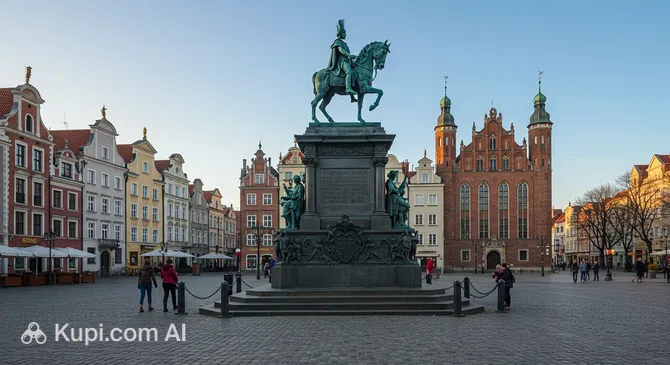
Statue of John III Sobieski. Illustration.
Source: Kupi.com AI

Traveler photos:

The composition is an impressive equestrian statue of the king, set on a high granite pedestal. John III Sobieski is depicted in a dynamic pose, emphasizing his role as a decisive leader and talented military commander. For the residents of Gdańsk and all of Poland, the monument is a symbol of national pride and historical memory.

The history of the monument itself is also quite remarkable. It was originally created by sculptor Tadeusz Barącz and erected in Lviv in 1898. However, after World War II, in 1950, the monument was transferred to Poland, and in 1965, it found its current home in Gdańsk, at Targ Drzewny (the Wood Market). Thus, the monument not only immortalizes the personality of the King but is itself a witness to complex historical turns.

John III Sobieski is primarily famous for his brilliant victory at the Battle of Vienna in 1683, where the combined forces of Christian Europe under his command defeated the Ottoman army, stopping its advance further into the continent. Visiting this monument is an opportunity to touch the rich history of Poland and pay tribute to an outstanding ruler and commander.

Contacts

The Monument to John III Sobieski is one of the landmark attractions in Gdańsk. As it is an outdoor historical monument, it does not have specific contact information or opening hours for visitors. To obtain the most up-to-date information about access to the monument or if you have any questions, it is recommended to contact the Gdańsk Tourist Information Center, where they can provide all the necessary details.

How to contactContact
AddressTarg Drzewny 9, 80-800 Gdańsk, Poland

What to Do

A visit to the Monument to John III Sobieski in Gdańsk provides tourists with an excellent opportunity to examine this monumental sculpture in detail. You can study its artistic features, appreciate the skill of the sculptors, and, of course, take commemorative photos against the backdrop of this significant historical landmark. Located in one of the city's squares, the monument is easily accessible and often serves as a starting point for exploring Gdańsk, especially for those arriving from the airport.

There are usually information plaques near the monument to help you delve deeper into the history of its creation and learn more about John III Sobieski himself. This is a great chance to expand your knowledge of Polish history and understand the role of this outstanding ruler and commander. For many travelers, viewing the monument becomes more than just a photo stop—it is an interesting journey into Poland's past.

Getting There

The Monument to John III Sobieski is located in the city of Gdańsk and is one of the easily accessible landmarks in Poland. Visitors can conveniently reach the monument by using public transport. City buses and trams run regularly to the central part of Gdańsk, where the monument is situated.

Many tourists note that the Monument to John III Sobieski can be one of the first iconic sites they see on the way from Gdańsk airport to the center. This speaks to its convenient location on the public transport routes connecting the airport with the heart of the city. Of course, you can always use taxis to reach your destination quickly and comfortably, especially if you are traveling from remote parts of the city or have heavy luggage.

The monument graces one of the squares in Gdańsk, making it a prominent point on the city map. Thanks to its central location, reaching the monument is easy, no matter which part of Gdańsk you are starting from. Simply take a bus or tram heading towards the center and get off at the nearest stop.

Nearest city: Gdansk

History & Facts

The Monument to John III Sobieski in Gdańsk is more than just a statue; it is a witness to a rich and sometimes complex history. The idea for its creation was born in 1883, the bicentennial year of the famous Battle of Vienna. It was on September 12, 1683, that the combined forces led by King John III Sobieski achieved a decisive victory, halting the Ottoman Empire's advance into Europe. In memory of this triumph and the monarch's outstanding role, the monument was ceremoniously unveiled on November 20, 1898, though originally not in Gdańsk, but in Lviv.

The fate of the monument turned out to be as eventful as the life of the King himself. In 1911, there was a plan to increase the pedestal's height by 1.25 meters and rotate the statue, but only the pedestal raising was realized. After World War II, in 1949, following repeated appeals from the Polish side, permission was granted to transfer the monument to Poland. In 1950, it was moved to Warsaw for temporary storage. The Monument to John III Sobieski found its current home in one of the squares of Gdańsk in 1965, becoming one of the city's symbols.

John III Sobieski left an indelible mark on the history of Poland and Europe. His persona was so significant that the famous Polish astronomer Johannes Hevelius named the constellation "Scutum Sobiescianum" (Sobieski's Shield) in his honor. The memory of the soldier-king lives on today: in February 2017, a 500-zloty banknote featuring his image was introduced in Poland. Additionally, the name of John III was given to the 11th Armored Cavalry Division of the Polish Army, and his image has been repeatedly reflected in literature and cinema, underscoring his status as a national hero.

Time Needed

When planning a visit to the Monument to John III Sobieski in Gdańsk, you should expect a relatively short but informative experience. On average, it will take about 15-30 minutes to view the monument, take commemorative photos, and look at its main details. This is quite enough time to walk around the monument and appreciate its grandeur.

If you are interested in the history of Poland and the life of John III Sobieski, you can set aside up to one hour for a more thoughtful study of the monument and any nearby information plaques. During this time, you can dive deeper into the historical context related to this outstanding ruler and his era, as well as examine the sculpture's artistic elements more closely.

Working Hours

The Monument to John III Sobieski in Gdańsk is a monument located in a public city square. As such, access to it is generally open 24 hours a day, year-round, allowing you to view it at any time convenient for you. No tickets or advance booking are required to visit this monument.

Since it is a public outdoor monument, it does not have specific opening hours. You can include it in your city itinerary without being tied to a specific time. Nevertheless, for the most accurate information, especially if an event is planned near the monument, you can check details at the local Gdańsk tourist information centers.

Open 24 hours

Nearby

Viewing the Monument to John III Sobieski is just the beginning of your acquaintance with the rich history and culture of Gdańsk. A walk through the surrounding area will allow you to immerse yourself deeper in the city's atmosphere, discover hidden gems, and see how the past intertwines with the present.

Many interesting sites are within walking distance, and visiting them will complement your impressions, creating a more complete picture of this amazing Polish city. Below is a list of some nearby attractions.

NameDistance
Amber Museum (Branch of the Gdańsk Museum)0.2 km
Mandu Pierogi House Gdansk City Center0.2 km
Pueblo0.2 km
High Gate0.3 km
Golden Gate0.3 km
St. Mary's Basilica (Bazylika Mariacka) in Gdańsk0.4 km
Neptune's Fountain0.5 km

Have you reached the end of the page?

So the route has been studied inside and out