Support

State Tretyakov Gallery

About

The State Tretyakov Gallery, or simply the Tretyakovka, is one of the most famous and significant art museums not only in Moscow but in all of Russia. Founded in 1856 by the merchant and patron Pavel Tretyakov, the gallery became the realization of his dream to create a public museum of national art. Today, its collection includes more than 180,000 works and is the world's largest collection of Russian fine art.

The museum complex is unique in that it consists of several buildings, the main ones being the historic building in Lavrushinsky Lane and the New Tretyakov building on Krymsky Val. The historic building, whose facade was designed based on drawings by the artist Viktor Vasnetsov, houses a rich collection of Russian art from the 11th to the early 20th century. Here you can see legendary icons, including Andrei Rublev's "Trinity," and masterpieces of painting. The New Tretyakov is dedicated to 20th and 21st-century art, featuring works by avant-garde artists, socialist realists, and contemporary artists.
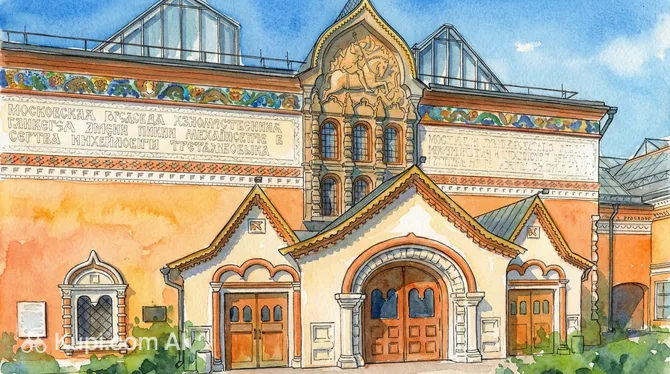
State Tretyakov Gallery. Illustration.
Source: Kupi.com AI

Traveler photos:

A visit to the Tretyakov Gallery is a true journey through the centuries of Russian culture. Here, every room opens a new page of history reflected in the canvases of great masters. It is a place where you can spend hours looking at paintings familiar since childhood from book illustrations and discovering new names. The gallery was donated to Moscow in 1892 and has since remained a center of attraction for everyone who values art and history.

Contacts

To plan your visit and find the current exhibition schedule, opening hours, and ticket prices, it is best to consult the gallery's official sources. All the necessary information for visitors is available on the museum's website and via the general information phone line.

How to contactContact
AddressLavrushinsky Ln, 10, Moskva, Russia, 119017
Phone number+7 495 957-07-27
Websitewww.tretyakovgallery.ru

What to Do

A visit to the Tretyakov Gallery offers a unique opportunity to trace the entire history of Russian fine art. The primary activity for any guest is, of course, exploring the rich permanent exhibition. Depending on your preferences, you can choose one of the two main routes. The historic building in Lavrushinsky Lane is dedicated to art created before the beginning of the 20th century. Here you will see quintessential paintings by Ivan Shishkin, Ilya Repin, Vasily Surikov, and other great masters. If you are more drawn to the avant-garde and the art of the last century, your path leads to the New Tretyakov on Krymsky Val, where 20th-century masterpieces are gathered.

The gallery is not just a collection frozen in time. Cultural life is constantly buzzing here: temporary exhibitions are regularly organized, allowing for a deeper look at the work of individual artists, entire movements, or historical periods in art. Additionally, themed tours and lectures are held for visitors, helping them better understand the context of the era and the authors' intentions. This is a wonderful opportunity to see familiar paintings from a new perspective and hear the fascinating stories of their creation.

Beyond viewing artworks, the Tretyakov Gallery offers other forms of leisure. It is a major scientific center involved in the storage, restoration, and study of cultural heritage. Although the restoration work itself is hidden from public view, knowing this adds special significance to the visit. For those seriously interested in art, it will be interesting to know that the museum houses one of the richest specialized libraries in Moscow, with over 200,000 volumes. Visiting the gallery is not just about looking at paintings, but a full immersion into the world of art and its history.

Getting There

The State Tretyakov Gallery is conveniently located in the center of Moscow, and getting there is quite easy. It is important to remember that the museum has two main buildings: the historic building in Lavrushinsky Lane and the New Tretyakov on Krymsky Val. Your route will depend on which specific exhibition you plan to visit.

The gallery's historic building, which houses Russian art up to the early 20th century, is located at 10 Lavrushinsky Lane. The most convenient way to get here is by metro. You need to go to the "Tretyakovskaya", "Novokuznetskaya", or "Polyanka" stations. From any of these stations, a pleasant walk of no more than 10–15 minutes will take you to the museum entrance.

If your goal is 20th and 21st-century art, you need the New Tretyakov, located at 10 Krymsky Val. The nearest metro stations to this building are "Oktyabrskaya" and "Park Kultury". A walk from these stations to the gallery takes about 10–12 minutes and passes through the picturesque "Muzeon" Art Park, opposite Gorky Park.

In addition to the metro, both gallery buildings can be reached by surface public transport. Many bus routes pass through the center of Moscow and stop within walking distance of the Tretyakovka. Furthermore, you can always use taxi services, which is especially convenient if you are traveling with children or prefer maximum comfort.

Nearest city: Moscow

History & Facts

The history of the Tretyakov Gallery is inextricably linked with the name of its founder, the Moscow merchant and patron of the arts Pavel Tretyakov. Its foundation date is considered to be May 22, 1856, when he acquired two works by Russian artists: "Temptation" by Nikolay Schilder and "Skirmish with Finnish Smugglers." This purchase marked the beginning of his main goal—to create a public museum of national art, which did not exist in Russia at that time. From the very beginning, Tretyakov collected the works not for himself but for society, dreaming of donating the collection to the city.

The collection grew so rapidly that during the patron's lifetime, in 1867, the gallery was first opened to visitors. A separate building was started in 1872 next to the Tretyakovs' mansion specifically for the expanded collection. In August 1892, Pavel Tretyakov realized his dream by presenting the entire collection along with the building as a gift to Moscow. At that time, the collection included 1,276 paintings, 471 drawings, and 10 sculptures by Russian masters, as well as 84 works by foreign artists. A year later, in 1893, the museum opened to the general public as a city-owned institution.

After the 1917 revolution, the gallery was nationalized and granted state status, solidifying its national importance. During this period, its holdings began to grow rapidly with works from confiscated private collections and other disbanded museums. Over the past decades, the Tretyakov Gallery has evolved not only into one of the world's most famous art museums but also into a major scientific and restoration center that continues its founder's mission of preserving and studying Russian art.

Time Needed

When planning a visit to the State Tretyakov Gallery, it is worth considering its scale. For a comprehensive but not overly detailed tour of the main exhibition in the historic building in Lavrushinsky Lane, it is recommended to allocate at least 3–4 hours. This time is generally sufficient to see the main masterpieces of Russian art from the 11th to the early 20th century, get acquainted with the work of key artists, and feel the museum's atmosphere. Some sources recommend at least 2 hours for a quick overview.

However, the Tretyakov Gallery is a complex that also includes the New Tretyakov on Krymsky Val, which presents 20th–21st-century art. If you wish to visit both buildings, it is best to spread your visit over two days, dedicating 3–4 hours to each. This approach will help avoid information fatigue and ensure you get the most enjoyment from each exhibition. For a deeper acquaintance with the collection, such as participating in themed tours or lectures, even more time may be required.

Working Hours

The State Tretyakov Gallery is open year-round, but visiting hours and days off may vary for the different buildings of the complex. As a rule, both the historic building in Lavrushinsky Lane and the New Tretyakov on Krymsky Val are open to visitors from Tuesday to Sunday, while Monday is a day off. Standard opening hours are from 10:00 to 18:00 on Tuesday, Wednesday, and Sunday. On Thursday, Friday, and Saturday, the gallery stays open longer—until 21:00—allowing you to plan an evening visit. Ticket offices and entry usually close an hour earlier.

To avoid long lines and guarantee entry to the museum, it is strongly recommended to buy tickets in advance online on the gallery's official website. Tickets are sold for a specific date and time slot (entry interval), and availability is limited. Although working hours are fairly stable, it is always useful to check the latest information on the museum's website before your visit, as the schedule may change on public holidays or during special events.

DayOpening hours
MondayClosed
Tuesday10:00 – 17:00
Wednesday10:00 – 17:00
Thursday10:00 – 20:00
Friday10:00 – 20:00
Saturday10:00 – 20:00
Sunday10:00 – 17:00

Nearby

A visit to the Tretyakov Gallery is a deep dive into the world of Russian art, but getting to know this historic district of Moscow would be incomplete without a walk through its surroundings. Located in the heart of the city, the gallery is surrounded by many other iconic sites within walking distance. By setting aside some time to explore the nearby streets, you can significantly enrich your experience and better feel the atmosphere of the capital.

Strolling through the neighborhood will allow you to see how closely history and modernity are intertwined. Just a few minutes' walk from the gallery, you can find ancient churches, modern art spaces, and world-famous landmarks. This is an excellent opportunity to gain a more comprehensive understanding of the cultural landscape of central Moscow.

NameDistance
Moscow Kremlin1.1 km
St. Basil's Cathedral1.2 km
Pushkin State Museum of Fine Arts1.2 km
Tomb of the Unknown Soldier1.5 km
The Black Swan Pub1.7 km
Vokrug Sveta1.9 km
Alexey Kozlov Club2 km

Have you reached the end of the page?

So the route has been studied inside and out