Support

Dmitriyevskaya Bashnya

About

The Dmitrievskaya Tower towers majestically over the city's central square — the main entrance to the ancient fortress and one of the most recognizable architectural monuments in Russia. Located in the center of the upland section of the Kremlin, it serves as the ceremonial gate through which thousands of tourists enter the historical complex every day.
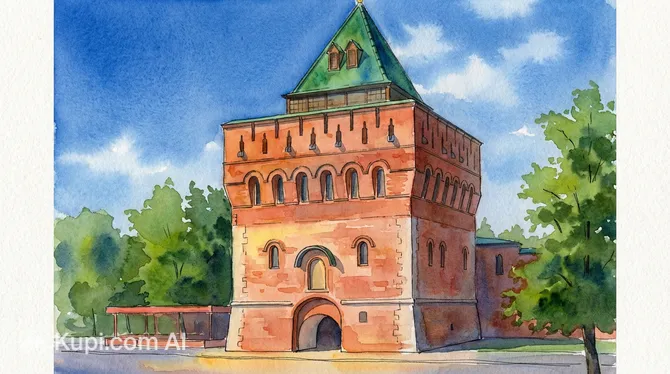
Dmitrievskaya Tower
Dmitrievskaya Tower. Иллюстрация. Источник: Kupi.com AI

This powerful stone structure with a square base is considered an unofficial symbol representing Nizhny Novgorod. The tower received its modern appearance in the ornate Russian Revival style at the end of the 19th century following a large-scale reconstruction led by architect Nikolay Sultanov. Although it has appeared slightly shorter over time due to the filling in of the fortress moat, its massive walls and high tented roof still make an imposing impression.

Today, the site holds museum status. The tower is not just a historical fortification but an important urban hub: the city's main streets radiate from here like rays. In the past, it was a central defensive post protected by drawbridges and powerful artillery, but today it is a place where history meets the modern rhythm of city life.

Contacts

For more details before your visit or to plan a group tour, you can use the official contact information. While the tower itself as an architectural site is accessible around the clock, the museum exhibitions inside may have specific visiting hours.

How to contactContact
AddressКремль, 6А, Нижний Новгород, Нижегородская обл., Россия, 603005
Websitekremlin.nnov.ru

What to Do

The first thing every guest should do is pass through the massive passage gates. Standing beneath the tower's vaults, you can physically feel the power of the ancient walls that protected the city for centuries. Be sure to notice the architectural details: the combination of rugged medieval masonry and decorative elements from the late 19th century creates a unique visual contrast.

Inside the tower, art and history exhibitions are regularly hosted. Since the building was specially converted into a museum in 1896, its interior spaces are perfectly adapted for displays. Here, you can learn more about the life of the Nizhny Novgorod garrison and see ancient artifacts. Photography enthusiasts should choose an angle from Varvarskaya Street or from the center of the square to capture the tower in all its glory against the cityscape.

A visit to the tower often marks the beginning of a grand journey through the Nizhny Novgorod Kremlin. It is a convenient starting point for a walk along the fortress walls, which offer breathtaking views of the confluence of the Volga and Oka rivers. Guides here often tell fascinating legends about the construction of the fortress and its defenders, turning a simple viewing of the stones into a vivid immersion into the past.

Getting There

The city's main gates are located in the very heart of the historical center at Kremlin, 6A. Thanks to its location, the Dmitrievskaya Tower is an ideal starting point for walks. Major pedestrian and transport arteries lead to it: Bolshaya Pokrovskaya, Varvarskaya, and Alekseyevskaya streets.

Reaching the site by public transport is very easy. You can take any bus, trolleybus, or fixed-route taxi heading to the "Minin and Pozharsky Square" or "Kremlin" stops. If you prefer the metro, the nearest station is "Gorkovskaya," from which you can enjoy a pleasant 15-minute walk along the pedestrianized Bolshaya Pokrovskaya Street directly to the fortress walls.

For those choosing a taxi or a private car, keep in mind that parking spaces directly near Minin Square are often limited. It is most convenient to leave your car in paid parking lots nearby and walk the last few hundred meters to fully appreciate the scale of the ancient walls. Navigator coordinates: 56.3270713, 44.0056501.

Ближайший город: Nizhny Novgorod

History & Facts

The history of this structure is rooted deep in the past. The first mentions of the tower appear in chronicles as early as 1372–1374. It is believed that Grand Prince Dmitry Konstantinovich initiated the construction. It was named either in honor of the prince himself or after Saint Demetrius of Thessaloniki, whose church once stood nearby. However, the appearance we see today was formed in the early 16th century, when the construction of the stone Kremlin was overseen by the Italian architect Pietro Francesco (known in Russia as Pyotr Fryazin).

In the 16th and 17th centuries, the Dmitrievskaya Tower was a powerful defensive hub. It possessed colossal firepower, housing more than 60 fortress guns and 7 heavy cannons. Throughout its history, the tower survived many trials, including a major fire in 1540 that destroyed its roof. In those times, a deep water-filled moat and additional fortifications stood before it, making the entrance to the city virtually impregnable.

Over time, the military significance of the fortress faded. In the 18th century, the artillery was removed, and in the 1830s, the defensive moat was filled in. Because of this, the tower visually "grew" out of the ground, although in reality, part of its lower tier became hidden by soil, making it 5 meters shorter. A new stage of life began at the end of the 19th century when architect Nikolay Sultanov reconstructed it in the Russian Revival style for the All-Russia Exhibition of 1896.

It was then that the tower acquired its famous silhouette with a high tented roof and became the home for the city's first art and history museum. Today, it remains the main facade of Nizhny Novgorod, combining austere medieval power with the elegance of Imperial-era architecture.

Time Needed

To simply admire the tower's architecture from the outside, take a few memorable photos, and walk through its majestic arches, 30–40 minutes will be sufficient. This is an ideal option for those visiting the city briefly or as part of a short walk through the center.

If you decide to go inside to explore the current museum exhibitions or plan to continue your route with a walk along the Kremlin walls themselves, you should set aside at least 1.5–2 hours. This will allow you to immerse yourself in history without rushing and enjoy the panoramic views overlooking Minin and Pozharsky Square.

Working Hours

External viewing of the tower and passage through its gates into the Kremlin territory is possible at any time — the site is accessible to visitors 24 hours a day, daily. This allows tourists to admire the architectural monument under the glow of night illumination, when it looks especially mysterious and majestic.

The schedule for the museum exhibitions located in the inner tiers may differ from the general access to the tower, so it is better to aim for daytime hours to visit the displays. Nevertheless, as part of the urban space, the Dmitrievskaya Tower is open from Monday to Sunday without breaks or days off.

Круглосуточно

Nearby

Its location in the very heart of the city makes a visit to the tower an excellent reason to check out neighboring interesting locations. The surrounding area is filled with entertainment centers and parks that will help diversify your cultural itinerary and add vivid impressions to your trip.

A walk through the adjacent blocks will allow you to find both modern interactive museums and spacious recreation areas. Below is a list of places within walking or driving distance of the Kremlin walls:

NameDistance
Kremlin Arsenal0.1 km
Nizhny Novgorod Kremlin0.2 km
Nizhny Novgorod State Art Museum0.3 km
Valery Chkalov Monument0.4 km
Monument to Yevgeny Evstigneev0.4 km
Dzhani Restaurant0.4 km
Chkalov Staircase0.4 km

Reached the end of the page?

That means the route is fully explored