Support

Dragon Bridge

About

The Dragon Bridge is one of the most recognizable and photographed symbols of Ljubljana, the capital of Slovenia. Spanning the Ljubljanica River near the Central Market and Vodnik Square, this bridge is more than just a transport artery; it is a true work of art and a signature landmark of the city. Its main feature is the four impressive bronze dragon sculptures that fiercely guard its corners, giving it a unique and mystical appearance.
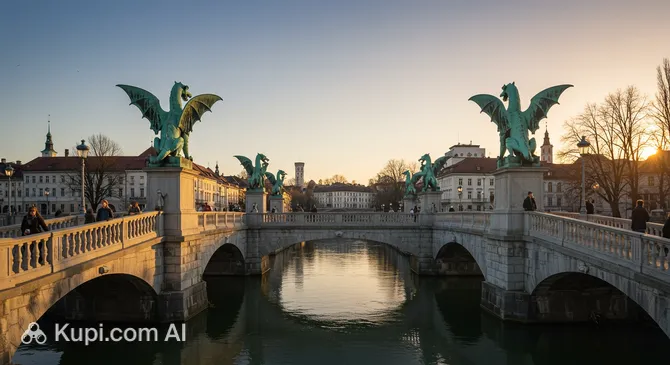
Dragon Bridge. Illustration.
Source: Kupi.com AI

Traveler photos:

Built between 1900 and 1901, the Dragon Bridge was a landmark structure for its time. It was erected on the site of an old wooden bridge damaged by the 1895 earthquake. Originally named the "Jubilee Bridge of Emperor Franz Joseph I," this official title was quickly forgotten, and locals began calling it the Dragon Bridge. Architecturally, the bridge is a brilliant example of the Vienna Secession (Art Nouveau) style, while from an engineering perspective, it was a real breakthrough: it was the first reinforced concrete bridge in Ljubljana and one of the first in Europe, as well as the first bridge in the country with an asphalt surface.

The dragon is not a random symbol for Ljubljana; it is closely tied to the legend of the city's founding. Tradition says it was here that the Argonaut Jason defeated a winged serpent. These mythical guardians of the bridge not only recall ancient history but are also the stars of a modern urban legend, which claims the dragons wag their tails when a virgin crosses the bridge. Visiting the Dragon Bridge is a must-do for any traveler wishing to feel the soul and character of the Slovenian capital.

Contacts

The Dragon Bridge is a public city landmark, so it does not have specific contact details such as a phone number or email address. For detailed information about the bridge and other interesting sights in Ljubljana, you can contact the city's Tourist Information Center. Additionally, up-to-date information is often available on the official tourism websites of the capital of Slovenia.

How to contactContact
AddressResljeva c. 2, 1000 Ljubljana, Slovenia
Phone number+386 1 306 12 15
Websitewww.visitljubljana.com

What to Do

Visiting the Dragon Bridge is, first and foremost, an opportunity to take iconic photos. The four bronze dragon sculptures guarding the bridge have become a true symbol of Ljubljana, and no travel album is complete without a picture with these mythical guardians. Find the perfect angle and capture yourself next to a legend!

Don't stop at just taking photos with the dragons. The bridge itself is a magnificent viewpoint, offering picturesque vistas of the Ljubljanica River, its embankments, and the charming architecture of the old town. It's a great place to pause for a few minutes, admire the panorama, and feel the rhythm of the Slovenian capital.

Be sure to recall the local legend that adds a touch of playfulness to your walk. They say the dragons wag their tails when a virgin crosses the bridge. This amusing story has become an integral part of Ljubljana's folklore and a constant source of jokes among tourists and locals alike.

Beyond the panoramic views, pay attention to the details. The bridge is a prime example of Vienna Secession architecture. Take a closer look at the intricate craftsmanship of the dragon sculptures themselves, created at a factory in Vienna, as well as the decorative elements adorning the structure. This will allow you to deeper appreciate the historical and artistic value of the site.

A walk across the Dragon Bridge is more than just crossing a river; it's a true immersion into the city's cultural identity. Since the dragon has adorned Ljubljana's coat of arms for centuries, meeting its monumental likenesses helps you better understand the soul and history of Slovenia's capital.

Getting There

The Dragon Bridge is conveniently located in the very heart of Ljubljana, making it easily accessible for tourists. Spanning the Ljubljanica River and situated northwest of Vodnik Square, it is an easy walk from most of the city's tourist areas. For example, if you are strolling through the old town or coming down from Ljubljana Castle, the walk to the bridge will take no more than 10–15 minutes. The journey from the main railway or bus stations is also short — only about 15–20 minutes on foot.

For those who prefer public transport, the bridge can be reached by one of the city buses — many routes pass nearby, and there are stops in the vicinity. Additionally, the capital of Slovenia has an excellent bike-sharing system, which is a convenient and pleasant way to get around. By renting a bike, you can not only quickly reach the Dragon Bridge but also enjoy exploring other attractions in charming Ljubljana.

Nearest city: Ljubljana

History & Facts

The history of the Dragon Bridge is closely linked to the renovation of Ljubljana following the devastating earthquake of 1895. The old wooden Butchers' Bridge, which had stood on this site since 1819, was seriously damaged, and city authorities decided to build a new, more modern crossing. The project was entrusted to Austrian engineer Josef Melan and architect Jurij Zaninović, who designed it in the then-fashionable Vienna Secession (Art Nouveau) style. Construction took place from 1900 to 1901 as part of a large-scale urban reconstruction plan.

The bridge was officially opened in 1901. Initially, it was named the "Jubilee Bridge of Emperor Franz Joseph I" to commemorate the 40th anniversary of the Austro-Hungarian monarch's reign. However, this long name never caught on with the locals. Thanks to the four expressive dragon sculptures gazing fiercely from their pedestals at the corners, residents almost immediately began calling it by the simple and descriptive name — the Dragon Bridge.

For its time, the Dragon Bridge was a true engineering marvel. It was the first reinforced concrete bridge in Ljubljana and one of the first in Europe built using the innovative "Melan system." Upon completion, its arch was considered the third largest in Europe. Furthermore, it became the first bridge in Slovenia to be paved with asphalt, highlighting its technical advancement.

The choice of dragons as decoration was not accidental, as this mythical creature has been the city's symbol for centuries. According to an ancient legend, the founder of Ljubljana, the Greek hero Jason, defeated a terrible dragon in these parts while on his way home with the Argonauts. Thus, the sculptures on the bridge serve not only as ornamentation but also as a reference to the mythological roots and the coat of arms of the Slovenian capital.

Time Needed

Viewing the Dragon Bridge won't take much time and can easily fit into any Ljubljana itinerary. For a quick look at this iconic landmark, 15–30 minutes is sufficient. This is enough time to walk leisurely across the bridge, take striking photos with the famous dragon sculptures that are considered the symbol of the city, and enjoy the panoramic views of the Ljubljanica River.

If you want to immerse yourself more deeply in the atmosphere of the place, plan for about one hour. This will allow you not only to take memorable photos but also to examine the architectural details of the bridge, designed in the Vienna Secession style. You can also combine your visit with a walk to nearby attractions, such as the Central Market or Vodnik Square, to get a more complete impression of the heart of Slovenia's capital.

Working Hours

Since the Dragon Bridge is part of the city infrastructure and a public space, it is open to visitors 24/7, including weekends and holidays. It is an active bridge for both vehicles and pedestrians, so access is completely free and requires no prior booking or ticket purchase.

The bridge is open for strolls year-round, regardless of the season. The place takes on a special charm in the evening when the lights come on, effectively highlighting the expressive dragon sculptures and the Art Nouveau architectural details. Thus, there are no specific working hours for the Dragon Bridge — it is always ready to welcome guests to the capital of Slovenia.

Open 24 hours

Nearby

Visiting the Dragon Bridge is a wonderful way to start your discovery of Ljubljana, but the city's true charm is revealed as you explore its surroundings. Thanks to its central location, the bridge serves as an ideal starting point for a walking tour of the most interesting corners of the Slovenian capital. Many key attractions are just a few steps away, making it easy to create a rich and exciting itinerary.

A stroll through the neighborhood will enhance your experience and help you feel the atmosphere of Ljubljana more deeply. From lively markets and majestic cathedrals to cozy squares and modern museums — everything is within walking distance. By exploring the areas closest to the bridge, you can get a complete picture of the cultural and historical diversity of this amazing city.

NameDistance
House of Experiments0.1 km
Central Market0.1 km
Ljubljana Castle Funicular0.2 km
Ljubljana Cathedral0.2 km
Robba Fountain0.3 km
Prešeren Square0.3 km
Ljubljana Castle0.4 km

Have you reached the end of the page?

So the route has been studied inside and out