Support

Torre de Mangana

About

Mangana Tower (Torre de Mangana) is one of the most recognizable symbols carefully preserved by ancient Cuenca. Perched on top of a rocky cliff, this historic structure is the only surviving fragment of the powerful fortress wall that protected the city during the Middle Ages. In 1996, the tower, along with other monuments of the old center, was included in the UNESCO World Heritage list.
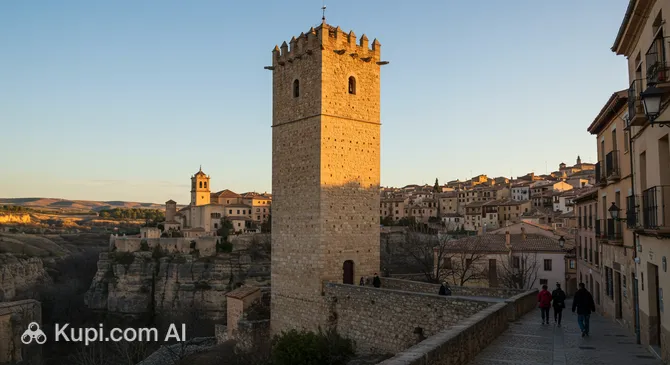
Mangana Tower
Mangana Tower. Иллюстрация. Источник: Kupi.com AI

Rising to an altitude of about 956 meters above sea level in Spain, the structure once served as a strategic watchpoint. Its platform offers breathtaking views of the confluence of the Júcar and Huécar rivers, as well as picturesque valleys. Today, the tower is equipped with the city's main clock, whose chime echoes over the ancient quarters.

The architectural appearance of the tower harmoniously combines Arabic heritage with elements rebuilt in subsequent centuries. It is located on Plaza Mangana and serves as an excellent landmark for all travelers wishing to touch the centuries-old history of the region.

Contacts

To clarify information about events on the square or rules for visiting observation points in Cuenca, you can use the official resources of the municipality.

How to contactContact
AddressC. Sta. María, 1, 16001 Cuenca, Spain
Websitewww.cuenca.es

What to Do

The main reason to visit Mangana Tower is the incredible panoramic views. From the observation deck, you can see the city as if it were in the palm of your hand: from the famous "hanging houses" to the winding riverbeds. We especially recommend planning your visit for sunset, when the rays of the setting sun paint the surrounding cliffs in warm golden tones, creating perfect conditions for photography.

A stroll around Plaza Mangana itself will allow you to examine the ancient clock and enjoy the silence away from the busiest tourist paths. Nearby is the Science Museum, a visit to which makes a great addition to your cultural itinerary. Don't forget to peek into the narrow alleys leading from the tower to Plaza Mayor—every stone here breathes history.

For fans of mysticism and folklore, getting to know the local legend of the clockmaker is a fascinating treat. They say the master put his soul into the mechanism of the city's main clock, and its rhythmic pulse has accompanied the lives of the townspeople for centuries. The atmosphere of this place invites a calm, contemplative mood and an immersion into the past.

Getting There

The tower is located in the heart of the historical district at C. Sta. María, 1. If you are already in the center, the most pleasant way to reach it is a stroll from Plaza Mayor. The walk along the picturesque Santa Maria Street takes no more than 5–10 minutes, allowing you to enjoy the architecture of the old houses along the way.

For those arriving from Madrid, the most convenient option is the high-speed train (AVE), which reaches Cuenca-Fernando Zóbel station in approximately one hour. From the station to the old town, you can quickly get there by city bus or taxi in about 10–15 minutes. There is also a regular bus service connecting to other major centers in Spain.

If you are traveling by car, keep in mind that access to the upper part of the city is often restricted to residents. It is recommended to leave your vehicle in the parking lot at the foot of the hill (for example, near Parque de San Julián) and walk up or use the special tourist transport.

Ближайший город: Cuenca

History & Facts

The history of this site dates back to the 11th century when an Arabic fortress—an alcazar—stood on the territory of modern Cuenca. The Moors chose this hard-to-reach plateau for their defensive lines, recognizing its strategic advantage. It was then that the foundations were laid, which later became part of the Mangana Tower.

After the Castilian King Alfonso VIII conquered the city in 1177, the tower was rebuilt and integrated into the system of Christian fortifications. In the 15th and 16th centuries, it began to acquire its modern features: the structure was used not only for defense but also as an important public building. During this period, the first mechanical clocks were installed, making it the center of city life.

Over the centuries, the building has undergone numerous reconstructions, surviving fires and natural decay. Although most of the Moorish walls were lost over time, Mangana Tower stood its ground, preserving its austere and majestic appearance as a reminder of the former power of the ancient fortress.

Time Needed

Typically, tourists need about 30–45 minutes for an external viewing of the tower and a rest in the square. This is enough time to take memorable photos, admire the architecture, and look over the information boards.

However, if you plan to wait for the beautiful evening light or combine your visit with a thorough walk through the nearby streets of the old town, it is better to set aside 1–1.5 hours. This will allow you to enjoy the views from the observation points without rushing and to soak in the unique atmosphere of the medieval quarter.

Working Hours

The square and Mangana Tower itself are available for external viewing at any time. According to official data, the site is open around the clock (24 hours) every day of the week, from Monday to Sunday.

This gives guests complete freedom when planning their itinerary: you can come here early in the morning to watch the sunrise in silence, or late in the evening when the city lights come on, giving the tower a mysterious look.

Круглосуточно

Nearby

Cuenca is a city literally steeped in history, so a walk around Mangana Tower will inevitably lead you to other fascinating sites. Exploring the surroundings will allow you to fully appreciate the unique location of this medieval settlement on the cliffs and see its main masterpieces.

NameDistance
Science Museum of Castilla-La Mancha0.1 km
Taberna Jovi0.2 km
La Edad de Oro Pub0.2 km
Hanging Houses of Cuenca0.3 km
Cuenca Cathedral0.3 km
Museum of Spanish Abstract Art0.3 km
5 Sentidos by Fran Martínez0.3 km

Reached the end of the page?

That means the route is fully explored