Support

Porch of the Glory

About

Imagine one of the most significant masterpieces of Romanesque sculpture in the world — the Pórtico de la Gloria (Portico of Glory). This magnificent portal, created by the legendary Master Mateo at the end of the 12th century, serves as the main western entrance to the famous Cathedral that Santiago de Compostela is so proud of. Located in the heart of Spain, this site draws millions of pilgrims and art lovers with its monumentality and spiritual depth.
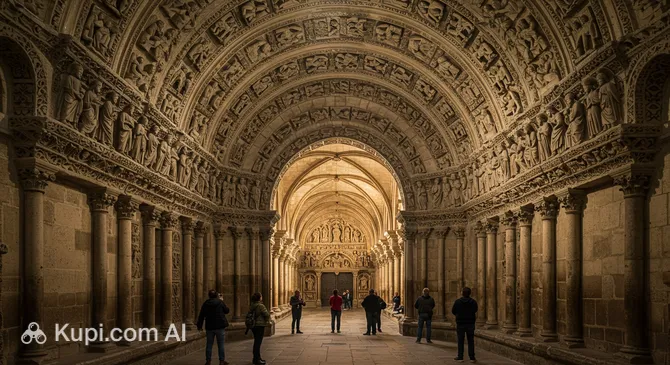
Portico of Glory
Portico of Glory. Иллюстрация. Источник: Kupi.com AI

Central to this stone symphony is the majestic figure of the resurrected Jesus Christ, surrounded by symbols of the Evangelists and the heavenly host. The three arches of the portico — the left dedicated to the Old Testament, the central to the Last Judgment, and the right to the New Testament — form a complex theological composition that for centuries served as a "Bible for the illiterate," telling the sacred story through the expressive plasticity of stone.

Thanks to a unique restoration completed recently, the Pórtico de la Gloria has regained the detailing and subtle shades of color that seemed lost forever. Today, it is not just a historical object but a living testament to medieval genius, included in the UNESCO World Heritage list as an integral part of Europe's cultural code.

Contacts

To clarify information regarding your visit, book tickets for special tours, or check the event schedule, you can use the cathedral's official communication channels.

How to contactContact
Address15704 Santiago de Compostela, A Coruña, Spain
Phone+34 981 55 29 85
Websitecatedraldesantiago.es

What to Do

When visiting this site, your main task will be a detailed study of the incredible stone carvings. Start with the central column, which depicts the Tree of Jesse — the genealogy of Christ. Notice the incredible expression of the figures: unlike many other Romanesque monuments, the characters of the Pórtico de la Gloria seem alive, as if they are engaged in a silent dialogue with each other, smiling or lost in thought.

Be sure to find the figure of Master Mateo himself, modestly kneeling on the reverse side of the portal. There is a long-standing tradition where pilgrims would touch their foreheads to the master's head, hoping to receive a portion of his wisdom and talent. Although direct contact with the stone is now restricted for its preservation, being near the "figure of wisdom" remains an important part of the visit.

Don't forget to look at the upper tiers, where the 24 Elders of the Apocalypse are tuning their musical instruments. The detailing is so high that musicologists have been able to reconstruct medieval instruments from these depictions. If you want to learn more about the hidden meanings, we recommend joining an organized tour, which often includes access to parts of the cathedral where you can appreciate the portal from unusual angles.

Getting There

The legendary Pórtico de la Gloria is located inside the Cathedral, which crowns the city's main square — Praza do Obradoiro. This is the very heart of the historical district, which is a fully pedestrian zone. If you are already in the old town, a walk to the cathedral will be a pleasant part of your route, as all pilgrim paths invariably lead right here.

If you arrive in Santiago de Compostela by plane, you can get from the airport (SCQ) to the city center by taxi or regular bus in about 20–30 minutes. Travelers arriving by train or intercity bus will find themselves at the station, from which the cathedral can be reached on foot in 15–20 minutes or by taking a local city bus.

For those traveling by car, it is important to remember that access to the historical center is restricted. It is recommended to leave your car in one of the paid parking lots on the edge of the old town, such as Parking San Francisco, which is only a 10-minute leisurely walk to the Pórtico de la Gloria through picturesque streets.

Ближайший город: Santiago de Compostela

History & Facts

The creation of this sculptural masterpiece is inextricably linked with the name of Master Mateo, a genius architect and sculptor of the 12th century. Work on the portal was completed in 1188, marking the culmination of the Romanesque cathedral's construction. Although the final consecration of the entire temple complex took place later, in 1211, the Portico immediately became a symbol of the triumph of Christian art.

The historical significance of the Portico of Glory is closely intertwined with the cult of Saint James the Apostle. According to legend, after the discovery of the saint's relics in the 9th century, this site became one of the main pilgrimage centers in Europe. The Portico served as the grand gateway through which pilgrims, exhausted by their long journey, entered "Heavenly Jerusalem," finding spiritual solace at the feet of the stone figures.

Over the centuries, the appearance of the portal changed under the influence of time; however, a massive ten-year restoration, completed in 2018, allowed the masterpiece to regain its former glory. Experts managed to restore fragments of the original polychrome painting, allowing modern visitors to see the details of the sculptures almost as vibrantly as people did in the Middle Ages.

Today, this site is recognized as a UNESCO World Heritage site as part of the old town. The Pórtico de la Gloria is not just an architectural element, but a stone chronicle capturing biblical stories, the emotions of prophets, and the faith of thousands of generations of pilgrims.

Time Needed

To do more than just glance at the Pórtico de la Gloria, and to truly appreciate the craftsmanship of the medieval carvers and delve into the complex symbolism of the composition, usually requires 1 to 2 hours. This is enough time to examine the central arch with the figure of Christ in detail and study the expressive faces of the prophets and apostles.

If you plan to combine viewing the portal with a full tour of the entire Cathedral, a visit to its museum, and a climb to the roof for panoramic views of the city, you should set aside at least 3 hours for your visit. Keep in mind that during the peak tourist season, there may be queues at the entrance, so it is better to arrive early.

Working Hours

You can visit the Pórtico de la Gloria daily throughout the week. The official operating hours for the cathedral and the portico are as follows:

  • Monday — Sunday: 09:00 – 20:00

Please take into account that on holidays or during solemn religious services, access for tourists may be limited. It is recommended to check for the most up-to-date information on the cathedral's official website before your visit.

9:00 – 20:00

Nearby

Its location in the heart of the historical center makes visiting the portico an ideal starting point for further exploration of the city. Just a few steps from the cathedral are magnificent examples of medieval and Baroque architecture that will help you feel the atmosphere of the pilgrimage capital more deeply.

A walk through the adjacent squares and narrow streets will reveal cozy courtyards, ancient universities, and majestic monasteries, each holding its own unique history.

NameDistance
Praza do Obradoiro0.1 km
San Martiño Pinario Monastery0.1 km
Fonseca Palace0.1 km
Monastery of San Martiño Pinario0.1 km
Cervantes Square0.2 km
Kiko Pastur Magic Museum0.2 km
Atlántico Pub0.2 km

Reached the end of the page?

That means the route is fully explored