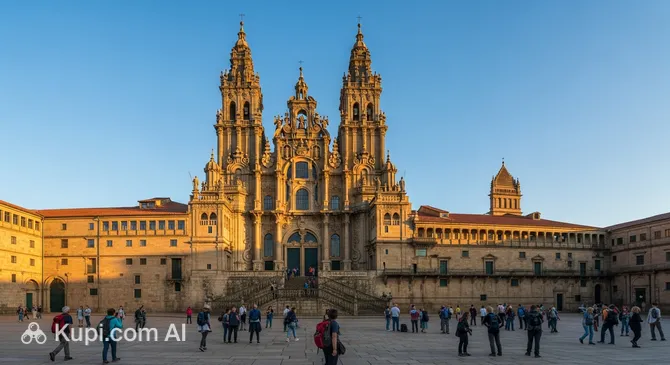
Imagine a place where centuries-old traditions meet architectural triumph—that is Praza do Obradoiro. It is the historic heart of the city of Santiago de Compostela in Spain and the main focal point for thousands of pilgrims completing their journey to the relics of St. James.
Praza do Obradoiro. Illustration.
Source: Kupi.com AI
Traveler photos:
The square gets its name from the Galician word "Obradoiro", which means "workshop." This name recalls the times when hundreds of stonemasons worked right here in the open air, carving blocks for the grand construction. Today, a unique ensemble has formed around the square where you can witness the city's thousand-year history: from the Baroque facade of the Cathedral to the majestic Raxoi Palace, designed by French architects in the 18th century.
Contacts
For those planning a visit to the heart of the city, below are the contact details for this historic location:
How to contact
Contact
Address
Praza da Inmaculada, 2, 15704 Santiago de Compostela, A Coruña, Spain
What to Do
The main reason people come to the square is to contemplate the magnificent western facade of the Cathedral. Built in the Baroque style, it is decorated with numerous sculptures, each with its own story and artistic value. It is the perfect place to simply stop and soak up the energy of the square while watching travelers arrive from all over the world.
From the square itself, the picturesque San Francisco Street begins. A walk along it will lead you to the monument of St. Francis of Assisi and the monastery of the same name. Although time has changed the appearance of the original 13th-century buildings, the modern Baroque facade of the monastery and its bell towers create an impressive visual contrast with the architecture of Obradoiro, making your walk even more rewarding.
Getting There
Getting to this iconic spot is easy, as the square is located in the very center of the city's historic district. Most tourists and pilgrims prefer walking through the narrow ancient streets leading to the Cathedral. All navigation in the old city intuitively guides you exactly to this point.
If you are in a remote area or have just arrived in the city, it is most convenient to use a taxi—drivers know this place perfectly and will drop you off in the immediate vicinity of the pedestrian zone. Public transport also runs through the city; however, movement inside the old quarters is limited, so a short walk along the cobbled streets will be a pleasant conclusion to your journey.
Nearest city: Santiago de Compostela
History & Facts
The history of Praza do Obradoiro is inextricably linked with the development of the main cathedral. The temple's original western facade was built in a strict Romanesque style and looked quite modest. Its towers differed significantly: the right one, the Torre de las Campanas (Bell Tower), was much taller than the left one, giving the cathedral its characteristic asymmetry.
A period of large-scale changes began in the 17th century. Under the guidance of masters such as José de la Peña de Toro and Domingo de Andrade, the square and facade began to take on their Baroque features. These works paved the way for the creation of El Obradoiro—the greatest work of 18th-century Galician Baroque that we see today.
Interestingly, the large-scale reconstruction was driven not only by a desire for beauty but also by engineering necessity. Over time, the internal columns of the cathedral began to lean noticeably. To strengthen the structure and prevent collapse, complex work was carried out, which simultaneously turned the facade into one of the most richly decorated architectural masterpieces in Europe.
Time Needed
To simply enjoy the atmosphere and view the surrounding buildings from the outside, 1–2 hours will be quite enough. This is plenty of time to take memorable photos, admire the Raxoi Palace, and witness the touching moments when pilgrims, having finished their multi-day journey, celebrate reaching their goal right on the square's stones.
However, if you plan to visit the cathedral's interior, go down to the crypt, or look into the museum, you should set aside at least half a day for your visit. The beauty of this place lies in the small details and slow contemplation, which is best experienced in the morning or pre-sunset hours.
Working Hours
Since Praza do Obradoiro is an open public space, it is accessible for visiting 24/7 and free of charge. You can appreciate its grandeur both in the rays of the morning sun and in the mysterious evening illumination.
Nevertheless, the museums and interior halls of the cathedral operate on a strict schedule. To enter the buildings or take a tour, we strongly recommend checking the official website of the attraction before your visit, as opening hours may change depending on the season and church holidays.
Nearby
Exploring the surroundings of the main square allows you to dive deeper into the atmosphere of the ancient city. Within a few minutes' walk, architectural monuments are concentrated that have neighbored the great cathedral for centuries.