Support

Palace of Fonseca

About

In the heart of the historical center of Santiago de Compostela lies an architectural gem known as the Fonseca Palace (or Colegio de Fonseca). This majestic 16th-century building is one of the oldest university buildings in Spain. Built of grey granite, the palace harmoniously combines the exquisite Plateresque style with Gothic and Renaissance elements, serving as a living testament to the region's rich academic history.
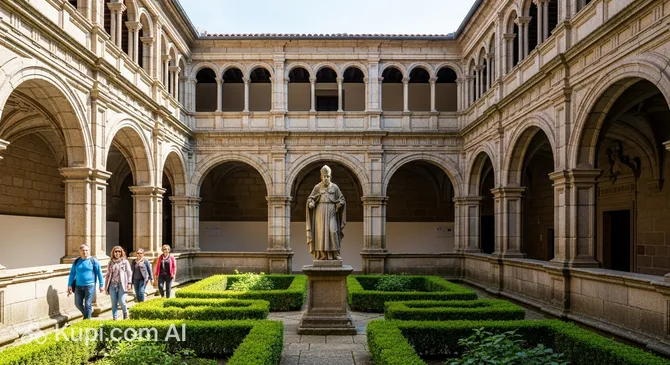
Fonseca Palace
Fonseca Palace. Иллюстрация. Источник: Kupi.com AI

The building's facade is decorated with magnificent carvings: here you can see statues of Saint James and the Virgin Mary, as well as the coat of arms of the noble Fonseca family, easily recognized by its five stars. Inside, a quiet and incredibly photogenic inner courtyard (cloister) awaits guests, surrounded by two-tier arcades with a rich balustrade. Medallions depicting monarchs and church figures adorn the walls, creating an atmosphere of strict dignity and grandeur.

Today, this historical monument is more than just a museum site—it houses the Faculty of Geography and History of the local university. This makes the Fonseca Palace a unique place where modern student life meets centuries-old traditions. For tourists, it is valuable not only as an architectural masterpiece but also as a venue for important cultural exhibitions and official events.

Contacts

To ensure your visit is as comfortable as possible, it is recommended to check the official details in advance. The palace is part of the university complex, so administrative matters are handled through the relevant university services. Below is the up-to-date information to help you find the building and contact the staff.

Please note that opening hours may change during holidays, so it is worth confirming details using the provided phone number.

How to contactContact
AddressRúa do Franco, s/n, 15704 Santiago de Compostela, A Coruña, Испания
Phone+34 881 81 10 99
Websitewww.santiagoturismo.com

What to Do

The main impression of visiting the Fonseca Palace is a walk through its inner courtyard, or cloister. Here, you can spend hours admiring the stone carvings and medallions featuring portraits of rulers, created by master Gil de Hontañón. The peaceful atmosphere of the courtyard is perfect for taking a break from the noise of pilgrimage routes and capturing artistic photos against the backdrop of Renaissance arches.

Be sure to visit the former refectory (dining hall) of the college — today, it is a spacious hall with a stunning ceiling, where important political decisions were made in the past. Nearby is the cozy Gothic chapel, whose interior invites quiet contemplation. Attentive visitors will also appreciate the filigree work on the second-tier balustrades, where every element looks like lace despite the hardness of the granite.

Since the building is actively used by the university, interesting temporary exhibitions and public lectures are often held here, usually open to everyone. This is an excellent opportunity to see not only the architecture but also ancient university furniture, frescoes, and library collections, feeling the continuity of knowledge in one of Europe's most respected educational institutions.

Getting There

The Fonseca Palace is located in the heart of the historical quarter, in close proximity to the famous cathedral. Since this is a pedestrian zone, the most pleasant way to get here is a walk through the old streets. From the main squares of Praterías or Obradoiro, the walk takes no more than 5 minutes. Finding the building is easy, as it is one of the architectural landmarks of the area.

If you plan to use public transport, the nearest stops are Praza da Quintana or Rúa do Franco. City buses on lines C1 and C2, which connect the center with the railway station, run here regularly. Travelers arriving from the airport can take the ALSA bus and then transfer to a taxi or walk for about 15 minutes from the city center stop.

For those traveling by car, it is important to remember that the center of Santiago de Compostela is closed to private vehicles. It is recommended to leave your car in one of the secure parking lots, such as the one near Praza da Galiza. From there, you can reach the palace in 10–15 minutes while enjoying the city's atmosphere.

Ближайший город: Santiago de Compostela

History & Facts

The history of this majestic building is inextricably linked to the name of Archbishop Alonso de Fonseca III. In the early 16th century, he decided to transform his family home into an educational center, laying the foundation for the future university. Construction took place between 1522 and 1544 under the guidance of prominent architects of the time — Juan de Alava and Alonso de Covarrubias. This site became the cradle of the city's academic life.

In 1555, the college was granted the status of a Royal University, becoming an important intellectual center in Spain. Arts, theology, and law were taught here, and the founder himself, Fonseca III, was a well-known patron of the arts who maintained contact with prominent thinkers of the era, including Erasmus of Rotterdam. Interestingly, the current Baroque facade was completed much later, in 1688, by architect Diego de Romay.

Over the centuries, the building's functions changed: for a long time, it served as the main university library, and in the 1980s, its halls hosted the first sessions of the Parliament of Galicia. Today, it houses the Faculty of Geography and History, but the building still preserves its Renaissance spirit and stands as a living monument to the history of education in Europe.

Time Needed

To explore the Fonseca Palace without rushing, you usually need about 1–1.5 hours. This is enough time to examine the facade details, walk through the courtyard, and peek into the halls open to the public. The site is compact but rich in small decorative elements that deserve attention.

It is recommended to allocate about 20 minutes for an external inspection and photos from the street, and spend the main part of your time inside, enjoying the silence of the cloister and the atmosphere of the ancient chapel. If you decide to visit one of the temporary exhibitions often held here, you should add another 30 minutes to your visit.

Working Hours

You can visit the Fonseca Palace during the week, except for Mondays and Sundays when the building is closed to tourists. The standard schedule includes a siesta break: on Tuesday and Saturday, the doors are open from 11:00 AM to 2:00 PM and from 5:00 PM to 8:30 PM.

Given that the palace houses an active faculty and hosts official events, the schedule may change. Before planning your visit, it is highly recommended to check the city's official tourism website to ensure the working hours are up to date.

DayWorking hours
понедельникЗакрыто
вторник11:00–14:00, 17:00–20:30
среда11:00–14:00, 17:00–20:30
четверг11:00–14:00, 17:00–20:30
пятница11:00–14:00, 17:00–20:30
суббота11:00–14:00, 17:00–20:30
воскресеньеЗакрыто

Nearby

Its location in the historical center makes the Fonseca Palace an ideal starting point for exploring the city's cultural heritage. Sites that have attracted pilgrims and art lovers from around the world for centuries are concentrated nearby. Exploring these surroundings will allow you to fully experience the unique spirit of the Galician capital.

A short walk will lead you to the main squares and cathedrals, where every stone breathes history. Below is a list of interesting locations within walking distance:

NameDistance
Praza do Obradoiro0.1 km
Portico of Glory0.1 km
San Martiño Pinario Monastery0.2 km
Monastery of San Martiño Pinario0.2 km
A Noiesa Casa de Comidas0.2 km
Praza de Galicia0.3 km
Cathedral Viewpoint0.3 km

Reached the end of the page?

That means the route is fully explored