Support

USC ~ Museo de Historia Natural

About

In the heart of the picturesque Vista Alegre Park lies a place where nature and science meet in wonderful harmony — the USC Natural History Museum. This modern museum complex belongs to the University of Santiago de Compostela and is rightfully considered one of the hidden gems that Spain is proud of.
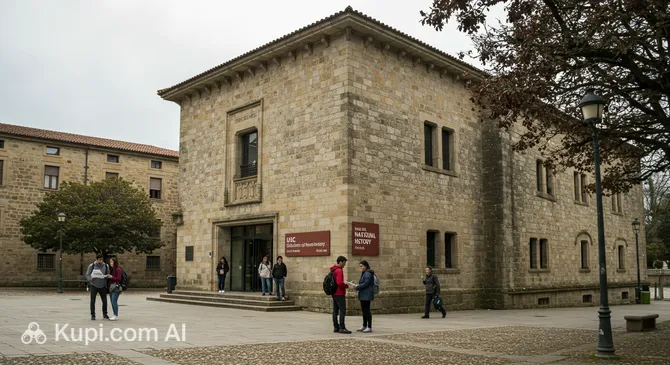
USC Museum of Natural History
USC Museum of Natural History. Иллюстрация. Источник: Kupi.com AI

The museum offers visitors a fascinating journey through the centuries, exploring rich collections of botanical, zoological, and geological specimens. Here, you can see not only rare fossils and minerals but also collections that are unique on a global scale, such as wooden crystal models or the extensive mollusk collection gathered by famous Galician naturalists.

A special feature of the museum is its modern approach to exhibition: realistic dioramas have been created here to recreate entire ecosystems. This allows you to do more than just look at display cases; you can literally immerse yourself in the natural environments of the region and other parts of the planet. The museum is a great discovery for both serious researchers and families with children who wish to expand their horizons in an engaging way.

Contacts

To find out more about special exhibitions or to book a group tour, you can use the museum's official contact channels.

How to contactContact
AddressParque Vista Alegre, s/n, 15705 Santiago de Compostela, A Coruña, Spain
Phone+34 881 81 63 50
Websitewww.usc.gal

What to Do

In the museum's halls, you can discover the amazing diversity of life on Earth. Be sure to pay attention to the malacology section, featuring thousands of mollusk species, and the collection of wooden crystal models, considered one of the most complete in the world. Animal lovers will appreciate the detailed taxidermy of local and exotic animals, displayed in realistic settings that mimic their natural habitats.

For those interested in our planet's past, the museum has prepared an impressive paleontology and geology department. Here, you can study ancient fossils and rare minerals found in Galicia. Informative panels and modern dioramas help to better understand the complex natural processes that took place thousands of years ago.

The museum is not just about viewing display cases; it is also an educational center. It frequently hosts science outreach programs and academic lectures. A nice bonus for budget travelers is that on the first Friday of every month, admission to the museum is completely free. After exploring the exhibits, we recommend a walk through Vista Alegre Park itself to soak in the experience in the fresh air.

Getting There

The museum is located at Parque Vista Alegre, s/n, in one of the city's most peaceful and green areas. If you are already in the historic center of Santiago de Compostela, the walk to the museum will take about 20–30 minutes. The route passes through picturesque streets, and the park itself is very pedestrian-friendly.

For those who prefer public transport, city buses run regularly toward Vista Alegre Park. You can also use taxi services, which will quickly take you from the main square or the train station directly to the park entrance. A taxi ride from the center is short and comfortable.

If you plan to arrive by car, please note that there are no parking spaces inside the park territory. It is recommended to look for parking on the surrounding streets. For precise navigation, you can use the coordinates: 42.8867672, -8.5457119.

Ближайший город: Santiago de Compostela

History & Facts

The history of this scientific collection dates back to 1840, when the old Cabinet of Natural History was established at the university. Initially, it served purely educational purposes, helping students study the world around them. However, the collection grew so rapidly that in 1906, the cabinet was officially granted museum status.

For over a hundred years, the holdings have expanded thanks to the passion and hard work of professors from the University of Santiago and prominent Galician naturalists. Many exhibits arrived through donations, scientific exchanges, and targeted acquisitions. Today, it houses items unique to all of Spain, such as the R. Oya wooden crystal model collection and the extensive mollusk collection of Emilio Rolán.

For a long time—about 50 years—the museum was housed in limited space at the Faculty of Chemistry, where it was impossible to display even a small fraction of its treasures. A new era began with the move to the modern building in Vista Alegre Park. This allowed for a complete update of the exhibits, making them more accessible and spectacular for the general public, and transforming an academic archive into a modern educational center.

Time Needed

To leisurely explore all the themed halls, study the detailed dioramas, and see the unique mineral collections, an average visitor will need 1 to 2 hours.

If you are planning a visit with children, who will likely want more time to look at the exotic taxidermy and interactive exhibits, or if you are a passionate lover of geology and biology, it is better to set aside a bit more time. Also, don't forget to leave half an hour for a pleasant stroll through Vista Alegre Park itself, which surrounds the museum building.

Working Hours

The museum maintains a stable schedule, though it is worth considering seasonal changes and holiday closures. Standard opening hours (Tuesday — Saturday): 10:00 AM to 2:00 PM and 4:30 PM to 8:00 PM. Sundays and Holidays: The museum is open in the morning, from 11:00 AM to 2:00 PM. Monday: Closed.

Note the summer period (from late June to mid-September), when the morning opening shifts to 11:00 AM and the evening closing to 8:30 PM. The museum is also closed on Spain's key public holidays, such as January 1 and 6, July 25, and during the Christmas period (December 24, 25, and 31).

DayWorking hours
ПонедельникЗакрыто
Вторник10:00 – 14:00, 4:30 – 20:00
Среда10:00 – 14:00, 4:30 – 20:00
Четверг10:00 – 14:00, 4:30 – 20:00
Пятница10:00 – 14:00, 4:30 – 20:00
Суббота10:00 – 14:00, 4:30 – 20:00
Воскресенье11:00 – 14:00

Nearby

The museum's location in a park area allows you to combine a scientific visit with a walk through historical sites. Exploring the surroundings after your museum visit will help you fully experience the atmosphere of this ancient city.

NameDistance
NuMaru (Vista Alegre Korean Bar)0.4 km
Sarela River Walk0.4 km
Kiko Pastur Magic Museum0.5 km
San Martiño Pinario Monastery0.6 km
Monastery of San Martiño Pinario0.6 km
Atlántico Pub0.6 km
Praza do Obradoiro0.7 km

Reached the end of the page?

That means the route is fully explored