Support

798 Art Zone

About

In the northeastern part of Beijing lies one of the metropolis's most unusual quarters — the 798 Art Zone. This large-scale creative space, which emerged on the territory of a decommissioned industrial plant, is today considered the main center of contemporary art in China. Here, among the brick chimneys and steel structures of the 1950s, the capital's cultural life pulses, bringing together artists, designers, and travelers from all over the world.
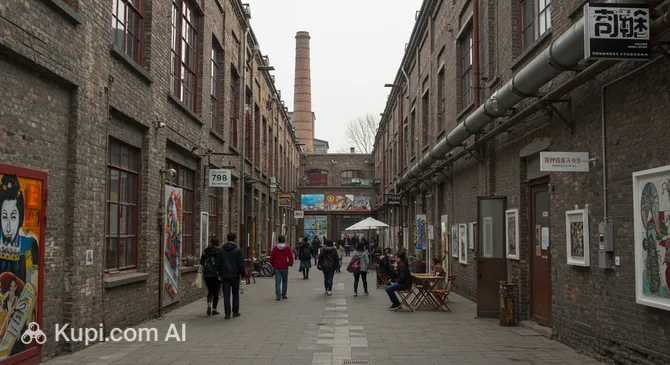
798 Art Zone. Illustration.
Source: Kupi.com AI

Traveler photos:

The main feature of the 798 Art Zone lies in its unique Bauhaus-style architecture. High vaulted ceilings, rough concrete beams, and huge windows, once designed by German engineers for electronics production, create the perfect backdrop for avant-garde installations. The post-industrial aesthetic harmoniously intertwines with modern trends here, turning former workshops into stylish exhibition halls and art laboratories.

Strolling through the Dashanzi district, you will discover not just a museum, but a living organism: dozens of galleries, fashion showrooms, creative agencies, and conceptual restaurants are concentrated here. 798 Art Zone is a place where the history of socialist production has become the foundation for creative self-expression, making this district a must-see for everyone seeking inspiration in Beijing.

Contacts

When planning a walk through the creative quarters of the 798 Art Zone in Beijing, we recommend checking the current contact details in advance. As the district brings together dozens of independent venues, information about specific exhibitions may change.

Below are the main coordinates and contact methods that will help you find your way and clarify the details of your upcoming visit to this unique corner of China.

How to contactContact
Address2 Jiu Xian Qiao Lu, Chao Yang Qu, Bei Jing Shi, Китай, 100102
Phone+86 10 5978 9798

What to Do

In the 798 Art Zone, every visitor will find something to their liking, whether it's a professional interest in art or simply a desire to walk in an unusual setting. The main reason to come here is to visit the numerous art galleries. Works by both world-renowned masters and bold experiments by young authors are exhibited here. You will be able to see everything from classical painting and sculpture to digital art and video installations.

Exploring the district itself is a special pleasure. Walking through the narrow alleys between the former workshops, you will surely come across large-scale graffiti, whimsical metal sculptures, and preserved elements of factory equipment that have become art objects in their own right. This is an ideal place for photo shoots, where every angle is saturated with an atmosphere of industrial romanticism.

In addition to contemplation, in the 798 Art Zone, you can look into open design studios and bookstores with rare art publications. And when it's time to take a break, stylish coffee shops and themed restaurants are at your service. It is customary here to spend time in long conversations about beauty, enjoying the creative atmosphere of Beijing and observing the local creative crowd.

Getting There

798 Art Zone is conveniently located in the Dashanzi area in the northeast of Beijing. The exact address of the complex is 2 Jiu Xian Qiao Lu, Chao Yang Qu. Thanks to its proximity to the expressway leading to the Capital International Airport, you can get here from the city center quite quickly.

The most comfortable way to travel around the capital of China is by taxi. You can use popular mobile apps like DiDi, or simply show the driver the name of the place in Chinese (798艺术区). If you prefer public transport, look for the nearest metro stations, from which you can take a bus or walk to the entrance of the art district.

For those traveling by private or rental car, parking zones are provided within the district itself or in its immediate vicinity. Navigator coordinates: 116.49609, 39.984138. Keep in mind that traffic in this direction can be heavy on weekends and holidays.

Nearest city: Beijing

History & Facts

The history of this place began in the mid-1950s when a giant industrial hub — the Beijing Joint Factory of Wired Communication Equipment — grew here with the support of the Soviet Union and specialists from the GDR. The project, known by the code name "Project 157", became one of the most important symbols of the socialist industrialization of China. The architectural appearance of the workshops was created by East German masters in the functional Bauhaus style, which provided the premises with an abundance of natural light and space.

In 1967, the complex was divided into several independent productions, the largest of which was Factory No. 798. However, by the late 1980s, with the start of market reforms, state support for the enterprises ceased, and the factories gradually began to decline. In 2000, the vacant areas were transferred to the management of the Sevenstar Group, which decided to lease out the workshops to cover the costs of maintaining the territory.

The turning point came in 2002 when the first major international exhibition, "Beijing in Motion," opened here. The vast spaces with high ceilings and industrial entourage immediately attracted the attention of the bohemians. Artists were lured by the low rental costs and the opportunity to work in a unique atmosphere where Maoist-era slogans on the walls sat side-by-side with avant-garde installations.

By 2006, 798 Art Zone received official status as one of Beijing's first cultural and creative zones. Today, it is a globally recognized center of contemporary art that has preserved its post-industrial aesthetic and turned abandoned machinery into part of a massive cultural landscape.

Time Needed

To feel the rhythm of the 798 Art Zone and peek into the most interesting galleries, most travelers need 2 to 4 hours. This is enough time to take a leisurely stroll through the main streets, see the outdoor installations, and visit a couple of large exhibition spaces.

However, for true connoisseurs of contemporary art and design, we recommend setting aside a whole day for the visit. The territory of the complex is huge, and a conceptual cafe, a cozy bookstore, or a workshop where you can watch artists at work may be hidden around every corner. In addition, the industrial architecture of the district requires time for thoughtful contemplation and photography.

Working Hours

798 Art Zone is an open urban territory, so you can walk along its streets and see the outdoor installations at almost any time. However, keep in mind that most galleries, exhibition halls, and designer boutiques operate on individual schedules. As a rule, the doors of the cultural centers are open to visitors from 10:00 AM to 6:00 PM.

Monday is often a day off for many private galleries, so it's better to choose other days of the week for a more fulfilling visit. If you plan to visit a specific exhibition or event in Beijing, we strongly recommend checking the opening hours on the official website of the venue or on its social media before your trip.

Nearby

A visit to the 798 Art Zone can easily be combined with a tour of other iconic sites in Beijing, allowing you to see the contrast between ultra-modern creativity and the city's deep historical traditions. Not far from here are landmarks that have become architectural symbols of a new era, such as the futuristic Beijing National Stadium.

If you want to change the post-industrial landscape for an atmosphere of spiritual tranquility, it is worth heading to the famous Yonghe Temple, which is one of the largest Tibetan Buddhist monasteries in the world. Exploring these diverse attractions will help you better understand the multifaceted character of the Chinese capital.

NameDistance
Yonghe Temple (Lama Temple)7.8 km
Imperial College (Guozijian)8.2 km
Beijing National Stadium8.5 km
Chinese Ethnic Culture Park (North Gate)8.8 km
Beijing National Aquatics Center9 km
Da Dong Roast Duck9.9 km
Jingshan Park10.7 km

Reached the end of the page?

That means the route is fully explored