Support

Jingshan Park

About

Jingshan Park is a magnificent imperial garden located in the heart of Beijing, on the city's central axis. This historical gem of China stretches just north of the Forbidden City, covering an area of about 230,000 m². The park's main feature is a man-made hill, which for a long time remained the highest point in the center of the capital.
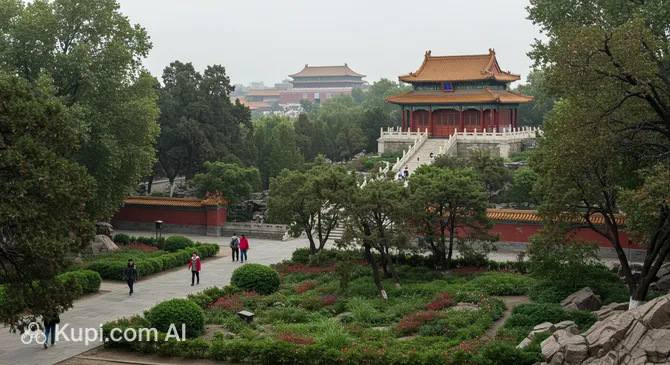
Jingshan Park. Illustration.
Source: Kupi.com AI

Traveler photos:

The central hill, standing 46 meters high, was created as far back as 1420 from soil excavated during the construction of the imperial residence's moats. Today, Jingshan Park harmoniously combines elements of Buddhism, Taoism, and Confucianism. Its landscape is adorned with winding alleys, century-old pines, cypresses, and fruit trees, creating an atmosphere of tranquility.

At the top of the hill stands the Wanchun Pavilion, built in 1750. This spot is considered the best observation deck in the city, offering breathtaking panoramic views of the Golden Roofs of the Imperial Palace and the old quarters. Since 2002, the park has held the prestigious status of a Class AAAA tourist attraction.

Contacts

Before heading out for a stroll through Jingshan Park in Beijing, we recommend checking for the latest information on official tourism portals. Although the schedule is generally consistent, visiting rules may change slightly during public holidays or major city events.

How to contactContact
Address44 Jing Shan Xi Jie, 景山 Xi Cheng Qu, Bei Jing Shi, China, 100009
Phone+86 10 6403 8098

What to Do

The main reason to visit Jingshan Park is to climb to the Wanchun Pavilion at the top of the central hill. After tackling the steps, you will be rewarded with the best view of Beijing: from here, the flawless symmetry of the Forbidden City is revealed. Photographers are best off arriving at sunrise or sunset, when the soft light highlights the majesty of the ancient architecture.

In addition to taking in the panoramas, be sure to wander the shaded paths and explore unique historical structures like the Shouhuang Hall complex and the Five Buddha Pavilions. In the morning, you can watch locals gathering to practice Tai Chi or calligraphy directly on the pavement of the alleys, creating a wonderful atmosphere of living tradition.

Getting There

Getting to the park, located at 44 Jingshan Xi Jie in the Xicheng District, is quite simple thanks to Beijing's extensive transport network. The most convenient way is by metro: take Line 8 and get off at Jingshan station (Exit C1). You can also travel to Nanluoguxiang station (Lines 6 and 8), from where it is about a 10–15 minute walk to the park entrance.

If you prefer surface transport, bus routes No. 58, 111, and 124 serve the Jingshan Houjie stop. For those in the very center, a walk from Tiananmen Square or the north gate of the Forbidden City will take about 20–30 minutes. A taxi ride from central areas is inexpensive, though you should account for the traffic density in this district.

Travelers arriving from Beijing Capital International Airport will find it most convenient to take the Airport Express train to Dongzhimen station and then transfer to the metro. A taxi from the airport will take 40 to 60 minutes depending on traffic and will cost approximately 100–150 yuan.

Nearest city: Beijing

History & Facts

The history of Jingshan Park dates back a thousand years to the Liao and Jin dynasties, when palace gardens occupied this territory. The site gained its current significance in 1420 under the Yongle Emperor of the Ming Dynasty. It was then that the famous artificial hill was formed, built from soil excavated during the construction of the Forbidden City's moats. According to feng shui principles, the hill was intended to protect the imperial residence from northern winds and evil spirits.

For centuries, the park served as the private garden of emperors: it was a place for hunting, relaxation, and important ancestral worship rituals. In 1750, by order of the Qianlong Emperor, the architectural ensemble was expanded with five pavilions on the slopes, each originally housing a bronze Buddha statue. The Shouhuang Hall complex, rebuilt during the same period, became a center for sacrifices, housing portraits of eight Qing dynasty rulers.

The park only opened to the general public in 1928, ceasing to be the private domain of the imperial court. After extensive restorations in the mid-20th century, it turned into one of the capital's most beloved "boutique parks." In 2001, the site was granted national cultural heritage status, preserving the atmosphere of ancient imperial grandeur amidst the modern metropolis.

Time Needed

To fully experience Jingshan Park, 1.5–2.5 hours is usually sufficient. This is enough time to leisurely climb to the top of the hill, take panoramic photos of the capital, explore the historical pavilions at the base, and relax for a while in the shade of century-old trees.

If you plan to combine your visit with a trip to the Palace Museum, we recommend allowing at least half a day for the entire excursion. Keep in mind that the climb to Wanchun Pavilion requires some physical effort, so the pace of your walk will depend on your fitness level and how long you wish to linger at the observation decks.

Working Hours

Jingshan Park is open to visitors daily from 6:00 AM to 9:00 PM, with the last entry allowed until 8:30 PM. During the summer, opening hours may be extended until 10:00 PM, while in winter, the park usually opens slightly later, around 6:30 AM.

The entrance fee ranges from 2 to 10 yuan depending on the season and ongoing events; a small additional fee may be charged for access to the Wanchun Pavilion. Since the exact schedule can change, it is recommended to check information on the city's official tourism resources before your visit.

Nearby

The location of Jingshan Park makes it an ideal point on an itinerary through the capital's historical center. Exploring the surrounding area will allow you to dive deeper into the atmosphere of imperial China. Just beyond the park's south gate lies the majestic Forbidden City, and to the west is the picturesque Beihai Park with its famous lake and pavilions.

If you feel like switching to a more dynamic setting after your walk, the popular Wangfujing Pedestrian Street, known for its shopping malls and food stalls, is within walking distance. This proximity allows you to create a rich, full-day cultural program.

NameDistance
Beihai Park0.6 km
Forbidden City0.9 km
The Palace Museum1 km
Meridian Gate1.2 km
Prince Gong Mansion1.5 km
Tiananmen Square1.8 km
Wangfujing Pedestrian Street2 km

Reached the end of the page?

That means the route is fully explored