Support

Summer Palace

About

The Summer Palace (Yiheyuan) is a majestic ensemble of imperial gardens and palaces stretching across the northwest of Beijing. A UNESCO World Heritage site, it is rightfully considered a masterpiece of Chinese landscape art. Spanning approximately 290 hectares, its architecture blends harmoniously with nature, creating a textbook example of Eastern harmony between water, mountains, and man-made structures.
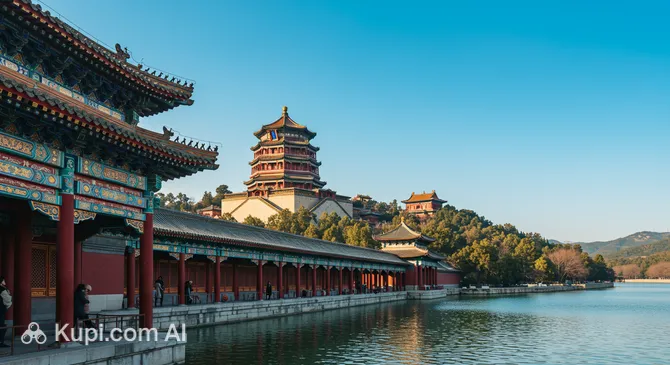
Summer Palace. Illustration.
Source: Kupi.com AI

Traveler photos:

Central to the composition is the artificial Kunming Lake, which covers three-quarters of the park's territory. The landscape was significantly transformed in the 18th century: the earth excavated during the lake's expansion was used to form Longevity Hill (Wanshou Shan). Its slopes and summit feature Buddhist temples and pavilions with roofs of shimmering glazed tiles, which look particularly striking in the rays of the setting sun.

Today, the Summer Palace is more than just an open-air museum; it is a symbol of the Qing dynasty's imperial grandeur. Visitors are drawn to unique sites such as the famous Long Corridor, adorned with thousands of paintings, and the mysterious Marble Boat. It is an ideal place to escape the bustle of the metropolis and immerse yourself in the atmosphere of ancient China, wandering along winding paths among ancient trees and elegant bridges.
Contacts

When planning a visit to the Summer Palace, one of the most popular attractions in Beijing, it is recommended to check the current operating hours and ticket prices on official resources in advance. As this is a large-scale state museum complex, information regarding special events or temporary closures of individual pavilions may be updated depending on the season.

For your convenience, the main contact details and coordinates are collected below to help you navigate the site and contact the park administration if necessary.

How to contactContact
Address19 Xin Jian Gong Men Lu, Hai Dian Qu, China, 100091
Phone+86 10 6288 1144
Websitewww.summerpalace-china.com

What to Do

A stroll through the Summer Palace is an endless series of discoveries. Be sure to walk along the famous Long Corridor, stretching over 700 meters along the lakeshore. As you examine more than 14,000 paintings depicting scenes from Chinese classical literature, mythology, and history, it is like flipping through a colorful encyclopedia of Eastern culture. At the end of the path, the legendary Marble Boat awaits—an unusual pavilion that appears to be floating on the water's surface.

For those who prefer active recreation and panoramic views, climbing Longevity Hill is the perfect choice. Reaching the Buddhist temples, you will be rewarded with a breathtaking view of the entire Kunming Lake and the distant silhouette of Beijing's skyscrapers. Boat rentals are also very popular: a water tour allows you to view the elegant bridges, including the famous Seventeen-Hole Bridge, from a completely different perspective and enjoy the breeze on a hot day.

Depending on the time of year, the park offers different aesthetic experiences: in summer, you can admire endless fields of blooming lotuses, and in spring, the shores are painted in delicate pink tones by the blossoming cherry trees. After a busy walk, it is worth visiting one of the traditional tea houses on the grounds to relax and enjoy the silence while looking at the calm water, just as Chinese emperors did centuries ago.

Getting There

Getting to the imperial residence from central Beijing is quite simple, despite it being located about 20 kilometers northwest of the city center. The fastest and most reliable way is the metro: you can take Line 4 (Beigongmen station, exit to the North Gate) or the Xiyuan line, the exit of which leads almost directly to the park entrance. Taking the subway allows you to avoid the capital's famous traffic jams.

If you prefer ground transportation, numerous buses (e.g., No. 332, 374, 456) run to the Xiyuan or Beigongmen stops. The bus journey from Tiananmen Square takes about an hour. For those who value maximum comfort, a taxi or calling a car via the Didi app is the optimal choice. The trip from the city center will take between 30 and 60 minutes depending on traffic and will cost approximately 100–200 yuan.

The main entrance for tourists arriving by metro is usually the North Gate, while the East Gate may be more convenient for those traveling by bus. Parking zones for private vehicles are provided near the entrances; however, finding a free spot can be difficult on weekends and holidays, so it is better to plan your visit for early morning.

Nearest city: Beijing

History & Facts

The history of the Summer Palace in Beijing spans more than eight centuries. The first imperial buildings on this site appeared as early as 1153 during the Jin Dynasty. However, the majestic appearance we see today began to take shape in 1750. Emperor Qianlong commissioned the creation of the grand Garden of Clear Ripples as a gift for his mother's 60th birthday. Construction lasted 15 years and required a colossal expenditure of silver, transforming the landscape into a harmonious combination of artificial lakes and man-made hills.

The fate of the palace has been full of dramatic turns: in 1860, it was almost completely destroyed. Empress Dowager Cixi undertook the reconstruction of the complex at the end of the 19th century. It is believed that she used funds originally intended for the modernization of the Chinese navy for the renovation. It was during this period that the residence received its current name—Yiheyuan, which means "Garden of Peace and Harmony." The famous Marble Boat, which became a symbol of the dynasty's stability, also dates back to this time.

Since 1924, after the last emperor Puyi left the capital, the palace finally became accessible to the general public as a public park. In 1998, UNESCO included the Summer Palace on the World Heritage list, recognizing it as a masterpiece of Chinese garden art. Today, this site serves as a living reminder of the empire's former greatness and the evolution of Eastern landscape design philosophy.

Time Needed

To explore the Summer Palace leisurely and soak in its atmosphere, it is recommended to set aside at least 4–6 hours for your visit. The complex's territory is vast, and even a quick tour of key locations, such as the Long Corridor and the Marble Boat, will require time to move between them. If you plan to climb to the temples at the top of Longevity Hill or take a boat trip on the lake, you should count on a longer stay.

During peak tourist seasons (April–May and September–October), visit times can stretch to a full day due to queues at ticket offices and popular pavilions. For those who want to study each of the hundreds of pavilions in detail and enjoy the silence in remote corners of the garden, one day might not even be enough. In any case, it is better to arrive by opening time to see the main sights before the park is filled with numerous tour groups.

Working Hours

The Summer Palace is welcoming to visitors year-round, but the opening hours depend directly on the tourist season. During high season, which lasts from April to October, the park gates open at 6:30 AM and close at 6:00 PM, with the last entry allowed until 5:00 PM. This is the best time for long walks and enjoying the lush greenery of the gardens.

In low season, from November to March, daylight hours are shorter, and the park operates from 6:30 AM to 5:00 PM (entry stops at 4:00 PM). Please note that individual pavilions and museums within the complex may have their own shorter operating schedules. Before your trip, it is recommended to check the information on-site or on the official website, as opening hours may be adjusted during national holidays.

Nearby

A visit to the Summer Palace can be conveniently combined with a tour of other historical monuments in the northwestern part of Beijing. Very close by are the ruins of Yuanmingyuan Park, known as the Old Summer Palace, where you can see the poignant but majestic remains of former luxury and 18th-century European pavilions. Exploring these two sites in one day allows for a visual comparison of different stages of China's imperial history.

If you want to change the atmosphere and return to more modern or classical city sites, Prince Gong's Mansion, with its magnificent gardens and labyrinths, is within easy reach. This proximity of attractions allows tourists to create a rich itinerary covering both monumental park ensembles and the exquisite architecture of the imperial nobility.

NameDistance
Old Summer Palace2.1 km
Beijing National Aquatics Center9.8 km
Chinese Ethnic Culture Park (North Gate)10.1 km
Beijing National Stadium10.3 km
Prince Gong Mansion11.8 km
Beihai Park12.7 km
Imperial College (Guozijian)13.1 km

Reached the end of the page?

That means the route is fully explored