Support

Tiananmen

About

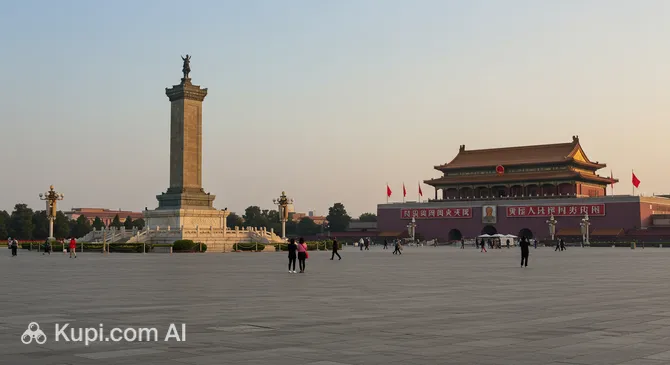
Tiananmen Square is the majestic heart of Beijing and one of the largest city squares in the world. Located in the very center of China, it covers an area of approximately 440,000 square meters, allowing it to accommodate up to a million people at once. The landmark is named after the Gate of Heavenly Peace (Tiananmen), which separates it from the northern part of the city and serves as the main entrance to the imperial Forbidden City.
\n
Tiananmen Square. Illustration.
Source: Kupi.com AI

Traveler photos:

\n

This space is a unique architectural ensemble home to the nation's most important state and historical sites. At its center stands the 37-meter Monument to the People's Heroes, adorned with intricate bas-reliefs, while the Mausoleum of Mao Zedong is located in the southern part. Flanked by the Great Hall of the People and the National Museum, the square is not just a place for walking but a living testament to the country's centuries-old history.

\n

Tiananmen is considered a symbol of national unity and a highly popular destination for tourists. Its grand scale, strict symmetry, and solemn atmosphere make it an essential stop for any traveler wishing to feel the power and magnitude of the Chinese capital. Here, you can experience the rhythm of a modern metropolis while touching the great heritage of imperial dynasties.

Contacts

When planning to visit Tiananmen Square in Beijing, we recommend checking current access regulations and potential schedule changes in advance. As this is a central state site in China, strict security measures are in place, and operating hours may vary.

\n

Before your trip, it is advisable to verify the current status of museums and the mausoleum on official resources or check details with your hotel staff to plan your visit as comfortably as possible.

How to contactContact
AddressW95W+FXQ, Дунчэн, Китай, 100051

What to Do

One of the most impressive experiences on the square is the daily national flag-raising ceremony. Honor guard soldiers march from the Tiananmen Gate to the flagpole exactly at sunrise, maintaining a pace of exactly 180 steps per minute. This solemn spectacle invariably draws hundreds of spectators and creates a special patriotic atmosphere that is worth seeing at least once in a lifetime.

\n

Visitors can take time to examine the Monument to the People's Heroes, studying the 10 detailed bas-reliefs that tell the story of key events in the country's history. Also popular is a visit to the Mausoleum of Mao Zedong, where a marble statue of the leader stands in solemn halls alongside a crystal coffin. After viewing the monuments, it is pleasant to simply wander across the vast open space, watching locals fly colorful kites in the sky.

\n

In the evening, the square is transformed by scenic illumination, which beautifully highlights the grandeur of the surrounding buildings and gates. This is the perfect time for quiet walks and panoramic photography, as the scale of the architectural forms is accentuated by the play of light and shadow, creating an ideal backdrop for memorable photos.

Getting There

Tiananmen Square is located in the heart of Beijing, in the Dongcheng District, making it one of the city's most accessible locations. The most convenient way to get there is by metro: Line 1 serves the "Tiananmen East" and "Tiananmen West" stations, while Line 2 serves the "Qianmen" station, with exits leading directly to the square.

\n

If you prefer surface transport, dozens of bus routes stop near the square, including numbers 1, 5, 10, 22, 52, and 120. For those traveling by taxi or using the Didi service, the reference address is: W95W+FXQ, Dongcheng, Beijing. A trip from central areas typically takes 10 to 20 minutes depending on traffic.

\n

Travelers arriving from Beijing Capital International Airport (PEK) or Daxing International Airport (PKX) can use the Airport Express high-speed trains to reach metro transfer hubs, from where the center is reachable within 60–90 minutes. If walking from nearby attractions such as the Temple of Heaven, the journey takes about 20–30 minutes.

Nearest city: Beijing

History & Facts

The history of the square began back in 1417, during the Ming Dynasty, coinciding with the construction of the imperial residence. Originally, it was a relatively small T-shaped space in front of the main gate of the Imperial City. The gate and the surrounding area received their modern name, meaning "Gate of Heavenly Peace," in the mid-17th century during the Qing Dynasty following a major reconstruction.

\n

The square acquired its current colossal appearance in the 1950s. At the initiative of the country's leadership, it was radically expanded, requiring the demolition of old buildings, and in just 11 months, it was transformed into one of the largest squares in the world. It was here in 1949 that the founding of the People's Republic of China was proclaimed, forever establishing the site's status as the country's main political center.

\n

In subsequent decades, the architectural ensemble was complemented by iconic structures: the 37-meter Monument to the People's Heroes was completed in 1958, and the majestic Mausoleum of Mao Zedong opened its doors in 1977. Over five centuries, the square has evolved from a closed imperial thoroughfare into a grand public symbol reflecting the changing eras of Chinese history.

Time Needed

To fully experience Tiananmen Square and view its key monuments, it is recommended to allocate 2 to 3 hours. This is enough time to take a leisurely stroll across the open space, take photos in front of the gate, and see the obelisk dedicated to the People's Heroes.

\n

If you plan to visit the Mausoleum of Mao Zedong, you should account for time spent in security checks and potential queues, which can add another hour or two to your visit. If you combine the square with a tour of the Forbidden City or the National Museum, the total duration can reach 4–5 hours or more.

Working Hours

Tiananmen Square in Beijing is open for walking daily and around the clock, allowing tourists to see it both in the rays of the rising sun and under evening illumination. However, keep in mind that entry to the territory is through security checkpoints, which may operate on a specific schedule.

\n

The internal sites have their own opening hours: for example, the Mausoleum of Mao Zedong usually receives visitors from 8:00 to 12:00 (until 11:00 in winter) and is closed on Mondays. The flag-raising ceremony takes place strictly at sunrise, so arriving early is recommended. It is best to check official websites for the most up-to-date information on museum and mausoleum hours immediately before your visit.

Nearby

A visit to Tiananmen Square opens the doors to many other iconic Beijing landmarks within walking distance. Just a few hundred meters to the north are the legendary gates leading to the Forbidden City—the former imperial residence whose scale and architectural elegance are truly breathtaking. For art and history enthusiasts, the National Museum of China, located on the east side of the square, is a must-visit.

\n

If you wish to change the pace after your cultural program for some shopping or to try famous local cuisine, head to the bustling Wangfujing Pedestrian Street. This proximity of key attractions allows you to create a rich itinerary and see the most vibrant facets of the Chinese capital without spending much time in transit.

NameDistance
Tiananmen Square0.4 km
National Museum of China0.5 km
Meridian Gate0.6 km
The Palace Museum0.8 km
Forbidden City0.9 km
Wangfujing Pedestrian Street1.2 km
Li Qun Roast Duck Restaurant1.4 km

Reached the end of the page?

That means the route is fully explored