Support

Meridian Gate

About

The Meridian Gate, also known as Wumen, is the majestic southern entrance to the legendary Forbidden City in Beijing. This monumental architectural landmark in China symbolizes the imperial grandeur of the Ming and Qing dynasties and is considered the largest structure in the entire palace complex.
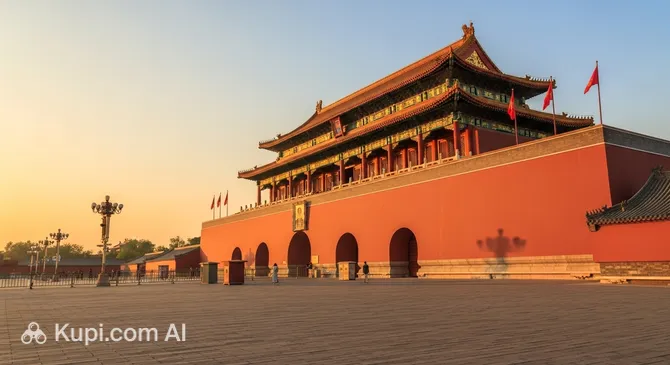
Meridian Gate. Illustration.
Source: Kupi.com AI

Traveler photos:

Standing about 38 meters tall, the structure is distinguished by its unique U-shape and five pavilions on the summit, poetically referred to as the "Five Phoenix Tower". The massive bright red walls combined with golden glazed roof tiles emphasize the site's status as a sacred threshold that once separated the world of ordinary people from the residence of the "Son of Heaven."

The gate's architecture is strictly hierarchical: five passages were intended for different levels of society. The central archway was the exclusive privilege of the Emperor, and only the Empress was permitted to pass through it once in her life—on her wedding day. Today, this site serves as the starting point for millions of tourists wishing to touch the centuries-old history of the Middle Kingdom.

Contacts

When planning your visit to the Meridian Gate, it is recommended to check the latest visitor information in advance. As this is the main entrance to the palace complex, rules may change depending on the season or official events.

For your convenience, the main contact details and links to official resources are provided below to help make your journey to Beijing as smooth and predictable as possible.

How to contactContact
Address4 Jing Shan Qian Jie, Dong Cheng Qu, Китай, 100009
Phone+86 10 8500 7427
Websitewww.dpm.org.cn

What to Do

Visiting the Meridian Gate is more than just passing through a checkpoint; it is a full immersion into the atmosphere of imperial China. First, it is worth lingering in the vast square in front of the gate to appreciate its scale and take impressive photographs of the "Five Phoenix Tower." Architectural details, such as the complex dougong brackets and carved eaves, deserve the closest inspection.

Passing through the massive vaults, you will find yourself in the inner courtyard, which offers a magnificent view of the five marble bridges spanning the winding "Golden Water River." From here, it is convenient to begin your exploration of the Forbidden City, heading toward the Hall of Supreme Harmony or visiting the side buildings—the Hall of Martial Valor and the Hall of Literary Glory, which often host temporary themed exhibitions.

Be sure to notice the symmetry of the space and the symbolism of the decor. In ancient times, imperial edicts were proclaimed here, and solemn military reviews were held. Today, tourists can stroll leisurely along the fortress walls, enjoying the harmony of stone and wood that has remained unchanged for centuries.

Getting There

The Meridian Gate is located in the heart of Beijing at 4 Jingshan Qianjie. The most convenient and fastest way to get here is by using the famous Beijing Subway. You can take Line 1 to either "Tian'anmen East" (Tian'anmen Dong) or "Tian'anmen West" (Tian'anmen Xi) stations. From there, walk north through Tian'anmen Square, following the massive red walls.

If you prefer the bus, routes 1, 2, 52, and 82 lead to the southern part of the palace. Taking a taxi or using ride-hailing apps is also a comfortable option, though you should account for heavy traffic in the city center. Entry to the palace complex is strictly from the south, so head toward the southern boundary of the Forbidden City.

The walk from Tian'anmen Square to the Meridian Gate is a travel experience in itself. Passing through the intermediate Duanmen Gate, you will gradually become immersed in the scale of imperial architecture, and the opening view of the main gate will be one of the most striking visual highlights of your itinerary.

Nearest city: Beijing

History & Facts

The history of the Meridian Gate began in 1420 under the Yongle Emperor, who moved the capital to Beijing. Constructing such a grand entrance required colossal effort; historians estimate that nearly one million workers were involved in the building of the entire palace ensemble. Over six centuries, the gate has survived several fires and two major reconstructions—in the 17th and 19th centuries—yet it has retained its original majestic appearance.

During the imperial era, the gate served not only as an entrance but also as a stage for essential state rituals. It was here that the Emperor would receive war trophies and, on the first day of the tenth lunar month, proclaim the new astronomical calendar. The towers housed special bells and drums: the sound of the bells announced the ruler's departure to the Temple of Heaven, while the beating of the drums signaled his progress to the Ancestral Temple for worship.

An interesting fact is related to the hierarchy of the passages: besides the Emperor, only the three top graduates of the civil service examinations had the right to use the central archway, and only once in their lives as a mark of recognition for their outstanding knowledge. This emphasized the deep respect for education in Chinese culture. Today, the Meridian Gate remains a living witness to the succession of 24 emperors and the fall of the great Ming and Qing dynasties.

Time Needed

A thoughtful viewing of the Meridian Gate itself, exploring its architecture, and walking across the adjacent square usually takes about 30 to 45 minutes. This will allow you to take high-quality photos, examine the decorative elements, and feel the monumentality of the structure before diving into the labyrinths of the ancient palace.

However, it is worth considering that the gate is only the beginning of a large-scale route. Most travelers combine their visit with a full tour of the Forbidden City, which takes a total of 3 to 5 hours. If you plan to study the museum exhibits in the side pavilions in detail, it is better to set aside an entire day for visiting this area of Beijing.

Working Hours

The operating hours of the Meridian Gate are closely tied to the schedule of the entire Palace Museum (Gugong) complex. During the peak tourist season, which runs from April to October, the gate is open to visitors from 08:30 to 17:00. During the winter period, starting in November, the working day is shortened, and entry is possible until 16:30.

It is important to remember that ticket offices and access to the grounds stop approximately one hour before the official closing time. Monday is traditionally a closing day for the museum, except on public holidays. Before your trip, we strongly recommend checking the current opening hours on the official website, as changes may occur due to restoration work or state events.

DayWorking hours
MondayЗакрыто
Tuesday08:30–17:00
Wednesday08:30–17:00
Thursday08:30–17:00
Friday08:30–17:00
Saturday08:30–17:00
Sunday08:30–17:00

Nearby

The location of the Meridian Gate in the city's historical core allows you to see several iconic landmarks in a single day. Just beyond the gate lies the Forbidden City, and a few minutes' walk to the south is the famous Tian'anmen Square—the heart of modern China.

For those who wish to see the palace complex from above, a walk to Jingshan Park, located just behind the palace's northern exit, is an excellent addition. Also nearby is the National Museum of China, which houses priceless artifacts from various eras. Exploring this area will provide you with a comprehensive understanding of the capital's cultural and historical wealth.

NameDistance
The Palace Museum0.3 km
Forbidden City0.3 km
Tiananmen Square0.6 km
Tiananmen Square0.9 km
National Museum of China1 km
Wangfujing Pedestrian Street1.2 km
Jingshan Park1.2 km

Reached the end of the page?

That means the route is fully explored