Support

Forbidden City

About

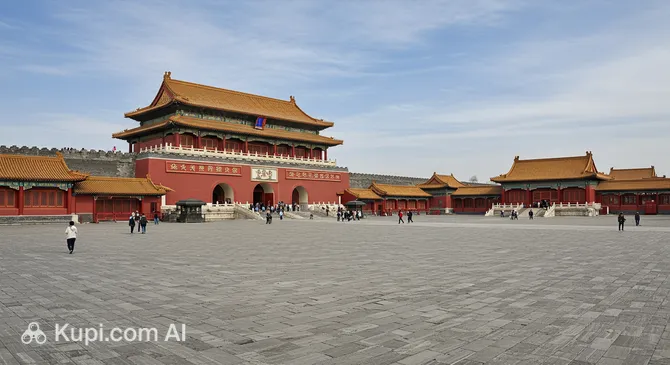
The Forbidden City (also known as the Gugong) is a monumental tribute to China's imperial grandeur and the largest surviving palace complex on the planet. Located in the heart of Beijing, it is a true "city within a city," surrounded by massive ten-meter walls and a deep moat. Across its 72 hectares lie nearly 1,000 buildings, which, according to legend, contain over 9,000 rooms.
\n\n
Forbidden City. Illustration.
Source: Kupi.com AI

Traveler photos:

\n\n

The architecture of the complex is striking for its strict symmetry and symbolism. Every detail—from the vibrant red walls and golden roof tiles to the carved stone ramps—underscores the emperor's status as the center of the universe. The entire ensemble is aligned along a sacred north-south central axis, creating a harmonious space where wooden structures remarkably stand without a single nail and have withstood the test of centuries.

\n\n

Today, this masterpiece of ancient architecture, listed as a UNESCO World Heritage site, is home to the Palace Museum. Its halls house priceless collections of Chinese art, turning a stroll through the grounds into a captivating journey through five centuries of Ming and Qing dynasty rule.

Contacts

Before setting off for this legendary site in the heart of Beijing, we strongly recommend checking the museum's official website for the latest updates. The Forbidden City is one of the world's most visited attractions, so information regarding opening hours and access rules may change depending on the season or government events.

How to contactContact
Address4 Jing Shan Qian Jie, Dong Cheng Qu, Bei Jing Shi, China, 100009
Phone+86 400 950 1925
Websitewww.dpm.org.cn

What to Do

Your introduction to the Forbidden City begins with a grand passage through the massive Meridian Gate. Moving along the central axis, you will find yourself before the majestic Hall of Supreme Harmony, where an authentic imperial throne is preserved. Here, you can spend hours admiring the intricate carvings, paintings, and mythical creatures on the roofs, which were traditionally believed to protect the buildings from fire and evil spirits.

\n\n

A visit to the Imperial Gardens in the northern part of the complex is a must. This oasis of tranquility features whimsical pavilions, rockeries, and ancient cypress trees where rulers once rested from affairs of state. In the museum pavilions, visitors can see rare artifacts ranging from exquisite imperial robes and jewelry to antique clocks and calligraphy. For the full experience, climb the palace's corner towers—their intricate design is considered a pinnacle of Chinese wooden architecture.

Getting There

The Forbidden City is located in the very center of Beijing, and the easiest way to reach it is by metro. Take Line 1 and get off at either Tiananmen East or Tiananmen West stations. The walk from the metro exits to the main southern gate of the complex takes about 5–10 minutes at a leisurely pace.

\n\n

For those who prefer surface transport, numerous buses stop nearby (routes 1, 2, 5, 52, and others). If you are taking a taxi from the city's central districts, the trip will take between 10 and 20 minutes. A car journey from Beijing Capital International Airport (PEK) takes about an hour, depending on traffic conditions.

\n\n

It is important to remember that tourist entry is through the southern Meridian Gate. Many travelers combine a visit to the palace with a walk across the famous Tiananmen Square, located just a 10-minute walk away across Chang'an Avenue. Keep in mind that parking in this area is extremely limited, making public transport the best choice.

Nearest city: Beijing

History & Facts

The history of the Forbidden City began in 1406, when the Ming Dynasty Emperor Yongle decided to move the capital and build a residence worthy of the "Son of Heaven." The construction was a monumental undertaking: for 14 years, approximately 100,000 skilled craftsmen and nearly a million laborers worked on it. The complex's layout is no accident—it embodies ancient Chinese philosophy and serves as a terrestrial reflection of the Celestial Emperor's "Purple Palace."

\n\n

For nearly five centuries, until 1912, the palace remained a closed world where 24 emperors of the Ming and Qing dynasties lived and ruled. It was more than just a home for the royal family; it was the sacred administrative center of a vast empire, the site of lavish coronations, weddings, and the reception of foreign ambassadors. The architecture of the complex was designed with incredible precision: unique flexible joints in the wooden structures allowed the buildings to survive hundreds of devastating earthquakes.

\n\n

Interestingly, even after the fall of the monarchy, the last members of the imperial court continued to occupy part of the premises until 1924. Only after their expulsion did the complex fully open to the public as the Palace Museum. Today, it is a masterpiece recognized by UNESCO as China's first World Heritage site and has served as a model for palace construction in Korea, Japan, and Vietnam.

Time Needed

To truly experience the scale of the Forbidden City, it is recommended to set aside 3 to 5 hours for your visit. This timeframe allows you to walk leisurely along the main central axis, explore the primary ceremonial halls, and visit the imperial gardens. If you are short on time, an express route through the key sites takes about 2 hours, though many fascinating details will be missed.

\n\n

For art and history enthusiasts who wish to study the museum exhibitions, ceramics collections, and treasuries in the side courtyards in detail, a full day may be required. It is important to note that the complex is vast, and movement is strictly one-way (from south to north), so it will be difficult to return to any missed halls at the end of your walk.

Working Hours

When planning your visit to the Forbidden City, it is important to note that the museum is closed on Mondays (except for public holidays). On other days—Tuesday through Sunday—the complex typically welcomes guests from 8:30 AM to 4:30 PM. Keep in mind that ticket offices and the entrance close one hour before the official closing time, so it is best to arrive early.

\n\n

As operating hours may vary slightly depending on the time of year (the schedule is often shortened during the winter season), it is recommended to check the current timetable on the official website before your trip. Additionally, remember that entrance tickets must be booked online in advance, as the number of daily visitors is strictly limited.

DayWorking hours
MondayClosed
Tuesday8:30 – 16:30
Wednesday8:30 – 16:30
Thursday8:30 – 16:30
Friday8:30 – 16:30
Saturday8:30 – 16:30
Sunday8:30 – 16:30

Nearby

Exploring the surroundings of the imperial complex allows for an even deeper immersion into the atmosphere of both ancient and modern Beijing. Directly beyond the palace's north gate lies Jingshan Park. Climbing to the top of its central hill rewards you with a breathtaking panoramic view of the palace's golden roofs, which is the best way to appreciate the scale of its symmetrical layout.

\n\n

To the south of the palace lies the legendary Tiananmen Square—a symbol of China's political life and home to the National Museum and the Chairman Mao Memorial Hall. The proximity of these monumental landmarks allows for a rich full-day itinerary, combining ancient artifacts with the primary symbols of the Chinese state.

NameDistance
The Palace Museum0.1 km
Meridian Gate0.3 km
Tiananmen Square0.9 km
Jingshan Park0.9 km
Beihai Park1.2 km
Tiananmen Square1.3 km
National Museum of China1.4 km

Reached the end of the page?

That means the route is fully explored