Support

Lama Temple

About

Yonghe Temple (Lama Temple) is a majestic spiritual center and architectural gem located in the northeastern part of Beijing. As the largest Tibetan Buddhist monastery outside of Tibet, it impresses with its scale and harmonious fusion of styles. Covering an area of 66,400 square meters, it features an ensemble of five main halls whose roofs shine with imperial yellow tiles.
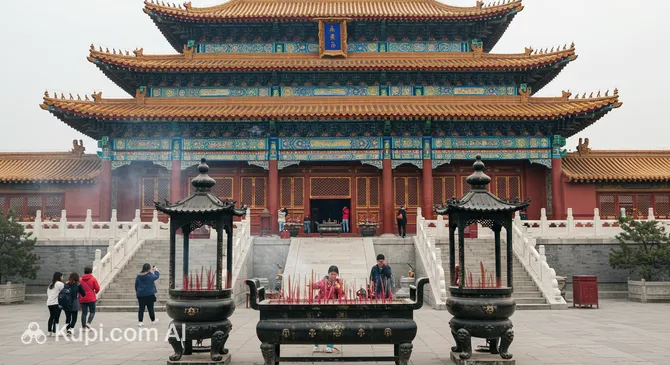
Yonghe Temple (Lama Temple). Illustration.
Source: Kupi.com AI

Traveler photos:

The temple's primary uniqueness lies in its eclecticism: elements of Han, Tibetan, Manchu, and Mongolian cultures are subtly intertwined here. Visitors can see exquisite wood carvings, colorful frescoes, and ancient incense burners. The most famous treasure of the complex is the giant statue of Maitreya Buddha in the Pavilion of Ten Thousand Happinesses. Carved from a single trunk of white sandalwood, it stands 26 meters tall, earning it a place in the Guinness World Records.

This "Palace of Eternal Peace" in China serves as a living reminder of the imperial past and remains an active place of pilgrimage. The air here is thick with the scent of incense, and the walls remember the days when the monastery was the administrative center for religious affairs for the entire empire.

Contacts

To contact the administration of the Yonghe Temple and obtain up-to-date information on visiting rules, you can use the official communication channels. Please note that this is a state historical site, so primary contacts are limited to the phone and website.

How to contactContact
Address12 Yong He Gong Da Jie, 国子监 Dong Cheng Qu, China, 100007
Phone+86 10 8419 1919
Websitewww.yonghegong.cn

What to Do

A visit to the Yonghe Temple is a deep dive into the world of Tibetan Buddhism. Start your journey with a stroll through the ceremonial courtyards, gradually moving along the central axis of the complex. Unique artifacts await you in each of the five halls: from bronze statues of the Buddhas of the Three Ages to the intricately detailed bronze Mount Sumeru, which symbolizes the center of the Buddhist universe.

Be sure to reach the Pavilion of Ten Thousand Happinesses to see the colossal sandalwood statue of Maitreya firsthand. Its grandeur and the fine craftsmanship of the artisans leave an indelible impression. You can also observe the monks' rituals or light traditional incense, breathing in the atmosphere of peace and tranquility amidst the bustling metropolis.

For fans of aesthetics, the temple is a wonderful location for photography: the play of light in the arcades, the vibrant paintings, and the contrast of the golden roofs against Beijing's blue sky allow for spectacular shots. It is recommended to arrive at opening time to catch the temple in the morning silence before the arrival of large tour groups.

Getting There

Yonghe Temple is located at 12 Yong He Gong Da Jie, in the historic Dong Cheng Qu district. Getting here is very easy thanks to Beijing's well-developed transport network. The most convenient way is by metro: Yonghegong Lama Temple station (an interchange for lines 2 and 5) has an exit leading almost directly to the entrance of the temple complex.

If you prefer surface transport, numerous bus routes stop near the temple, including Nos. 13, 18, 44, 62, and 130. A taxi or a ride through the Didi app from the city center will cost approximately 20–40 yuan. Just tell the driver "Yonghegong," and they will take you to the main gates.

A visit to the temple is easy to combine with a stroll through the neighboring hutong alleys or a visit to the Temple of Confucius. Keep in mind that parking spots nearby are very limited, so public transport remains the priority option for tourists.

Nearest city: Beijing

History & Facts

The history of the Yonghe Temple began in 1694, when the Kangxi Emperor of the Qing Dynasty ordered the construction of a luxurious residence here for his palace eunuchs. Later, the building became the property of his son, Prince Yinzhen. After ascending the throne as the Yongzheng Emperor in 1722, he gave half of the palace to Tibetan monks of the Gelug school, transforming it into a monastery.

The status of the "Palace of Eternal Peace" was established for the complex in 1725. After Yongzheng's death, his successor, the Qianlong Emperor, carried out a large-scale renovation in memory of his father. It was then that the roofs of the pavilions were adorned with yellow glazed tiles — an exclusive privilege of imperial buildings. In 1744, the monastery officially became the state center for the administration of Tibetan Buddhist affairs.

The 1950s deserve special mention: despite the political changes in China, the temple was preserved in its original form. In 1961, it was declared a national heritage site and placed under special state protection. Today, it is not only a popular tourist destination but also an active monastery that carefully preserves centuries-old traditions.

Time Needed

To leisurely explore all five main halls of the Yonghe Temple and soak up its spiritual atmosphere, most tourists need about 2 to 3 hours. This time is sufficient to study the architectural details, examine the unique statues, and take commemorative photos in the inner courtyards.

If you plan to study the exhibits in detail, read the information plaques, or are visiting as part of an organized tour, your stay may increase to 4 hours. It is also worth considering potential queues at the ticket office and entrance during popular holidays and weekends.

Working Hours

Yonghe Temple is open to visitors daily. Opening hours: from 9:00 AM to 5:00 PM. The site operates without a lunch break, allowing you to conveniently plan your visit throughout the day.

Please note that ticket sales stop and the last entry to the grounds is 30 minutes before closing, at 4:30 PM. On public holidays, the schedule may change slightly, so it is worth checking the official website before your trip.

9:00 – 17:00

Nearby

The area around the Yonghe Temple is the quintessence of old Beijing, where centuries-old traditions coexist with the modern rhythm of life. Exploring the surroundings will allow you to dive deeper into the history of China by visiting imperial educational institutions and picturesque parks.

Many iconic landmarks are within walking distance or a short drive away, making it easy to create a packed itinerary for the whole day.

NameDistance
Imperial College (Guozijian)0.3 km
Prince Gong Mansion2.9 km
Jingshan Park3.1 km
Beihai Park3.4 km
Da Dong Roast Duck3.6 km
Forbidden City3.8 km
The Palace Museum3.9 km

Reached the end of the page?

That means the route is fully explored