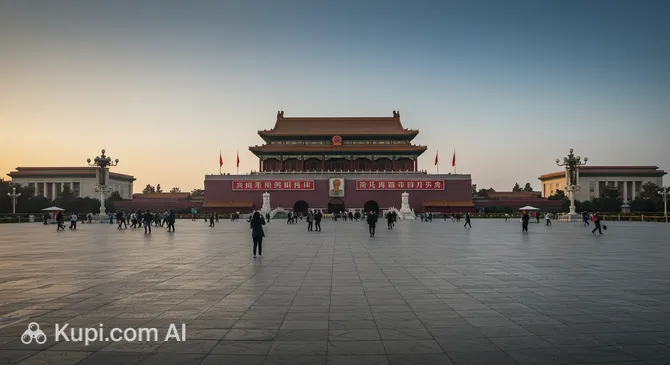
Tiananmen Square is the grand heart of Beijing and one of the largest city squares in the world. Located in the very center of the capital of China, it occupies a colossal territory of about 440,000 square meters. The name of the place translates as the "Gate of Heavenly Peace," named after the gate of the same name that leads into the famous Forbidden City.
Tiananmen Square. Illustration.
Source: Kupi.com AI
Traveller photos:
This space possesses a unique atmosphere of imperial grandeur and modern state power. Key symbols of the nation are concentrated around the enormous plaza: the Great Hall of the People, the National Museum of China, and the majestic Chairman Mao Memorial Hall. Rising in the very center is the 37-meter Monument to the People's Heroes, made of granite and decorated with exquisite bas-reliefs.
For every traveler, a visit to this location becomes a deep immersion into the history of China. The scale of Tiananmen is truly staggering: it is 880 meters long and 500 meters wide, making it not just a square, but a true symbol of statehood and a must-see on any tourist itinerary.
Contacts
When planning a visit to Tiananmen Square, we recommend checking for the latest information and access rules in advance. As this is a central state site in Beijing, the opening hours of individual museums and security protocols may change depending on current government events.
One of the most impressive events on the square is the daily national flag-raising ceremony, which takes place at dawn. The sight of the honor guard marching at exactly 180 steps per minute gathers hundreds of spectators and leaves an unforgettable sense of solemnity. A similar flag-lowering ceremony is held at sunset.
While walking through the open space, it is worth taking the time for a detailed inspection of the bas-reliefs on the Monument to the People's Heroes, depicting key episodes of the country's history. Another popular activity among visitors is visiting the Mausoleum of Mao Zedong and the museums located along the perimeter. For those seeking panoramic views, there is an opportunity to climb the Tiananmen Gate rostrum, from where the entire square is visible at a glance.
On weekends, you can catch a traditional local pastime here—kite flying. This hobby has existed in China for over five centuries, and watching the bright figures in the sky above the somber government buildings adds a special flavor to the walk. In the evening, the square is transformed by spectacular lighting, creating an atmosphere for thoughtful contemplation of the architectural ensemble.
Getting There
The landmark is located in the very heart of Beijing, and the easiest way to reach it is by metro. The Tian'anmen East and Tian'anmen West stations (Line 1) are located right at the northern end of the square. You can also use the Qianmen station (Line 2) for convenient access from the south side.
A taxi ride or a trip via the Didi service from the international airport will take between 45 to 60 minutes, while it takes about half an hour from Beijing South Railway Station. Numerous bus routes (including Nos. 1, 5, 22, and 52) also stop in the immediate vicinity of the main entrances. If you are already in the Forbidden City area, it is no more than a 5–10 minute walk to the square.
An important tip for tourists: when visiting Tiananmen Square, you must have your original passport with you to pass the mandatory security check. Personal belongings are scanned at the entrances, so try not to bring bulky backpacks or prohibited items to avoid delays in line.
Nearest city: Beijing
History & Facts
The history of this iconic site began in 1417 during the Ming Dynasty. Initially, Tiananmen Square served as a ceremonial courtyard in front of the entrance to the imperial residence and was much smaller in size. The famous gate that gave the square its name was erected in 1420 and has been rebuilt several times since then, maintaining its majestic appearance to this day.
The square took on its modern shape in the late 1950s. During a large-scale reconstruction of the capital of China, the territory was significantly expanded, becoming one of the most spacious urban areas in the world. The work was carried out at a breakneck pace and was completed in just 11 months, allowing for the integration of historical buildings with new monumental ensembles.
In the following decades, new important landmarks appeared here, such as the Great Hall of the People and the Mao Zedong memorial complex, which opened in 1977. For five centuries, Tiananmen has remained a place where history is made, serving as the main stage for the most significant national celebrations and parades in the Middle Kingdom.
Time Needed
To explore Tiananmen Square at a leisurely pace and fully appreciate its scale, it is recommended to set aside about 2–3 hours in your schedule. This time is quite sufficient for walking through the open area, viewing the monuments, and taking commemorative photos against the backdrop of the main architectural landmarks.
If your plans include visiting the National Museum, the Mausoleum, or climbing the Tiananmen Gate, it is better to allocate at least half a day for the location. Keep in mind that passing through security procedures at the entrance can take extra time, especially on public holidays and during high tourist seasons.
Working Hours
Tiananmen Square itself, as a public space, is open to visitors daily and around the clock. However, it is worth considering that access to individual sites, such as the Mausoleum of Mao Zedong (usually closed on Mondays) or the museums, is limited by their own schedules—most often they welcome guests from 8:30 AM to 5:00 PM.
The formal flag ceremonies are tied to the exact time of sunrise and sunset in Beijing, so their start times change depending on the season. Before planning your visit, we recommend checking the current schedule on official city resources, as entry to the square may be temporarily restricted during official state events.
Nearby
Exploring the surroundings of Tiananmen Square will allow you to deeply experience the capital's cultural and historical heritage. Literally a few minutes' walk away is the majestic Forbidden City—the legendary residence of emperors—as well as the National Museum of China, which houses rich collections of artifacts from different eras.
A stroll through the adjacent blocks reveals the striking contrasts of modern Beijing: from the austere architecture of government buildings to the lively Wangfujing pedestrian street. The proximity of key cultural sites makes this area an ideal starting point for your first introduction to Chinese culture.