Support

Khajoo Bridge

About

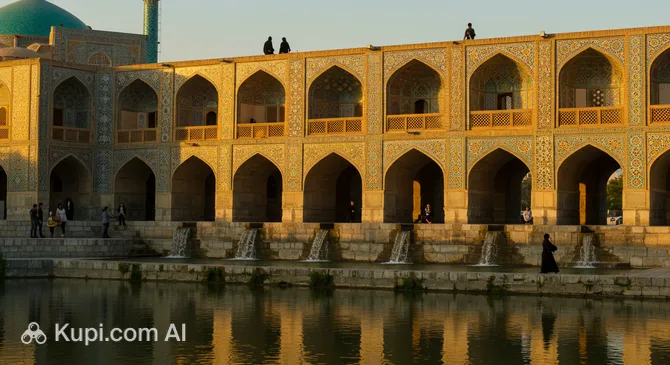
Elegant and majestic, the Khaju Bridge is considered one of the most impressive architectural monuments gracing Isfahan. This arched stone masterpiece, built in the 17th century, crosses the Zayandeh-rud River and is rightfully recognized as one of the most beautiful bridges that modern Iran has to offer.
\n\n
Khaju Bridge
Khaju Bridge. Иллюстрация. Источник: Kupi.com AI
\n\n

The bridge's design is unique: it functions not only as a pedestrian zone but also as a dam regulating the water level. The structure, approximately 133 meters long, is decorated with exquisite tilework and arches that create a unique rhythmic pattern against the river's surface. At its very center lies a richly decorated pavilion, originally intended for the relaxation of rulers and for receiving guests of honor.

\n\n

Today, Khaju Bridge is a vibrant public space. Friends meet here, families take walks along the banks, and improvised singing often echoes under the vaults of the lower tier. It is a place where Persian history harmoniously intertwines with the city's daily life.

Contacts

For convenience in planning your route, please use the contact details and the exact location of the site. The bridge is situated in the central part of the city, making it accessible to most tourists.

\n\n
How to contactContact
AddressIsfahan Province, Isfahan, Khajoo Bridge, JMPM+P8H, Iran

What to Do

A visit to the Khaju Bridge offers a unique experience to connect with the city's living culture. We recommend starting your walk from the upper level, which offers a panoramic view of the river and riverside parks. Afterward, be sure to descend to the lower level: its massive stone steps and shady arches create a special atmosphere of coolness and seclusion.

\n\n

One of the most soulful traditions here is singing under the arches. Thanks to the unique acoustics of the vaults, locals often perform ancient Persian songs here. If you are lucky enough to be here in the evening, you can enjoy these impromptu concerts, which leave no one indifferent.

\n\n

Don't forget to bring your camera — the bridge is incredibly photogenic, especially during the golden hour, when the setting sun paints the stone in warm golden tones. After dark, artistic lighting is switched on, turning the bridge into a fairy-tale vision. It is also fascinating to observe the operation of the sluice gates, which still function perfectly today.

Getting There

Reaching this architectural masterpiece is easy, as it is located in the eastern part of central Isfahan. The bridge serves as an important link between the historic Khaju quarter and the Zoroastrian district on the southern bank of the Zayandeh-rud River.

\n\n

The simplest way is to take a taxi from the city center; the trip will take only 10–15 minutes. If you prefer public transport, look for bus routes running along Esmail Street. The nearest metro station is Si-o-se-pol; however, from there it is better to take a pleasant walk along the embankment to Khaju Bridge or take a taxi to save time.

\n\n

For those who enjoy walking, the route from Naqsh-e Jahan Square takes about 30–40 minutes. This walk will allow you to better experience the city's atmosphere and see local life away from the main tourist paths.

Ближайший город: Isfahan

History & Facts

The history of this structure dates back to 1650, when, by order of Shah Abbas II, construction of a new grand project began on the foundations of an older bridge. Khaju Bridge became a striking embodiment of the architectural genius of the Safavid dynasty, an era considered the golden age of Persian art in Iran.

\n\n

One of the key features of the project was its multi-functionality. The bridge was designed not just as a crossing, but as a complex hydrotechnical system. Using sluice gates built into the lower tier, the water level in the river was regulated, allowing for the irrigation of the city's famous gardens located upstream.

\n\n

A royal pavilion was specially constructed in the center of the bridge. Shah Abbas II and his retinue used it as a box for observing water festivals, competitions, and fireworks. Surviving fragments of wall paintings and decorative tiles serve as reminders of its former grandeur. In 1873, the bridge underwent a large-scale restoration, as evidenced by historical inscriptions on its walls.

Time Needed

To fully appreciate the beauty and craftsmanship of the structure, most visitors need between 30 minutes and 1.5 hours. This is ample time to leisurely walk across both levels, examine the tilework, and take memorable photos.

\n\n

If you decide to join the locals and listen to traditional singing under the arches in the evening, or simply take a short break with a view of the river, your stay might extend to a couple of hours. In any case, a visit to the bridge easily fits into a busy day of city sightseeing.

Working Hours

Khaju Bridge is a public pedestrian space, so it is accessible to visitors 24/7 every day. You can come here at any convenient time, whether it's early morning for a quiet viewing or late evening to immerse yourself in the city's nightlife.

\n\n

The most active life on the bridge begins after sunset. The evening hours are the best time to see the bridge in all its glory with the illumination turned on and to hear the famous singing under its vaults. Entrance to the bridge area is completely free.

Круглосуточно

Nearby

Exploring the surroundings of the Zayandeh-rud River will provide plenty of additional experiences. After admiring the historic architecture, you can change the scenery and visit entertainment zones that are particularly popular with families.

\n\n
NameDistance
Flower Garden of Isfahan1.3 km
Si-o-se-pol Bridge1.7 km
Shah Mosque2.1 km
Hasht Behesht Palace2.2 km
Ali Qapu Palace2.3 km
Isfahan Music Museum2.3 km
Naqsh-e Jahan Square2.3 km

Reached the end of the page?

That means the route is fully explored