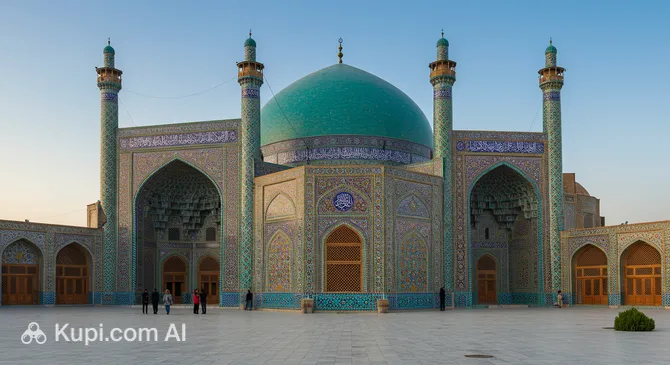
Imagine a pearl of Persian architecture shining on the eastern side of the famous Naqsh-e Jahan Square. The Sheikh Lotfollah Mosque is not just a religious building, but a true architectural triumph of the 17th century. Located in the heart of Isfahan, it is recognized as one of the most exquisite monuments that Iran has given to the world.
This site is unique because it was originally built as a private sanctuary for the Shah's family rather than for public prayer. This is why the mosque lacks the usual minarets and courtyard, making its appearance mysterious and intimate. Its coffee-colored dome is particularly breathtaking, adorned with intricate patterns that change color depending on the lighting—from cream to delicate pink.
As part of the Naqsh-e Jahan Square ensemble, the mosque is included in the UNESCO World Heritage list. It is considered a benchmark of the Isfahan school of architecture, where harmony of proportions meets the incredible skill of ceramic artists who created an atmosphere of celestial radiance inside.
Sheikh Lotfollah Mosque. Illustration.
Source: Kupi.com AI
Traveler photos:
Contacts
For those planning a visit to this architectural masterpiece, it is helpful to familiarize yourself with its exact location and contact details beforehand. Although the landmark is at the heart of the main tourist route, having the official coordinates will help you better navigate the city's streets.
Below are the current contact details for the mosque, which may be useful for confirming information or planning your route:
The main reason to step inside is the opportunity to see the interior decoration of the dome, which many art historians call the pinnacle of Islamic art. Notice how light penetrates through the lattice windows, creating a whimsical play of shadows on the walls. The ornament of medallions and mosaics creates a "peacock tail" effect that feels almost tangible thanks to the masterful use of glaze.
Visitors should also appreciate the unusual layout: the entrance to the mosque is set at an angle to the square. To enter the main hall, you must pass through a long, slightly dimmed corridor. This architectural technique allows one to gradually disconnect from the noise of the square and prepare for the grandeur of the interior space.
Don't forget to examine the majolica and mosaics on the walls—their detail is staggering. The craftsmanship here even surpasses the famous Imam Mosque. Every inch of the surface is covered with a fine pattern that appears three-dimensional in the diffused light. This is an ideal place for those seeking inspiration in silence and beauty created by the hands of the great masters of the past.
Getting There
Finding the Sheikh Lotfollah Mosque is easy, as it is located in the very heart of the historical center. It holds a place of honor on the eastern side of the famous Naqsh-e Jahan Square. This area is pedestrianized, so a stroll to the mosque will be a pleasant part of your city exploration.
The simplest and most comfortable way to get here from other districts is by taxi. Drivers know this location perfectly; simply say the name of the square or the mosque itself. If you prefer public transport, look for bus routes heading to the center, or use the metro (the nearest station is within walking distance, though the walk may take about 15–20 minutes).
Remember that the address in Farsi may look like this: استان اصفهان، اصفهان، میدان مسجد شیخ لطف الله. We recommend saving this name in your navigator to easily find the entrance to the mosque, which is connected to the square by an elegant corridor.
Nearest city: Isfahan
History & Facts
The history of this remarkable structure began in 1603 by order of the great Safavid ruler Shah Abbas. After moving the empire's capital to the city, the Shah decided to transform the central square into a symbol of his power, and the mosque became the first grand construction of this architectural ensemble. Outstanding masters of the time—Baha' ad-Din al-`Amili and Mohammad Reza Isfahani—worked on its creation.
The mosque was dedicated to the Shah's father-in-law, the prominent scholar Sheikh Lotfollah, who later became its first imam. For centuries, the building remained closed to the general public. It was intended exclusively for the royal family and the harem, which influenced its architectural design: there are no traditional minarets or an open courtyard, ensuring that outsiders could not peek inside.
For a long time, Western travelers were not even aware of such a luxurious interior, focusing their attention on the more accessible Shah Mosque. Only when the doors of the sanctuary opened to everyone could the world appreciate the true splendor of the decoration and the unique design of the dome. Today, this site is recognized as a world-class masterpiece and is included in the UNESCO World Heritage List.
Time Needed
To fully enjoy the beauty of the mosque and study the details of its unique ornamentation, you typically need 1 to 2 hours. Although the building itself is small in area compared to neighboring complexes, the density of the decor and the play of light cause visitors to linger here for a long time.
We recommend not rushing: sit on the floor and watch as the sun's rays slowly move across the dome's mosaics, changing its shades. Thoughtful contemplation will allow you to notice the smallest details of the majolica and feel the secluded atmosphere that was created specifically for the empire's rulers.
Given that the mosque is located on Naqsh-e Jahan Square, a visit here is easy to combine with the Ali Qapu Palace and the Grand Bazaar. It is better to set aside half a day to explore the entire square complex, giving you the chance not only to see all the buildings but also to relax in one of the local cafes with a view of the historical monuments.
Working Hours
The mosque is open to visitors daily; however, the schedule is divided into two shifts with a break in the middle of the day. It is important to keep this in mind when planning your route through Isfahan so you don't arrive at closed doors during the midday heat.
Opening Hours:
Monday – Sunday: 9:00 AM – 12:30 PM and 2:00 PM – 6:00 PM.
Please note that access times may change slightly depending on religious events or public holidays, so we recommend arriving an hour before closing to explore the interiors without rushing.
9:00 – 12:30, 2:00 – 18:00
Nearby
The surroundings of Naqsh-e Jahan Square are a concentration of cultural and historical treasures. Exploring the attractions located within a few kilometers will allow you to dive deeper into the city's atmosphere and see not only ancient monuments but also modern recreational areas.
In addition to architectural masterpieces, you can find many parks and family vacation spots nearby. Here is a list of sites located nearby: