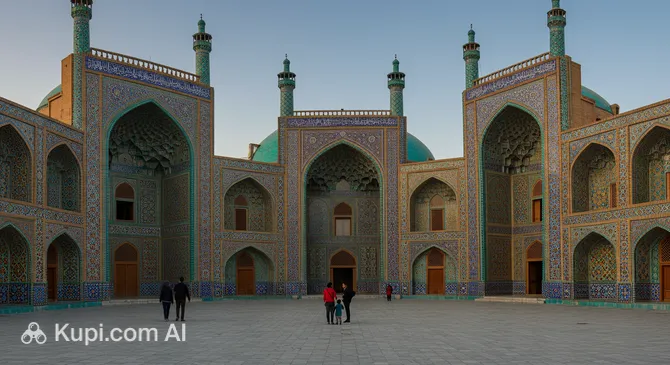
Menar Jonban is one of the most incredible architectural structures for which ancient Isfahan and all of Iran are famous. This monument, also known as the "Shaking Minarets," is a 14th-century mausoleum built over the resting place of the Sufi mystic Amu Abdollah Soqla.
Monar Jonban. Illustration.
Source: Kupi.com AI
Traveler photos:
The main secret of this place is hidden in physics: if you apply force and start to shake one of the brick minarets rising above the mosque's roof, the second minaret will start moving in perfect sync with the first a moment later. This phenomenon of resonance has puzzled travelers for centuries, turning an ordinary brick building into a mystical attraction.
The building itself is designed in a classic Persian style, featuring decorative tiling and elegant brickwork. Despite its global fame as a technical curiosity, Menar Jonban remains an important historical and spiritual site, reflecting the deep knowledge of medieval Eastern masters in engineering and geometry.
Contacts
To find the most up-to-date information regarding the memorial complex, you can use the official contact details below. It is recommended to check the schedule for demonstrations in advance, as they may vary by season.
Undoubtedly, the main reason travelers come here is to witness the demonstration of the shaking minarets. Today, tourists are not allowed to climb the towers themselves to avoid damaging the ancient masonry; however, a designated staff member conducts demonstrations according to a schedule. You can see with your own eyes how the massive brick structure begins to move, and the bells on the second minaret start to ring, confirming the transmission of vibrations.
Beyond the technical show, it is worth taking the time to explore the interior of the mausoleum. Inside, the remains of the Sufi Amu Abdollah lie beneath a massive stone slab, while the walls are adorned with traditional patterns. The place is filled with an atmosphere of peace that contrasts with the excitement of the tourist demonstrations.
Don't forget to head up to the open terrace to see the construction of the towers up close. From here, you get a great view of the surroundings and can study the architectural decor and masonry that has withstood the elements for several centuries. It is the perfect moment to take unique photos of one of Iran’s most "living" monuments.
Getting There
Getting to this amazing site is quite simple, as it is located on the outskirts of Isfahan along the busy Atashgah Boulevard. The drive from the city center takes about 15–20 minutes, depending on traffic conditions.
The most convenient way to get there is by taxi (using local apps like Snapp or Tap30). You can also take a city bus heading towards the Atashgah district; the nearest stop is just a few minutes' walk from the mausoleum entrance. If you are planning to use the metro, the nearest stations are in the city center, so you will still need to transfer to ground transportation from there.
Nearest city: Isfahan
History & Facts
The history of this site began in the 14th century when a mausoleum was built over the grave of the respected Persian Sufi Amu Abdollah Soqla. For many years, the modest yet majestic square-shaped mosque served as a place of pilgrimage and quiet prayer, preserving the memory of the sage who passed away in 1316.
The famous "shaking" towers appeared much later—during the reign of Shah Abbas I the Great of the Safavid dynasty. It was then that architects added two five-meter minarets to the main structure. It is believed that the designer intentionally applied the laws of physics to turn a simple building into a true engineering marvel, which has remained an unsolved mystery for many researchers for four centuries.
For a long time, the minarets were shaken at the request of any visitor, which put immense stress on the structure. Despite thousands of these man-made "micro-earthquakes," the building has maintained its integrity. Today, access to shaking the minarets is strictly restricted to protect this fragile architectural monument for future generations of travelers.
Time Needed
A visit to the complex usually takes between 45 minutes and 1 hour. Most of this time is spent waiting for the shaking demonstration and exploring the architectural details of the mausoleum. If you arrive just before a scheduled demonstration, your visit might be shorter.
Since the attraction is located away from the main city squares, it is worth allowing extra time for travel. A trip to the minarets can be easily combined with a visit to the ancient Atashgah Zoroastrian Fire Temple, which is located on a nearby hill.
Working Hours
The complex is open to visitors daily, with no days off. Standard operating hours are from 8:00 AM to 4:00 PM. Please note that the minaret shaking demonstrations are held at specific times (usually several times a day), so it is best to plan your visit for the first half of the day.
8:00 – 16:00
Nearby
Visiting the outskirts of Isfahan is a great opportunity to combine sightseeing with outdoor walks. This part of the city is home to many spots for family recreation and active leisure.