Support

Cattedrale di San Ciriaco

About

Perched atop Guasco Hill, the San Ciriaco Cathedral stands majestically as the primary spiritual symbol of the city of Ancona. This outstanding monument of medieval architecture is one of the most fascinating examples of Romanesque style in Italy, harmoniously blending austere Western forms with elegant Byzantine and Gothic elements.
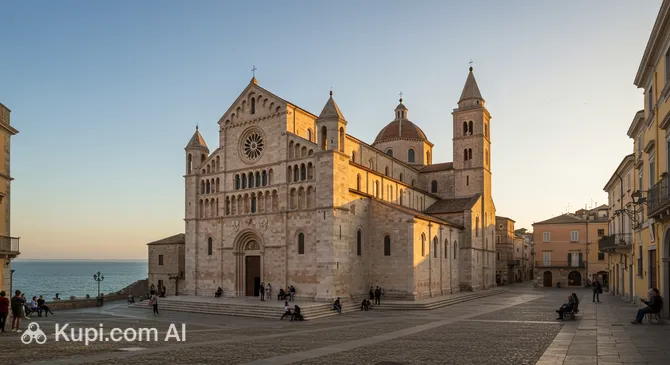
Cathedral of San Ciriaco
Cathedral of San Ciriaco. Иллюстрация. Источник: Kupi.com AI

The cathedral building, constructed from light-colored Conero stone, features a Greek-cross plan, which is rare for this region. Its facade is adorned with a magnificent Gothic portal, while one of the oldest ogival domes in Europe soars over the central section. Thanks to its location, the cathedral serves as a natural lighthouse: its silhouette is the first to greet ships entering the port of Ancona.

The interior of the church is striking for its noble materials and mystical atmosphere. Red columns of Verona marble support high vaults, while soft light pours through the windows of the dodecagonal drum, illuminating ancient mosaics and frescoes. The cathedral is not just an open-air museum, but a living testament to the rich history of the Adriatic.

Contacts

To check for information regarding services or special events, you can use the cathedral's official contact details. Please note that the church administration responds most promptly to inquiries made via the provided phone number.

How to contactContact
AddressPiazzale del Duomo, 9, 60121 Ancona AN, Italy
Phone+39 071 52688
Websitewww.beweb.chiesacattolica.it

What to Do

Begin your visit before even stepping inside: climb the wide ceremonial staircase and be sure to turn around to enjoy the panoramic views of the boundless Adriatic Sea and the bustle of the city port. Examine the main portal, guarded by lion figures, and the elegant rose window on the facade—both are excellent subjects for detailed photography.

Once inside, allow yourself a moment of silence to experience the acoustics and the scale of the space. Be sure to visit the crypt, where the relics of Saint Ciriaco are kept, and look for the glass fragments in the floor that reveal the remains of paleo-Christian foundations. This is a unique opportunity to literally see the layers of time.

In the cathedral's left transept, there is a special spot—a chapel with a sea view. The combination of the austere church interior and the blue water outside the window creates a wonderful sense of harmony. You can conclude your visit with a peaceful walk around the cathedral at sunset, when the white Conero stone walls are bathed in soft pink hues.

Getting There

The cathedral is located at the city's highest point at Piazzale del Duomo, 9. If you prefer walking, the most scenic route from the city center is via the monumental Scala dei Cappuccini staircase, which starts near Piazza Plebiscito. The climb takes about 10–15 minutes and rewards you with breathtaking views of the port.

For those choosing public transport, Conero Bus lines run from the train station or the port, stopping at Duomo or Guasco. If you are arriving by car, it is best to leave it in the parking area at the foot of the hill, as the road leading directly to Piazzale del Duomo is narrow and parking at the top is limited.

A taxi from the city center is the most comfortable and fastest way to reach the cathedral gates, especially if you are traveling with heavy luggage or in hot weather. The trip from the port or station takes no more than 5-10 minutes.

Ближайший город: Ancona

History & Facts

The site where the temple stands today has been considered sacred since ancient times: in antiquity, it was home to the acropolis of Greek-Doric Ancona, featuring a majestic temple dedicated to Aphrodite, whom sailors revered as their patroness. It was not until the 6th century that the first Christian basilica, dedicated to Saint Lawrence, was built on the ancient foundations; fragments of its mosaic floor can still be seen today.

The cathedral began to take its modern Greek-cross shape at the turn of the 10th and 11th centuries. After the relics of Saint Ciriaco were moved here, the church became the city's main cathedral. Byzantine influence, closely interwoven with Romanesque traditions, created a unique architectural ensemble that was expanded and refined until the 13th century, when the building was crowned with its famous dome.

Over its thousand-year history, the cathedral has survived many trials, including Baroque-era restorations and damage during various historical events, yet it has always remained the spiritual heart of the region. In 1926, the significance of the monument was highlighted when Pope Pius XI granted it the status of a minor basilica.

Time Needed

To leisurely explore San Ciriaco Cathedral, you will need approximately 1.5–2 hours. This is plenty of time to admire the facade, visit the crypt with its relics, and study the Byzantine mosaics and wooden vaulted ceilings inside the building.

Don't forget to set aside an extra 20–30 minutes for a stroll around the adjacent square. The panoramic view of the Adriatic Sea and the port from the top of Guasco Hill is well worth lingering for and capturing in photos.

Working Hours

San Ciriaco Cathedral welcomes visitors daily, though it does close for a mid-day break. On weekdays (Monday to Friday), the church is open from 8:00 AM to 12:00 PM and from 1:00 PM to 7:00 PM.

The schedule changes slightly on weekends: on Saturday and Sunday, the morning hours remain the same (8:00 AM – 12:00 PM), but in the afternoon, the cathedral opens a bit later—from 3:30 PM to 7:00 PM. Please keep in mind that tourist access to the interior may be limited during liturgical services.

DayWorking hours
Понедельник8:00 – 12:00, 1:00 – 19:00
Вторник8:00 – 12:00, 1:00 – 19:00
Среда8:00 – 12:00, 1:00 – 19:00
Четверг8:00 – 12:00, 1:00 – 19:00
Пятница8:00 – 12:00, 1:00 – 19:00
Суббота8:00 – 12:00, 3:30 – 19:00
Воскресенье8:00 – 12:00, 3:30 – 19:00

Nearby

The cathedral's location on Guasco Hill makes it an ideal starting point for a walk through the city's historic core. Just steps away from the church lie hidden traces of the ancient and medieval past, allowing you to truly feel the multilayered history of this port hub.

After touring the cathedral's interior, it is worth heading down toward the sea or deeper into the surrounding neighborhoods to see triumphal arches and ruins of ancient theaters, all within walking distance.

NameDistance
National Archaeological Museum of the Marche Region0.2 km
Arch of Trajan0.3 km
Civic Art Gallery of Ancona0.5 km
Piazza del Plebiscito0.7 km
Spaghetteria No. 90.8 km
Mole Vanvitelliana1.3 km
Red Lantern1.3 km

Reached the end of the page?

That means the route is fully explored