Support

Museo Archeologico Nazionale delle Marche

About

Imagine a place where thousands of years of Adriatic history come to life. The National Archaeological Museum of the Marche is not just a collection of antiquities, but a fascinating journey through time, housed within the walls of the luxurious 16th-century Palazzo Ferretti. Located in the heart of Ancona, this museum is considered one of the most important cultural centers that Italy is proud of.
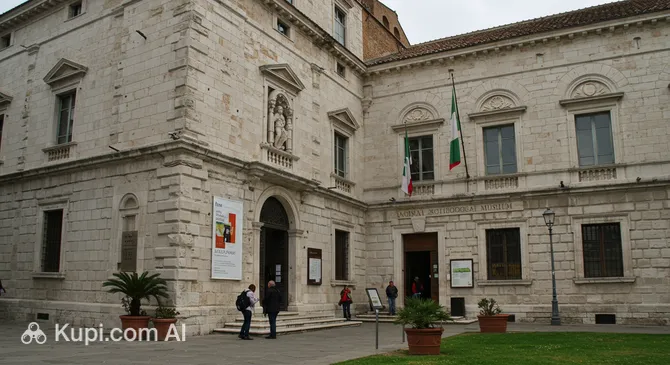
National Archaeological Museum of the Marche Region
National Archaeological Museum of the Marche Region. Иллюстрация. Источник: Kupi.com AI

The museum's exhibition is striking in its scale, featuring finds spanning from the Paleolithic to the early Middle Ages. The pride of the collection includes unique artifacts of the mysterious Piceni culture, exquisite Greek relics, and the rich heritage of the Roman era. The magnificent interiors of the palace, decorated with frescoes by Pellegrino Tibaldi, create a solemn atmosphere that perfectly complements the ancient masterpieces.

Visitors can see everything here: from tools dating back 200,000 years to the dazzling golden crowns of Gallic chieftains. The museum's special status, confirmed as far back as 1906, makes it an essential stop for anyone wanting to unravel the secrets of the ancient civilizations of the Marche region.

Contacts

To check current information before your visit or to book guided tours, you can use the following contact details:

How to contactContact
AddressVia Gabriele Ferretti, 6, 60121 Ancona AN, Италия
Phone+39 071 202602
Websitewww.musei.marche.beniculturali.it

What to Do

In the museum's halls, a discovery of the amazing worlds of the past awaits you. Begin your exploration in the protohistoric section, which houses the armor and helmets of the warlike Piceni people. Don't miss the chance to see the details of the famous "golden crowns" with floral ornaments — evidence of the presence of Celtic Gallic tribes here in the 6th century BC. Ancient history buffs will be interested in the model of the Temple of Aphrodite, which once stood on the site of the current Ancona Cathedral.

One of the most striking parts of the exhibition is the Roman mosaics. Here you can literally touch history: for example, by examining a rare mosaic depicting a boar hunt or the famous "Head of Oceanus." It is also worth noting the magnificent bronze statues from Cartoceto di Pergola — rare examples of gilded bronze dating back to the mid-1st century BC.

The walk through the museum is organized chronologically, allowing for a smooth transition from one era to another. For a deeper immersion, we recommend taking an audio guide. Be sure to go up to the upper floors of the palace, not only to study the sarcophagi and ancient glass but also to admire the architectural details of the building itself, which is a Renaissance masterpiece.

Getting There

The museum is located in the heart of the historic center at Via Gabriele Ferretti, 6, very close to the port. If you arrive at the main train station, Ancona Centrale, the walk to the museum takes about 15–20 minutes (a distance of approximately 1 km). You can also take city buses No. 1 or No. 4, which will take you to the Piazza Cavour stop, from where the museum is just a few minutes' walk away.

For those flying into Ancona Falcone Borsellino Airport, the distance is about 10 kilometers. The most comfortable way is to take a taxi (the ride takes about 25 minutes) or take the Conero Bus (lines A or B) to the city center. If you are traveling by car, keep in mind that parking in the center of Ancona is mostly paid and spots can be limited, so public transport is often a more convenient option.

Ближайший город: Ancona

History & Facts

The history of this collection began in 1863, during the era of the Italian Risorgimento. The museum was founded by patriots Carlo Rinaldini and Carisio Ciavarini, who sought to protect the region's ancient artifacts from looting and the black market. In 1906, the institution officially received national status, and in 1927, it was formally opened by King Victor Emmanuel III.

The museum's fate has been quite eventful: during World War II, between 1943 and 1944, its buildings were seriously damaged by bombing. It was after this that the collection found its current home in the magnificent Palazzo Ferretti. This 16th-century building, which Antonio da Sangallo the Younger likely had a hand in designing, is an architectural monument in its own right, featuring exquisite interiors by Pellegrino Tibaldi.

Another challenge faced the museum in 1972, when a strong earthquake forced the halls to close to the public. A partial reopening took place only in 1988, and the full restoration of the exhibition took even longer. Today, the museum is the primary guardian of the memory of the Piceni — a warlike Iron Age people whose culture dominated these lands for a long time before the arrival of the Romans.

Time Needed

To leisurely explore all the thematic halls and appreciate the beauty of the Palazzo Ferretti itself, a typical visitor will need 2 to 3 hours. The exhibition is quite extensive and covers a vast period of time, so a quick walk-through might not leave the proper impression.

If you are a true archaeology enthusiast and plan to study the information panels in detail or use an audio guide, it is worth setting aside about 4 hours for your visit. This will allow you to examine the smallest details of ancient mosaics and Gallic jewelry without rushing.

Working Hours

When planning your visit, please note the opening hours: the museum is closed to visitors on Mondays. On weekdays (Tuesday and Wednesday), it usually welcomes guests in the morning, from 08:30 to 13:30. From Thursday to Saturday, the doors are open longer — from 08:30 to 19:30, and on Sunday, you can view the collection from 14:00 to 19:30.

Please note that operating hours may change on public holidays or depending on the season. To ensure your visit goes perfectly, we recommend checking the current schedule on the museum's official website before you go.

DayWorking hours
понедельникЗакрыто
вторник08:30–13:30
среда08:30–13:30
четверг08:30–13:30
пятница08:30–19:30
суббота08:30–19:30
воскресенье14:00–19:30

Nearby

A stroll through the area surrounding the museum will allow you to immerse yourself even deeper into the atmosphere of ancient Ancona. Monuments from different eras, from Roman ruins to medieval palaces, can be found at every turn.

Below are the most interesting sites located within walking distance of the museum:

NameDistance
Cathedral of San Ciriaco0.2 km
Civic Art Gallery of Ancona0.3 km
Arch of Trajan0.4 km
Piazza del Plebiscito0.4 km
Spaghetteria No. 90.6 km
Omero Tactile Museum1.2 km
Mole Vanvitelliana1.2 km

Reached the end of the page?

That means the route is fully explored