Support

Mole Vanvitelliana

About

If you find yourself in the port of Ancona, your eye will inevitably be drawn to a massive and harmonious pentagonal structure that seems to rise right out of the water. This is the Mole Vanvitelliana—an outstanding 18th-century architectural monument located on an artificial island in the heart of the bay. Once a site that protected Italy from external threats, this unique location has today become the city's primary cultural magnet.
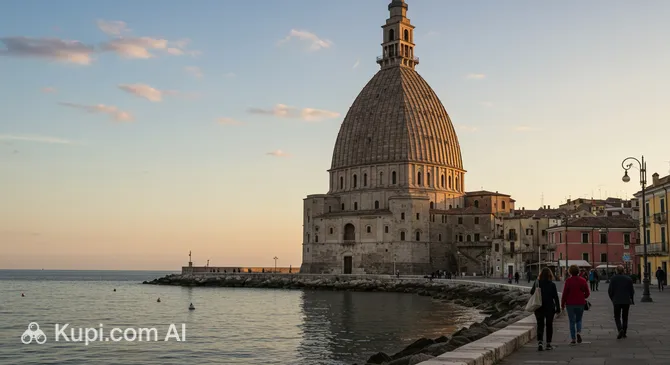
Mole Vanvitelliana
Mole Vanvitelliana. Иллюстрация. Источник: Kupi.com AI

Historically, the building is known as the Lazzaretto. It was designed as a quarantine outpost where goods and people arriving at the port were held under observation to prevent epidemics. The brilliance of the design lies in its shape: a regular pentagon with a spacious inner courtyard ensured perfect ventilation and sector isolation.

In the very center of the courtyard stands the elegant Chapel of Saint Roch, dedicated to the patron saint of the sick. Interestingly, the complex was completely self-sufficient: deep wells were drilled beneath the chapel, providing an independent water supply for the entire structure. Today, Mole Vanvitelliana is not just a historical monument, but a living space where art and modernity meet.

Contacts

To plan your visit and check the current schedule of events at Mole Vanvitelliana, you can use the following contact information. This will help you find out about ongoing exhibitions and any potential changes to the opening hours in advance.

How to contactContact
AddressBanchina Giovanni da Chio, 28, 60121 Ancona AN, Italy
Phone+39 071 925 7388
Websitewww.lamoleancona.it

What to Do

Today, Mole Vanvitelliana is the beating heart of the city's cultural life. Visitors come here not only for the architecture but also for the rich program of events. The walls of the former Lazzaretto regularly host international exhibitions, contemporary art festivals, and open-air theatrical performances. A stroll through the galleries of this pentagonal building allows you to literally touch history and feel the scale of Luigi Vanvitelli's vision.

Be sure to visit the museum located inside the complex. Here, you can study the history of Ancona in detail, from the Roman era to the heyday of the Maritime Republic. Exploring the inner courtyard and viewing the Chapel of Saint Roch offers a sense of peace and seclusion that contrasts with the bustle of the active port just outside the walls. This location is perfect for both thoughtful historical study and for taking inspiring photos against the backdrop of geometrically perfect arches.

Getting There

Located in the heart of the port area, Mole Vanvitelliana is easily accessible from any part of the city. If you are staying in the center, a pleasant walk along the waterfront will allow you to enjoy the sea breeze before exploring the attraction.

For those who prefer public transport, city buses run regularly toward the port. The nearest stop is just a few minutes' walk from the main entrance of the complex. You can also use a taxi, which will take no more than 10 minutes from the central station or the city's main squares.

If you are traveling by car, follow the address Banchina Giovanni da Chio, 28. There are parking areas near the site, though arriving early is recommended during major festivals or exhibitions due to high demand.

Ближайший город: Ancona

History & Facts

Construction of this massive structure began in 1732, commissioned by Pope Clement XII. The project was designed by the great Italian architect Luigi Vanvitelli. Construction lasted more than ten years and was completed in 1743. The building's original purpose was strictly practical and even austere: it served as a quarantine station (Lazzaretto) to protect citizens from dangerous diseases brought by sailors from the East.

Vanvitelli's architectural genius is evident in the flawless logic of the layout. The inner perimeter of the pentagon was intended for housing and treating the sick, while the outer part was used for storing goods. This isolation allowed for effective control of the epidemiological situation without interrupting the port's trade processes. Remarkably, the Lazzaretto was fully autonomous, thanks to its own freshwater wells.

Over the centuries of its existence, Mole Vanvitelliana has changed many roles. Its walls have housed military barracks, a prison, a hospital, and even a sugar refinery with a tobacco warehouse. Each era left its mark on the building's appearance, turning it into a living chronicle of the city's history.

Among the "guests" forced to spend time here in isolation were not only ordinary sailors but also historical figures. For example, the famous adventurer and traveler Giacomo Casanova also underwent the required quarantine here, as documented in historical records.

Time Needed

For a general overview of the architecture and a walk through the inner courtyard, 1–1.5 hours is usually sufficient. This time is enough to appreciate the scale of the complex's pentagonal shape and to view the central Chapel of Saint Roch.

If you plan to visit temporary exhibitions, theatrical performances, or the local museum, you should set aside half a day. The center's rich cultural program often draws visitors in, and the unique atmosphere of the site encourages a leisurely exploration of every detail of Vanvitelli's brilliant creation.

Working Hours

The attraction is open to visitors daily, offering a very convenient schedule. Mole Vanvitelliana is open from 8:00 AM to midnight (12:00 AM), Monday through Sunday. This schedule allows you to spend the morning hours exploring museum exhibits or enjoy the building's evening lighting during a late-night walk.

8:00 – 12:00

Nearby

Exploring the area around Mole Vanvitelliana is a great way to dive deeper into the atmosphere of this port city. Its proximity to ancient ruins and majestic monuments provides a complete picture of the region's rich heritage.

After visiting the cultural center, you can walk to historical arches or climb up to the ancient amphitheater while enjoying views of the Adriatic Sea. Below is a list of interesting locations within walking distance.

NameDistance
Omero Tactile Museum0.1 km
Cittadella Park of Ancona0.8 km
Civic Art Gallery of Ancona0.9 km
Piazza del Plebiscito0.9 km
Spaghetteria No. 91 km
Arch of Trajan1.2 km
Gasoline Road Bar1.2 km

Reached the end of the page?

That means the route is fully explored